Department of Colorectal Surgery, University Hospital Waterford, Waterford, Ireland.
Department of General and Colorectal Surgery, University of Limerick Hospital Group, Limerick, Ireland.
BJS Open. 2023 Jul 10;7(4). doi: 10.1093/bjsopen/zrad026.
Obesity can pose perioperative challenges related to obesity-associated co-morbidities and technical factors. However, the true impact of obesity on postoperative outcomes is not well established and reports are conflicting. The aim was to perform a systematic review and meta-analysis to explore the effect of obesity on perioperative outcomes for general surgery procedures in distinct obesity subtypes.
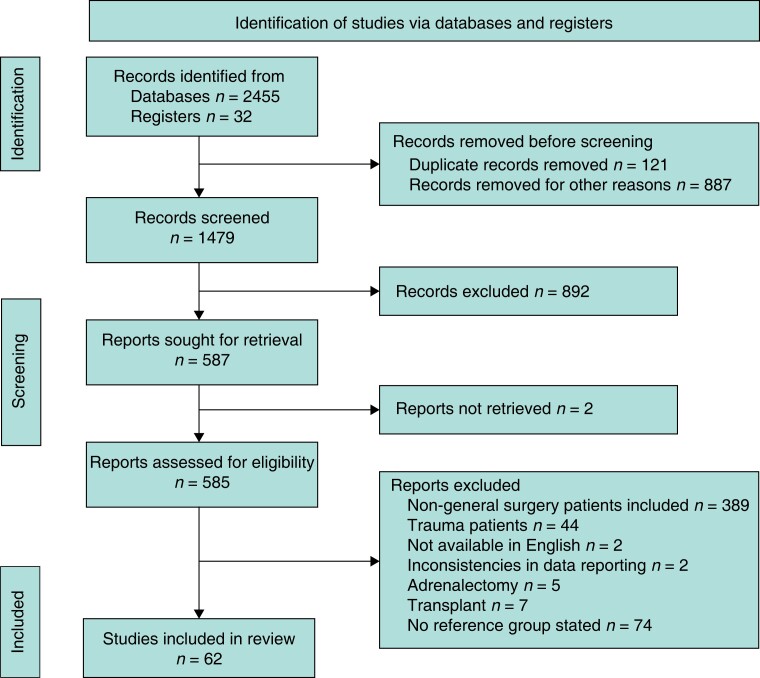
A systematic review was performed for studies reporting postoperative outcomes in relation to BMI in upper gastrointestinal, hepatobiliary and colorectal based on an electronic search using the Cochrane Library, Science Direct, PubMed and Embase up to January 2022. The primary outcome was the incidence of 30-day postoperative mortality among patients with obesity undergoing general surgical procedures in comparison to patients with normal range BMI.
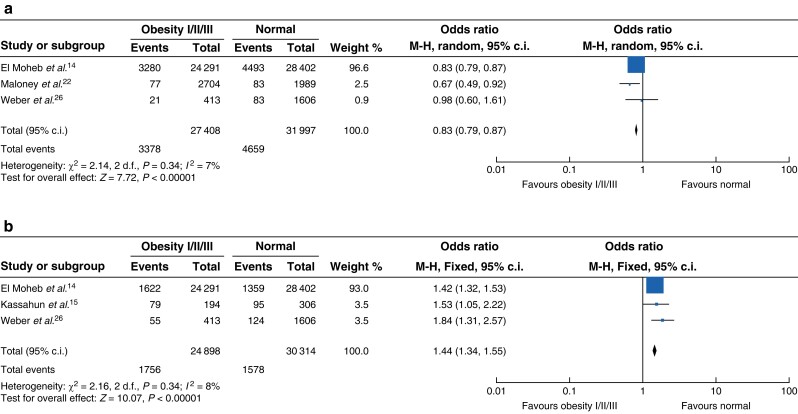
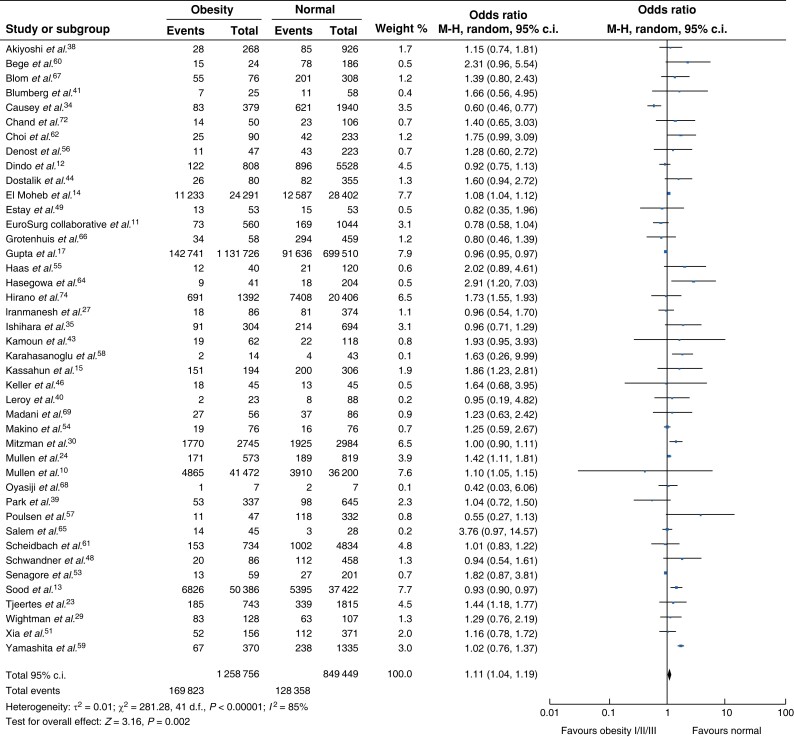
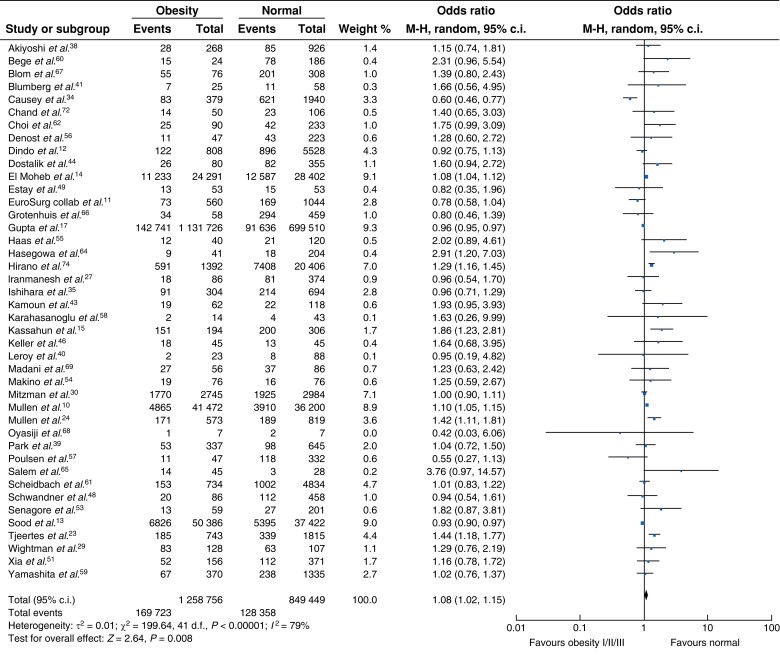
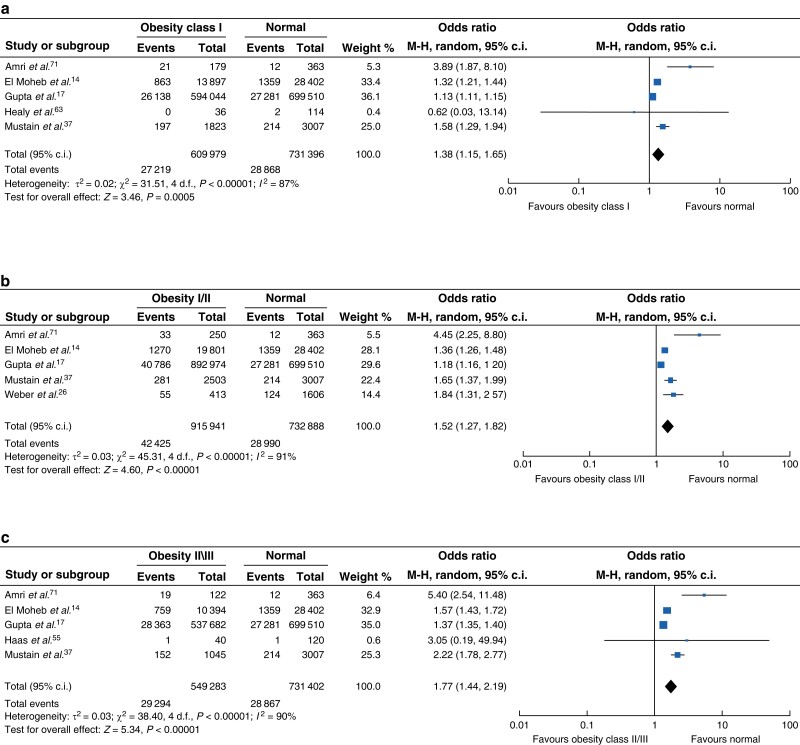
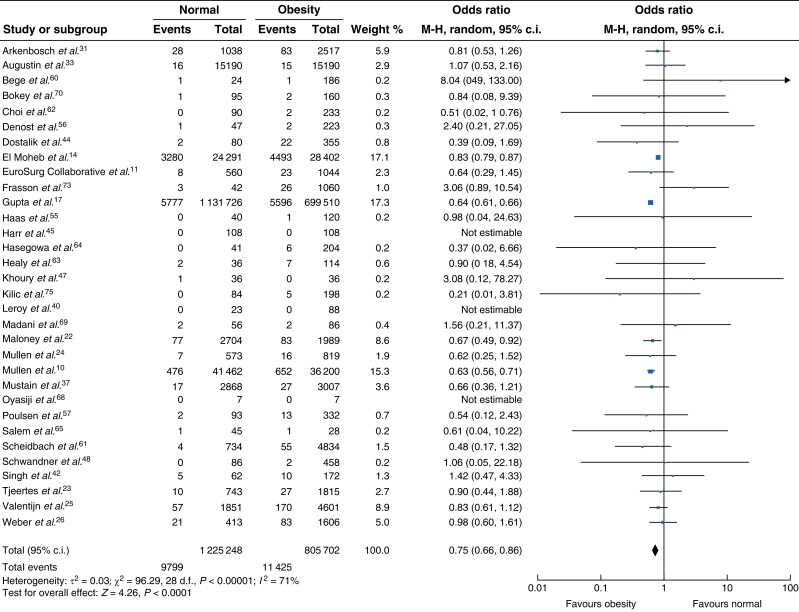
Sixty-two studies, including 1 886 326 patients, were eligible for inclusion. Overall, patients with obesity (including class I/II/II) had lower 30-day mortality rates in comparison to patients with a normal BMI (odds ratio (OR) 0.75, 95 per cent c.i. 0.66 to 0.86, P < 0.0001, I2 = 71 per cent); this was also observed specifically in emergency general surgery (OR 0.83, 95 per cent c.i. 0.79 to 0.87, P < 0.0000001, I2 = 7 per cent). Compared with normal BMI, obesity was positively associated with an increased risk of 30-day postoperative morbidity (OR 1.11, 95 per cent c.i. 1.04 to 1.19, P = 0.002, I2 = 85 per cent). However, there was no significant difference in postoperative morbidity rates between the cohorts of patients with a normal BMI and class I/II obesity (OR 0.98, 95 per cent c.i. 0.92 to 1.04, P = 0.542, I2 = 92 per cent). Overall, the cohort with obesity had a higher rate of postoperative wound infections compared with the non-obese group (OR 1.40, 95 per cent c.i. 1.24 to 1.59, P < 0.0001, I2 = 82 per cent).
These data suggest a possible 'obesity paradox' and challenge the assumption that patients with obesity have higher postoperative mortality compared with patients with normal range BMI. Increased BMI alone is not associated with increased perioperative mortality in general surgery, highlighting the importance of more accurate body composition assessment, such as computed tomography anthropometrics, to support perioperative risk stratification and decision-making.
CRD42022337442 (PROSPERO https://www.crd.york.ac.uk/prospero/).
肥胖可能会带来与肥胖相关合并症和技术因素相关的围手术期挑战。然而,肥胖对术后结果的真正影响尚未得到充分证实,且报告结果相互矛盾。本研究旨在进行系统评价和荟萃分析,以探讨不同肥胖亚组中普通外科手术中肥胖对围手术期结局的影响。
本系统评价检索了 Cochrane 图书馆、Science Direct、PubMed 和 Embase 中关于上消化道、肝胆和结直肠手术中 BMI 与术后结局关系的研究,检索时间截至 2022 年 1 月。主要结局为肥胖患者(包括 I/II/III 类肥胖)与 BMI 正常范围患者相比,术后 30 天内死亡率的发生率。
共有 62 项研究,包括 1886326 名患者,符合纳入标准。总体而言,与 BMI 正常的患者相比,肥胖患者(包括 I/II/III 类肥胖)的 30 天死亡率较低(比值比(OR)0.75,95%置信区间(CI)0.66 至 0.86,P<0.0001,I2=71%);在急诊普通外科手术中,这一结果更为明显(OR 0.83,95%CI 0.79 至 0.87,P<0.0000001,I2=7%)。与 BMI 正常的患者相比,肥胖与 30 天术后发病率增加相关(OR 1.11,95%CI 1.04 至 1.19,P=0.002,I2=85%)。然而,BMI 正常和 I/II 类肥胖患者的术后发病率差异无统计学意义(OR 0.98,95%CI 0.92 至 1.04,P=0.542,I2=92%)。总体而言,肥胖组术后伤口感染的发生率高于非肥胖组(OR 1.40,95%CI 1.24 至 1.59,P<0.0001,I2=82%)。
这些数据表明可能存在“肥胖悖论”,挑战了肥胖患者术后死亡率高于 BMI 正常范围患者的假设。单纯 BMI 升高与普通外科手术围手术期死亡率增加无关,这突出了更准确的体成分评估(如计算机断层扫描人体测量学)的重要性,以支持围手术期风险分层和决策。
CRD42022337442(PROSPERO https://www.crd.york.ac.uk/prospero/)。