Division of Physiotherapy, Department of Applied Health Sciences, Hochschule Für Gesundheit (University of Applied Sciences), Gesundheitscampus 6-8, 44801, Bochum, Germany.
Appleton Institute, Central Queensland University, Adelaide, SA, 5034, Australia.
Osteoporos Int. 2023 Nov;34(11):1867-1880. doi: 10.1007/s00198-023-06829-0. Epub 2023 Jul 11.
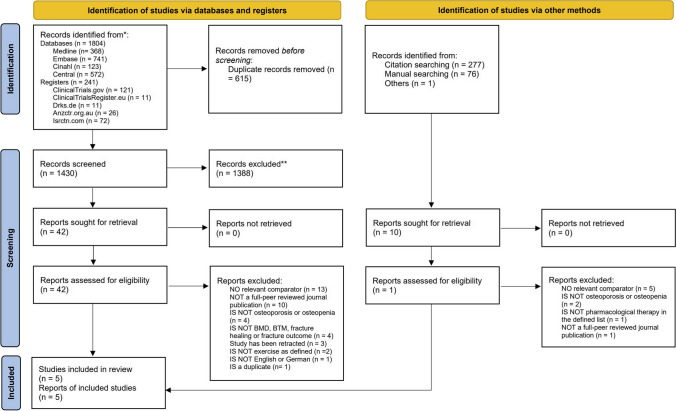
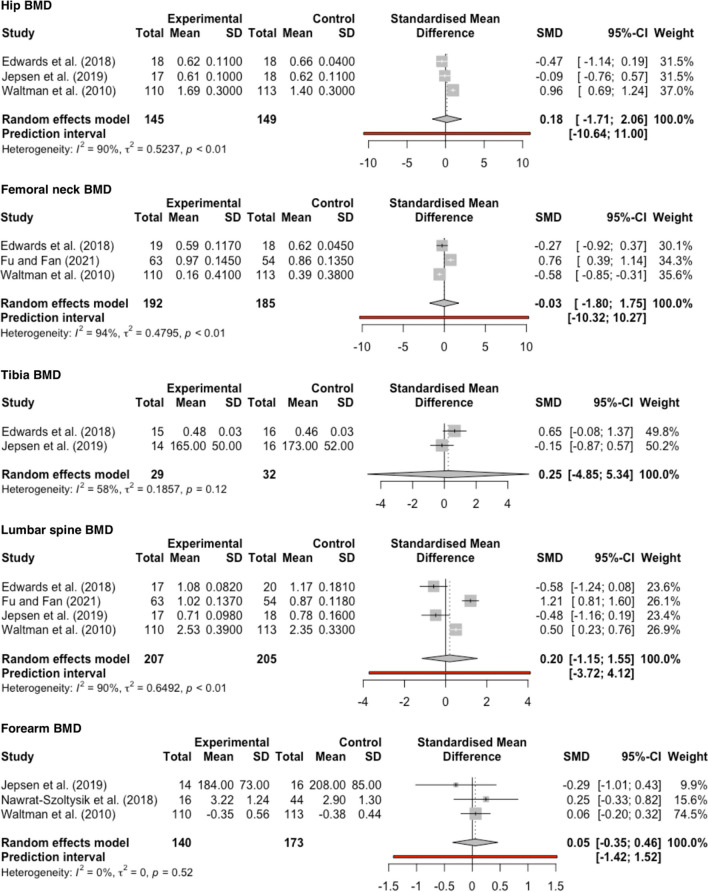
This prospectively registered systematic review and meta-analysis examines whether exercise (EX) training has an additive effect to osteoanabolic and/or antiresorptive pharmacological therapy (PT) in people with osteoporosis on bone mineral density (BMD), bone turnover markers (BTMs), fracture healing, and fractures. Four databases (inception to 6 May 2022), 5 trial registries, and reference lists were searched. Included were randomized controlled trials comparing the effect of EX + PT vs. PT with regard to BMD, BTM, fracture healing, and fractures. Risk of bias was assessed using the Cochrane RoB2 and certainty of evidence by the GRADE approach. Random-effects meta-analysis with Hartung-Knapp-Sidik-Jonkman adjustment was used to estimate standardized mean differences and 95% confidence intervals. Out of 2593 records, five RCTs with 530 participants were included. Meta-analysis showed with very low certainty evidence and wide confidence intervals that EX + PT compared to PT had larger effect sizes for BMD at 12 months at the hip (SMD [95%CI]: 0.18 [- 1.71; 2.06], n = 3 studies), tibia (0.25 [- 4.85; 5.34], n = 2), lumbar spine (0.20 [- 1.15; 1.55], n = 4), and forearm (0.05 [- 0.35; 0.46], n = 3), but not femoral neck (- 0.03 [- 1.80; 1.75], n = 3). Furthermore, no improvement was revealed for BTM such as bone ALP (- 0.68 [- 5.88; 4.53], n = 3), PINP (- 0.74 [- 10.42; 8.93], n = 2), and CTX-I (- 0.69 [- 9.61; 8.23], n = 2), but with very wide confidence intervals. Three potentially relevant ongoing trials were identified via registries. No data were found for fracture healing or fracture outcomes. It remains unclear whether EX has an additive impact to PT in people with osteoporosis. High-quality, adequately powered, targetted RCTs are required. PROTOCOL REGISTRATION: PROSPERO CRD42022336132.
这项前瞻性注册的系统评价和荟萃分析研究了在骨质疏松症患者中,运动(EX)训练是否对成骨和/或抗吸收的药物治疗(PT)具有附加效应,以观察其对骨密度(BMD)、骨转换标志物(BTM)、骨折愈合和骨折的影响。我们在四个数据库(从开始到 2022 年 5 月 6 日)、五个试验注册处和参考文献列表中进行了搜索。纳入了比较 EX+PT 与 PT 对 BMD、BTM、骨折愈合和骨折影响的随机对照试验。使用 Cochrane RoB2 评估偏倚风险,并使用 GRADE 方法评估证据确定性。使用 Hartung-Knapp-Sidik-Jonkman 调整的随机效应荟萃分析来估计标准化均数差和 95%置信区间。在 2593 条记录中,纳入了五项 RCT 共 530 名参与者。荟萃分析显示,证据确定性为极低,置信区间较宽,与 PT 相比,EX+PT 在 12 个月时髋部(SMD[95%CI]:0.18[-1.71;2.06],n=3 项研究)、胫骨(0.25[-4.85;5.34],n=2 项研究)、腰椎(0.20[-1.15;1.55],n=4 项研究)和前臂(0.05[-0.35;0.46],n=3 项研究)的 BMD 具有更大的效应量,但股骨颈(-0.03[-1.80;1.75],n=3 项研究)则没有改善。此外,骨碱性磷酸酶(-0.68[-5.88;4.53],n=3 项研究)、I 型原胶原氨基端延长肽(-0.74[-10.42;8.93],n=2 项研究)和交联 C 端肽(-0.69[-9.61;8.23],n=2 项研究)等 BTM 也没有改善,但置信区间非常宽。通过注册处确定了三项潜在相关的正在进行的试验。没有关于骨折愈合或骨折结局的数据。目前尚不清楚 EX 是否对骨质疏松症患者的 PT 具有附加影响。需要高质量、充分有力、有针对性的 RCT。方案注册:PROSPERO CRD42022336132。