Institute of Social and Preventive Medicine, University of Bern, Bern, Switzerland.
Oeschger Center for Climate Change Research, University of Bern, Bern, Switzerland.
Environ Health. 2023 Jul 11;22(1):52. doi: 10.1186/s12940-023-01003-9.
Recent research has suggested that an increase in temperature can negatively affect mental health and increase hospitalization for mental illness. It is not clear, however, what factors or mechanisms mediate this association. We aimed to (1) investigate the associations between ambient temperatures and bad daily mood, and (2) identify variables affecting the strength of these associations (modifiers) including the time, the day of the week and the year of the mood rating, socio-demographic characteristics, sleep quality, psychiatric disorders and the personality trait neuroticism in the community.
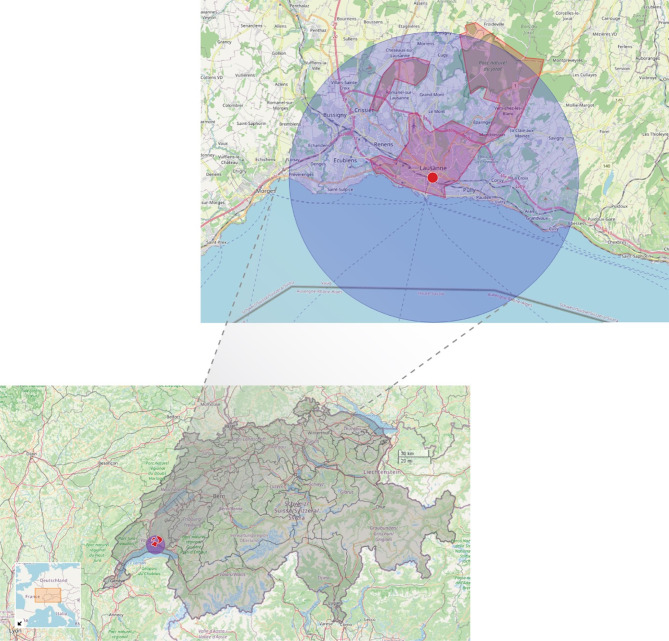
Data stemmed from the second follow-up evaluation of CoLaus|PsyCoLaus, a prospective cohort study conducted in the general population of Lausanne (Switzerland). The 906 participants rated their mood level four times a day during seven days using a cell phone app. Mixed-effects logistic regression was used to determine the association between daily maximum temperature and mood level. Participant ID was inserted as a random effect in the model, whereas the time of the day, the day of the week and the year were inserted as fixed effects. Models were controlled for several confounders (socio-demographic characteristics, sleep quality, weather parameters and air pollutants). Stratified analyses were conducted based on socio-demographic characteristics, sleep quality, presence of psychiatric disorders or a high neuroticism.
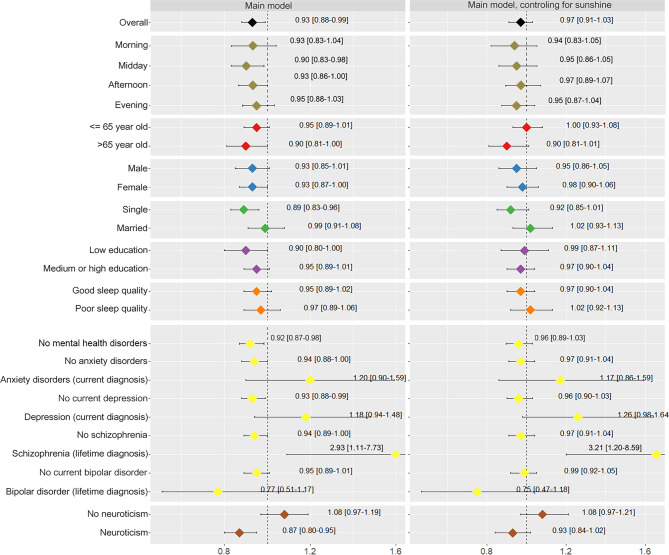
Overall, the probability of having a bad mood for the entire day decreased by 7.0% (OR: 0.93: 95% CI 0.88, 0.99) for each 5 °C increase in maximum temperature. A smaller and less precise effect (-3%; OR: 0.97: 95% CI 0.91, 1.03) was found when controlling for sunshine duration. A higher association was found in participants with bipolar disorder (-23%; OR: 0.77: 95% CI 0.51, 1.17) and in participants with a high neuroticism (-13%; OR: 0.87 95% CI 0.80, 0.95), whereas the association was reversed for participants with anxiety (20%; OR: 1.20: 95% CI 0.90, 1.59), depression (18%; OR: 1.18 95% CI 0.94, 1.48) and schizophrenia (193%; OR: 2.93 95% CI 1.17, 7.73).
According to our findings, rising temperatures may positively affect mood in the general population. However, individuals with certain psychiatric disorders, such as anxiety, depression, and schizophrenia, may exhibit altered responses to heat, which may explain their increased morbidity when exposed to high temperatures. This suggests that tailored public health policies are required to protect this vulnerable population.
最近的研究表明,温度升高会对心理健康产生负面影响,并导致精神疾病住院率增加。然而,目前尚不清楚是什么因素或机制介导了这种关联。我们旨在(1)研究环境温度与不良日常情绪之间的关联,(2)确定影响这些关联强度的变量(调节剂),包括情绪评估时的时间、一周中的天数和年份、社会人口统计学特征、睡眠质量、精神障碍和人格特质神经质在社区中的作用。
数据来自 CoLaus|PsyCoLaus 的第二次随访评估,这是一项在洛桑(瑞士)普通人群中进行的前瞻性队列研究。906 名参与者使用手机应用程序每天四次评估他们的情绪水平。使用混合效应逻辑回归来确定日最高温度与情绪水平之间的关联。参与者 ID 被插入模型作为随机效应,而一天中的时间、一周中的天数和年份被插入作为固定效应。模型控制了几个混杂因素(社会人口统计学特征、睡眠质量、天气参数和空气污染物)。根据社会人口统计学特征、睡眠质量、精神障碍或高神经质进行分层分析。
总的来说,最高温度每升高 5°C,全天出现不良情绪的概率降低 7.0%(OR:0.93;95%CI 0.88,0.99)。当控制日照时间时,发现的关联较小且不太准确(-3%;OR:0.97;95%CI 0.91,1.03)。在双相情感障碍患者(-23%;OR:0.77;95%CI 0.51,1.17)和神经质较高的患者(-13%;OR:0.87;95%CI 0.80,0.95)中发现了更高的关联,而在焦虑症患者(20%;OR:1.20;95%CI 0.90,1.59)、抑郁症患者(18%;OR:1.18;95%CI 0.94,1.48)和精神分裂症患者(193%;OR:2.93;95%CI 1.17,7.73)中发现了相反的关联。
根据我们的发现,气温升高可能会对普通人群的情绪产生积极影响。然而,某些精神障碍患者,如焦虑症、抑郁症和精神分裂症,可能对热有不同的反应,这可能解释了他们在暴露于高温时发病率增加的原因。这表明需要制定有针对性的公共卫生政策来保护这一弱势群体。