Cognitive Science HUB, University of Vienna, Liebbigasse 5, 1110, Vienna, Austria.
European Centre for Environment and Human Health, University of Exeter Medical School, Exeter, UK.
Sci Rep. 2021 Apr 26;11(1):8903. doi: 10.1038/s41598-021-87675-0.
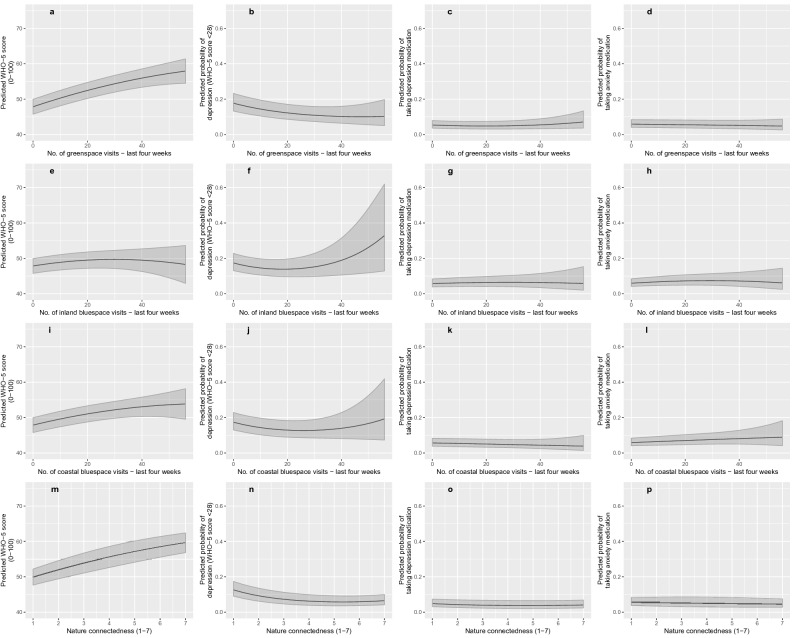
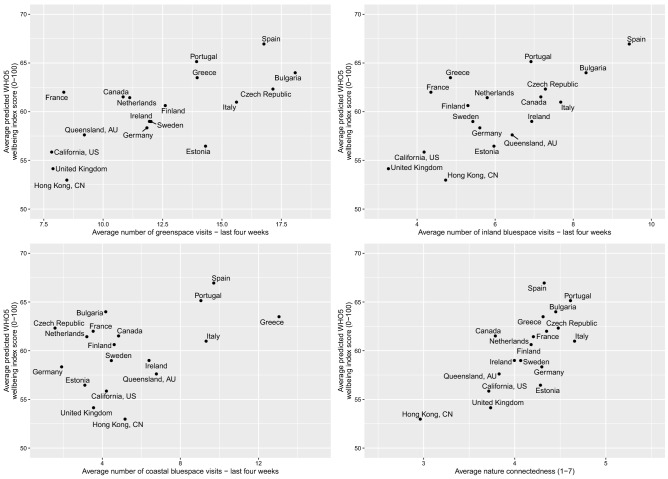
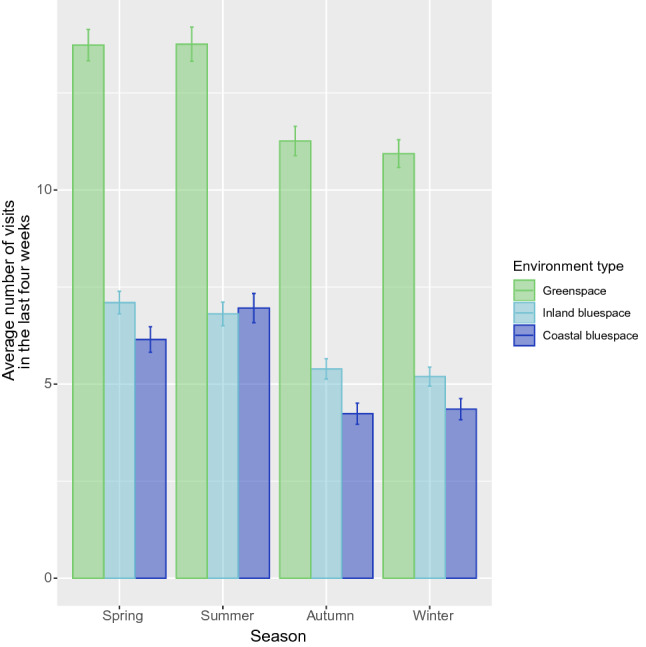
Living near, recreating in, and feeling psychologically connected to, the natural world are all associated with better mental health, but many exposure-related questions remain. Using data from an 18-country survey (n = 16,307) we explored associations between multiple measures of mental health (positive well-being, mental distress, depression/anxiety medication use) and: (a) exposures (residential/recreational visits) to different natural settings (green/inland-blue/coastal-blue spaces); and (b) nature connectedness, across season and country. People who lived in greener/coastal neighbourhoods reported higher positive well-being, but this association largely disappeared when recreational visits were controlled for. Frequency of recreational visits to green, inland-blue, and coastal-blue spaces in the last 4 weeks were all positively associated with positive well-being and negatively associated with mental distress. Associations with green space visits were relatively consistent across seasons and countries but associations with blue space visits showed greater heterogeneity. Nature connectedness was also positively associated with positive well-being and negatively associated with mental distress and was, along with green space visits, associated with a lower likelihood of using medication for depression. By contrast inland-blue space visits were associated with a greater likelihood of using anxiety medication. Results highlight the benefits of multi-exposure, multi-response, multi-country studies in exploring complexity in nature-health associations.
居住在自然环境附近、在自然环境中娱乐以及在心理上与自然环境相连,这些都与更好的心理健康有关,但许多与暴露相关的问题仍然存在。本研究使用来自 18 个国家的调查数据(n=16307),探索了多种心理健康指标(积极幸福感、心理困扰、抑郁/焦虑药物使用)与以下因素之间的关联:(a)不同自然环境(绿色/内陆蓝色/沿海蓝色空间)的暴露(居住/娱乐访问);(b)自然联系,跨越季节和国家。居住在绿化/沿海地区的人报告有更高的积极幸福感,但当控制娱乐访问时,这种关联就消失了。在过去 4 周内,绿色、内陆蓝色和沿海蓝色空间的娱乐访问频率均与积极幸福感呈正相关,与心理困扰呈负相关。与绿色空间访问的关联在不同季节和国家相对一致,但与蓝色空间访问的关联显示出更大的异质性。自然联系也与积极幸福感呈正相关,与心理困扰呈负相关,并且与绿色空间访问一样,与使用抗抑郁药物的可能性降低有关。相比之下,内陆蓝色空间的访问与使用焦虑药物的可能性增加有关。研究结果强调了多暴露、多响应、多国家研究在探索自然与健康关联复杂性方面的益处。