Avila-Sosa Raul, Nevárez-Moorillón Guadalupe Virginia, Ochoa-Velasco Carlos Enrique, Navarro-Cruz Addí Rhode, Hernández-Carranza Paola, Cid-Pérez Teresa Soledad
Facultad de Ciencias Químicas, Benemérita Universidad Autónoma de Puebla, Edificio 105E, 14 Sur y Av. San Claudio, Ciudad Universitaria, Col. San Manuel, Puebla 72420, Mexico.
Facultad de Ciencias Químicas, Universidad Autónoma de Chihuahua, Circuito Universitario s/n Campus, Universitario II, Chihuahua 31125, Mexico.
Foods. 2022 Oct 18;11(20):3245. doi: 10.3390/foods11203245.
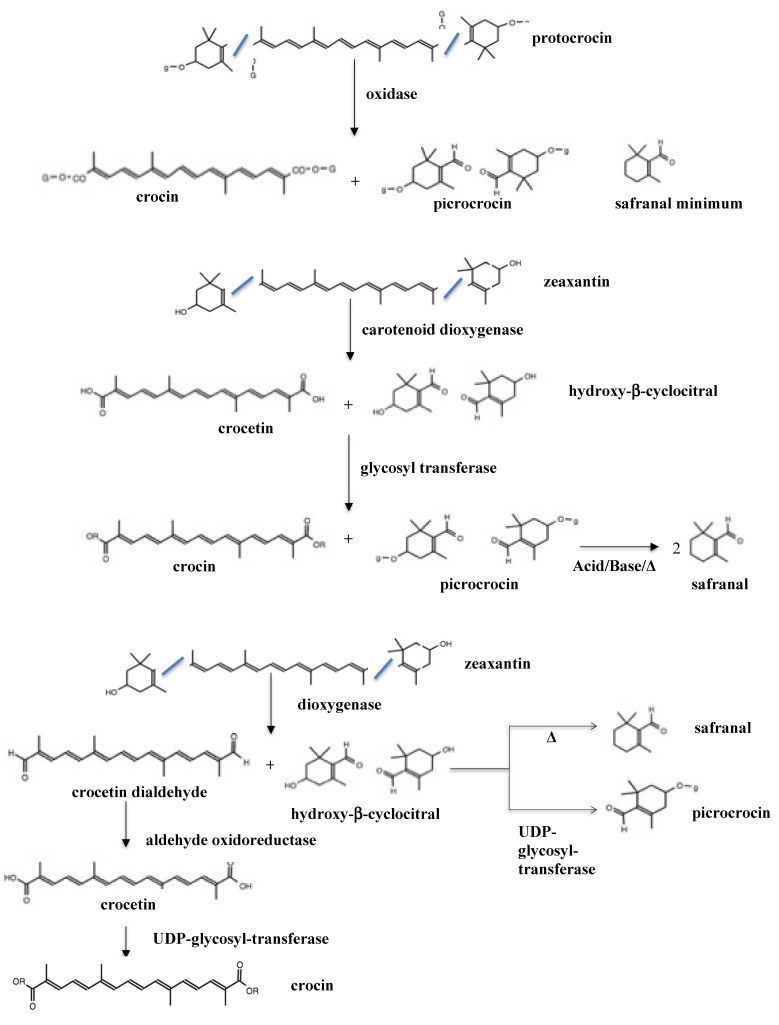
This review aims to evaluate the state of saffron's main bioactive compounds and their relationship with its commercial quality. Saffron is the commercial name for the dried red stigmas of the L. flower. It owes its sensory and functional properties mainly to the presence of its carotenoid derivatives, synthesized throughout flowering and also during the whole production process. These compounds include crocin, crocetin, picrocrocin, and safranal, which are bioactive metabolites. Saffron's commercial value is determined according to the ISO/TS3632 standard that determines their main apocatotenoids. Other techniques such as chromatography (gas and liquid) are used to detect the apocarotenoids. This, together with the determination of spectral fingerprinting or chemo typing are essential for saffron identification. The determination of the specific chemical markers coupled with chemometric methods favors the discrimination of adulterated samples, possible plants, or adulterating compounds and even the concentrations at which these are obtained. Chemical characterization and concentration of various compounds could be affected by saffron's geographical origin and harvest/postharvest characteristics. The large number of chemical compounds found in the by-products (flower parts) of saffron (catechin, quercetin, delphinidin, etc.) make it an interesting aromatic spice as a colorant, antioxidant, and source of phytochemicals, which can also bring additional economic value to the most expensive aromatic species in the world.
本综述旨在评估藏红花主要生物活性成分的状况及其与商业品质的关系。藏红花是番红花属植物干燥红色柱头的商业名称。其感官和功能特性主要归因于类胡萝卜素衍生物的存在,这些衍生物在整个开花过程以及整个生产过程中合成。这些化合物包括藏花素、藏红花酸、苦藏花素和藏红花醛,它们都是生物活性代谢产物。藏红花的商业价值是根据ISO/TS3632标准确定的,该标准规定了其主要的类胡萝卜素。其他技术,如色谱法(气相和液相),用于检测类胡萝卜素。这与光谱指纹图谱或化学分型的测定一起,对于藏红花的鉴定至关重要。特定化学标志物的测定与化学计量学方法相结合,有利于鉴别掺假样品、可能的植物或掺假化合物,甚至它们的浓度。各种化合物的化学特征和浓度可能会受到藏红花地理来源以及收获/采后特性的影响。藏红花副产品(花的各部分)中发现的大量化合物(儿茶素、槲皮素、飞燕草素等)使其成为一种有趣的芳香香料,可作为着色剂、抗氧化剂和植物化学物质的来源,这也可为世界上最昂贵的芳香物种带来额外的经济价值。