INSERM U1059-SAINBIOSE, Jean Monnet University, Mines Saint-Etienne, Saint-Etienne, France
INSERM U1059-SAINBIOSE, Jean Monnet University, Mines Saint-Etienne, Saint-Etienne, France.
BMJ Open. 2023 Jul 11;13(7):e069966. doi: 10.1136/bmjopen-2022-069966.
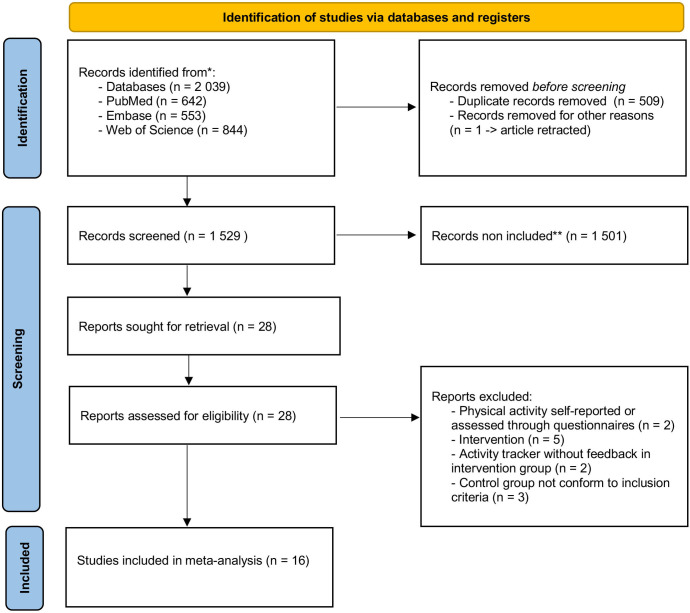
To systematically review randomised controlled trials (RCTs) using a wearable physical activity monitoring device as an intervention to increase daily walking activity and improve physical capacities in patients with cardiovascular disease (CVD).
Systematic review and meta-analysis of RCTs.
PubMed, Embase and Web of Science from inception to June 2022.
Randomised controlled studies including patients with CVD over 18 years of age at the end of a cardiac rehabilitation programme comparing an intervention group using a wearable physical activity monitoring device with feedback with usual care or with a control group receiving no feedback on their physical activity and reporting a change in the daily number of steps and/or a change in the distance covered in the 6-minute walk test (6-MWT) or a change in peak oxygen uptake (V̇O2) as endpoints.
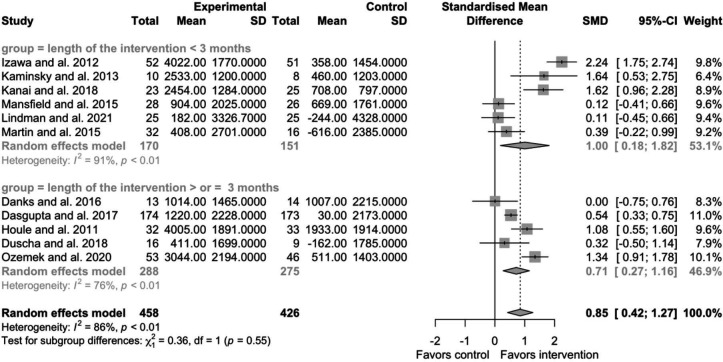
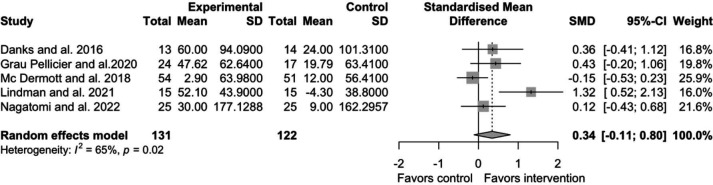
Sixteen RCTs were included. The intervention of wearing a physical activity monitoring device with feedback significantly improved daily number of steps compared with controls (standardised mean difference (SMD) 0.85; 95% CI (0.42; 1.27); p<0.01). The effect was greater when the duration of the intervention was less than 3 months (SMD 1.0; 95% CI (0.18; 1.82); p<0.01) than when the duration of the intervention was 3 months or longer (SMD 0.71; 95% CI (0.27; 1.16); p<0.01), but no significant interaction was found between subgroups (p=0.55). 6-MWT distance and V̇O2 showed only small effects (SMD 0.34; 95% CI (-0.11; 0.80); p=0.02 and SMD 0.54; 95% CI (0.03; 1.03); p=0.07, respectively).
The use of wearable physical activity monitoring devices appears to help patients with CVD to increase their daily walking activity and thus their physical activity, particularly in the short term.
CRD42022300423.
系统综述使用可穿戴式身体活动监测设备作为干预措施以增加心血管疾病(CVD)患者日常步行活动并改善身体能力的随机对照试验(RCT)。
RCT 的系统综述和荟萃分析。
从PubMed、Embase 和 Web of Science 数据库的创建到 2022 年 6 月。
比较在心脏康复计划结束时年龄超过 18 岁的 CVD 患者的干预组(使用带反馈的可穿戴身体活动监测设备)与常规护理组或不提供身体活动反馈的对照组的随机对照研究,报告每日步数的变化和/或 6 分钟步行试验(6-MWT)的距离变化或峰值摄氧量(V̇O2)作为终点。
纳入了 16 项 RCT。与对照组相比,穿戴带反馈的身体活动监测设备的干预措施显著增加了每日步数(标准化均数差(SMD)0.85;95%CI(0.42;1.27);p<0.01)。干预时间小于 3 个月时效果更大(SMD 1.0;95%CI(0.18;1.82);p<0.01),而干预时间为 3 个月或更长时间时效果较小(SMD 0.71;95%CI(0.27;1.16);p<0.01),但亚组之间无显著交互作用(p=0.55)。6-MWT 距离和 V̇O2 仅显示较小的效果(SMD 0.34;95%CI(-0.11;0.80);p=0.02 和 SMD 0.54;95%CI(0.03;1.03);p=0.07)。
使用可穿戴式身体活动监测设备似乎有助于 CVD 患者增加日常步行活动,从而提高他们的身体活动量,尤其是在短期内。
PROSPERO 注册号:CRD42022300423。