Almeida Diana Bastos, Semedo Miguel, Magalhães Catarina, Blanquet Isidro, Mucha Ana Paula
ICBAS - Instituto de Ciências Biomédicas Abel Salazar, University of Porto, Porto, Portugal.
CIIMAR - Interdisciplinary Centre of Marine and Environmental Research, University of Porto, Matosinhos, Portugal.
Front Microbiol. 2023 Jun 26;14:1188876. doi: 10.3389/fmicb.2023.1188876. eCollection 2023.
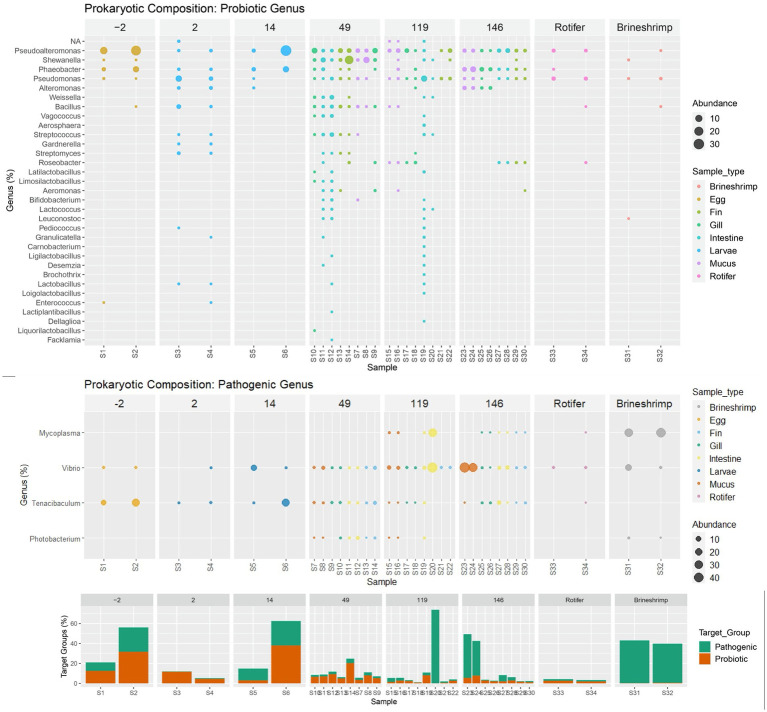
Recirculating aquaculture systems (RAS) pose unique challenges in microbial community management since they rely on a stable community with key target groups, both in the RAS environment and in the host (in this case, ). Our goal was to determine how much of the sole microbiome is inherited from the egg stage, and how much is acquired during the remainder of the sole life cycle in an aquaculture production batch, especially regarding potentially probiotic and pathogenic groups. Our work comprises sole tissue samples from 2 days before hatching and up to 146 days after hatching (-2 to 146 DAH), encompassing the egg, larval, weaning, and pre-ongrowing stages. Total DNA was isolated from the different sole tissues, as well as from live feed introduced in the first stages, and 16S rRNA gene was sequenced (V6-V8 region) using the Illumina MiSeq platform. The output was analysed with the DADA2 pipeline, and taxonomic attribution with SILVAngs version 138.1. Using the Bray-Curtis dissimilarity index, both age and life cycle stage appeared to be drivers of bacterial community dissimilarity. To try to distinguish the inherited (present since the egg stage) from the acquired community (detected at later stages), different tissues were analysed at 49, 119 and 146 DAH (gill, intestine, fin and mucus). Only a few genera were inherited, but those that were inherited accompany the sole microbiome throughout the life cycle. Two genera of potentially probiotic bacteria ( and ) were already present in the eggs, while others were acquired later, in particularly, forty days after live feed was introduced. The potentially pathogenic genera and were inherited from the eggs, while and seemed to be acquired at 49 and 119 DAH, respectively. Significant co-occurrence was found between and both and . On the other hand, significantly negative correlations were detected between and , , and . Our work reinforces the importance of life cycle studies, which can contribute to improve production husbandry strategies. However, we still need more information on this topic as repetition of patterns in different settings is essential to confirm our findings.
循环水养殖系统(RAS)在微生物群落管理方面面临独特挑战,因为它们依赖于RAS环境和宿主(在这种情况下)中具有关键目标群体的稳定群落。我们的目标是确定舌鳎的微生物组有多少是从卵阶段遗传而来的,以及在水产养殖生产批次中舌鳎生命周期的其余阶段获得了多少,特别是关于潜在的益生菌和致病菌群。我们的工作包括孵化前2天至孵化后146天(-2至146日龄)的舌鳎组织样本,涵盖卵、幼虫、断奶和幼鱼前期阶段。从不同的舌鳎组织以及早期引入的活饵中分离总DNA,并使用Illumina MiSeq平台对16S rRNA基因(V6-V8区域)进行测序。使用DADA2流程分析输出结果,并使用SILVAngs 138.1版本进行分类归属。使用Bray-Curtis差异指数,年龄和生命周期阶段似乎都是细菌群落差异的驱动因素。为了区分遗传群落(从卵阶段就存在)和获得性群落(在后期检测到),在49、119和146日龄对不同组织(鳃、肠道、鳍和黏液)进行了分析。只有少数属是遗传而来的,但那些遗传而来的属在整个生命周期中都伴随着舌鳎的微生物组。两种潜在的益生菌属(和)在卵中就已存在,而其他的则在后期获得,特别是在引入活饵40天后。潜在的致病属和是从卵中遗传而来的,而和似乎分别在49和119日龄获得。在和以及之间发现了显著的共现关系。另一方面,在和、、以及之间检测到显著的负相关。我们的工作强化了生命周期研究的重要性,这有助于改进生产养殖策略。然而,我们仍然需要关于这个主题的更多信息,因为在不同环境中重复这些模式对于证实我们的发现至关重要。