Kwon Yonghyun, Kang Kyung Woo, Chang Jong Sung
Department of Physical Therapy, Yeungnam University College, Daegu, Korea.
J Exerc Rehabil. 2023 Jun 28;19(3):163-169. doi: 10.12965/jer.2346170.085. eCollection 2023 Jun.
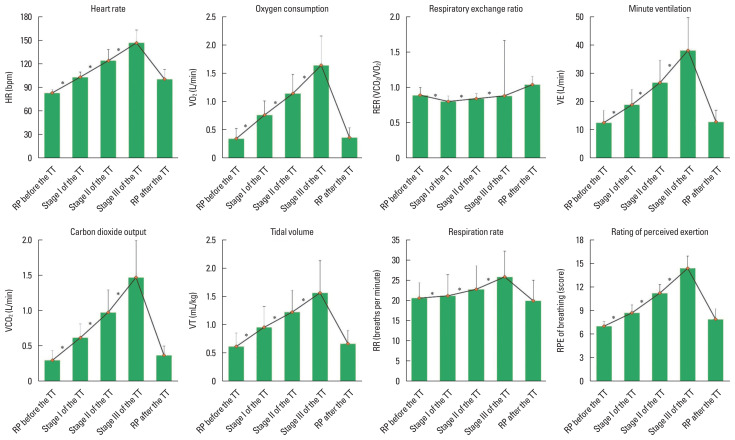
The talk test (TT) is subjective method to measure exercise intensity in costless and feasible manner, compared to sophisticated laboratory equipment. We attempted to investigate whether the TT was a valid method for evaluation of exercise intensity, by comparing with values derived from various physiologic markers during cardiopulmonary exercise testing on treadmill in healthy population. A total of 17 healthy subjects (12 males and 5 females) participated in this study. The TT was applied, which consisted of 3-stages difficulties demanding respiratory load while they performed the cardiopulmonary exercise testing on treadmill. In each of the TT stages, ergospirometric and psychophysiologic response marker were collected such as heart rate, oxygen consumption, respiratory exchange ratio, minute ventilation, carbon dioxide output, tidal volume, respiratory rate, and rating of perceived exertion of breathing. Statistical analyses revealed a significant difference of all dependent variables in each of three TT stages, comparing with the resting phase before the TT. The TT showed strong correlation coefficient with all variables except for rating of perceived exertion during the resting phase before the TT. According to increase of exercise intensity, all dependent variables showed a linear tendency with the stages of the TT. Our findings indicated that each of the TT stages was strongly correlated with ergospirometric variables as well as psychophysiologic response during cardiopulmonary exercise testing on treadmill. We suggested that the TT can be used to evaluate and prescribe exercise intensity of aerobic activity in cardiovascular and pulmonary rehabilitation settings.
与复杂的实验室设备相比,谈话测试(TT)是一种以低成本且可行的方式来测量运动强度的主观方法。我们试图通过在健康人群的跑步机心肺运动测试中,将其与各种生理指标得出的值进行比较,来研究TT是否是评估运动强度的有效方法。共有17名健康受试者(12名男性和5名女性)参与了本研究。应用了TT,它由三个难度阶段组成,在他们进行跑步机心肺运动测试时需要呼吸负荷。在每个TT阶段,收集了运动气体代谢和心理生理反应指标,如心率、耗氧量、呼吸交换率、分钟通气量、二氧化碳排出量、潮气量、呼吸频率以及呼吸主观用力程度评分。统计分析显示,与TT之前的静息阶段相比,三个TT阶段中每个阶段的所有因变量都有显著差异。TT与TT之前静息阶段的除呼吸主观用力程度评分之外的所有变量都显示出很强的相关系数。随着运动强度的增加,所有因变量随TT阶段呈现出线性趋势。我们的研究结果表明,在跑步机心肺运动测试期间,每个TT阶段都与运动气体代谢变量以及心理生理反应密切相关。我们建议TT可用于评估和规定心血管和肺部康复环境中有氧活动的运动强度。