Lai Derek Ka-Hei, Cheng Ethan Shiu-Wang, Lim Hyo-Jung, So Bryan Pak-Hei, Lam Wing-Kai, Cheung Daphne Sze Ki, Wong Duo Wai-Chi, Cheung James Chung-Wai
Department of Biomedical Engineering, Faculty of Engineering, The Hong Kong Polytechnic University, Hong Kong, China.
Department of Electronic and Information Engineering, Faculty of Engineering, The Hong Kong Polytechnic University, Hong Kong, China.
Front Bioeng Biotechnol. 2023 Jun 27;11:1205009. doi: 10.3389/fbioe.2023.1205009. eCollection 2023.
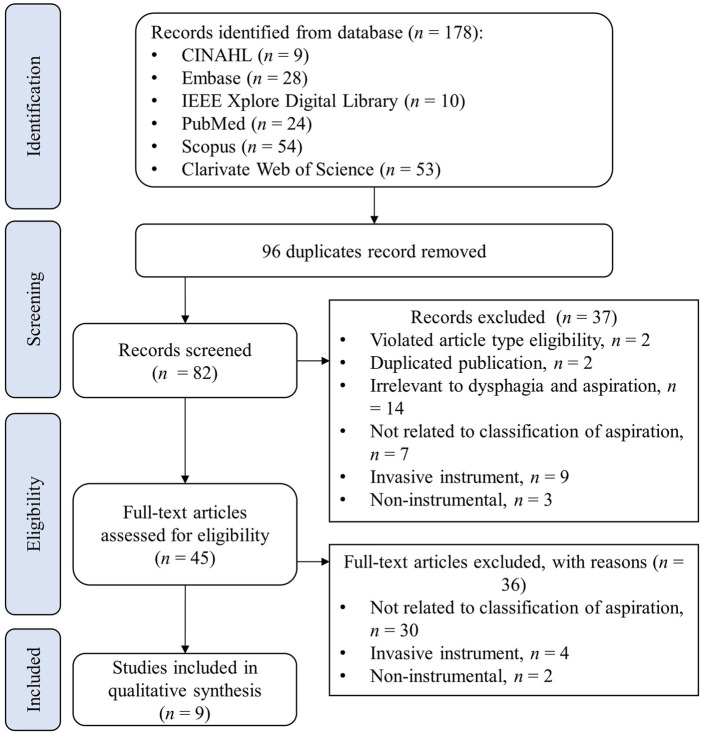
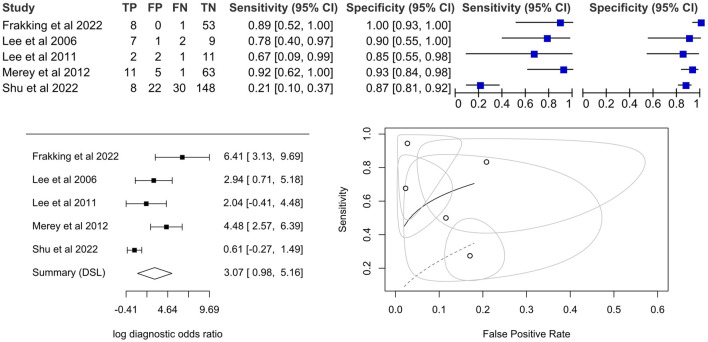
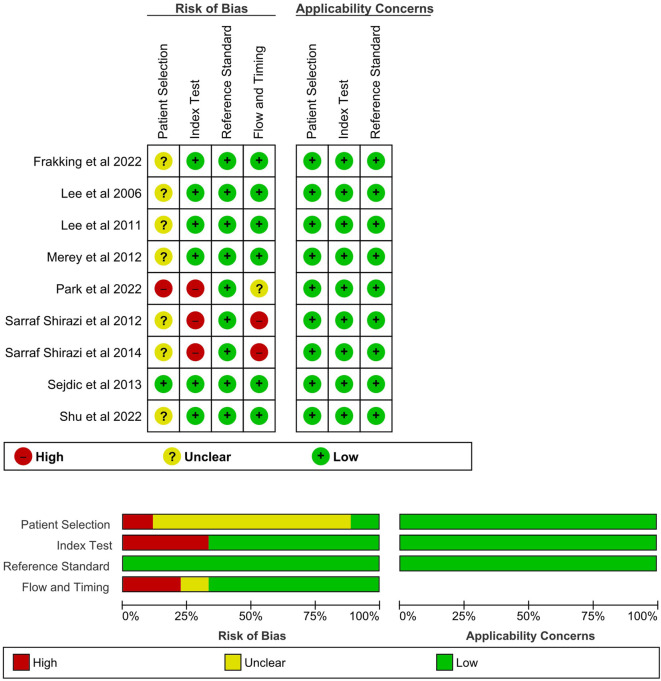
Aspiration caused by dysphagia is a prevalent problem that causes serious health consequences and even death. Traditional diagnostic instruments could induce pain, discomfort, nausea, and radiation exposure. The emergence of wearable technology with computer-aided screening might facilitate continuous or frequent assessments to prompt early and effective management. The objectives of this review are to summarize these systems to identify aspiration risks in dysphagic individuals and inquire about their accuracy. Two authors independently searched electronic databases, including CINAHL, Embase, IEEE Xplore Digital Library, PubMed, Scopus, and Web of Science (PROSPERO reference number: CRD42023408960). The risk of bias and applicability were assessed using QUADAS-2. Nine (n = 9) articles applied accelerometers and/or acoustic devices to identify aspiration risks in patients with neurodegenerative problems (e.g., dementia, Alzheimer's disease), neurogenic problems (e.g., stroke, brain injury), in addition to some children with congenital abnormalities, using videofluoroscopic swallowing study (VFSS) or fiberoptic endoscopic evaluation of swallowing (FEES) as the reference standard. All studies employed a traditional machine learning approach with a feature extraction process. Support vector machine (SVM) was the most famous machine learning model used. A meta-analysis was conducted to evaluate the classification accuracy and identify risky swallows. Nevertheless, we decided not to conclude the meta-analysis findings (pooled diagnostic odds ratio: 21.5, 95% CI, 2.7-173.6) because studies had unique methodological characteristics and major differences in the set of parameters/thresholds, in addition to the substantial heterogeneity and variations, with sensitivity levels ranging from 21.7% to 90.0% between studies. Small sample sizes could be a critical problem in existing studies (median = 34.5, range 18-449), especially for machine learning models. Only two out of the nine studies had an optimized model with sensitivity over 90%. There is a need to enlarge the sample size for better generalizability and optimize signal processing, segmentation, feature extraction, classifiers, and their combinations to improve the assessment performance. (https://www.crd.york.ac.uk/prospero/), identifier (CRD42023408960).
吞咽困难引起的误吸是一个普遍存在的问题,会导致严重的健康后果甚至死亡。传统的诊断仪器可能会引起疼痛、不适、恶心和辐射暴露。具有计算机辅助筛查功能的可穿戴技术的出现,可能有助于进行连续或频繁的评估,以便及时进行早期有效管理。本综述的目的是总结这些系统,以识别吞咽困难患者的误吸风险,并探讨其准确性。两位作者独立检索了电子数据库,包括CINAHL、Embase、IEEE Xplore数字图书馆、PubMed、Scopus和Web of Science(PROSPERO注册号:CRD42023408960)。使用QUADAS-2评估偏倚风险和适用性。9篇文章应用加速度计和/或声学设备,以视频荧光吞咽造影(VFSS)或纤维光学内镜吞咽评估(FEES)作为参考标准,识别神经退行性疾病(如痴呆、阿尔茨海默病)、神经源性疾病(如中风、脑损伤)患者以及一些先天性异常儿童的误吸风险。所有研究都采用了带有特征提取过程的传统机器学习方法。支持向量机(SVM)是使用最广泛的机器学习模型。进行了一项荟萃分析,以评估分类准确性并识别危险吞咽。然而,我们决定不总结荟萃分析结果(合并诊断比值比:21.5,95%CI,2.7-173.6),因为研究具有独特的方法学特征,且在参数/阈值设置方面存在重大差异,此外还存在很大的异质性和变异性,各研究之间的敏感性水平在21.7%至90.0%之间。小样本量可能是现有研究中的一个关键问题(中位数=34.5,范围18-449),尤其是对于机器学习模型而言。9项研究中只有两项具有灵敏度超过90%的优化模型。有必要扩大样本量以提高普遍性,并优化信号处理、分割、特征提取、分类器及其组合,以提高评估性能。(https://www.crd.york.ac.uk/prospero/),标识符(CRD42023408960)