Mao Ye-Jiao, Zha Li-Wen, Tam Andy Yiu-Chau, Lim Hyo-Jung, Cheung Alyssa Ka-Yan, Zhang Ying-Qi, Ni Ming, Cheung James Chung-Wai, Wong Duo Wai-Chi
Department of Biomedical Engineering, Faculty of Engineering, The Hong Kong Polytechnic University, Hong Kong, China.
Department of Bioengineering, Imperial College London, London SW7 2AZ, UK.
Cancers (Basel). 2023 Jan 29;15(3):837. doi: 10.3390/cancers15030837.
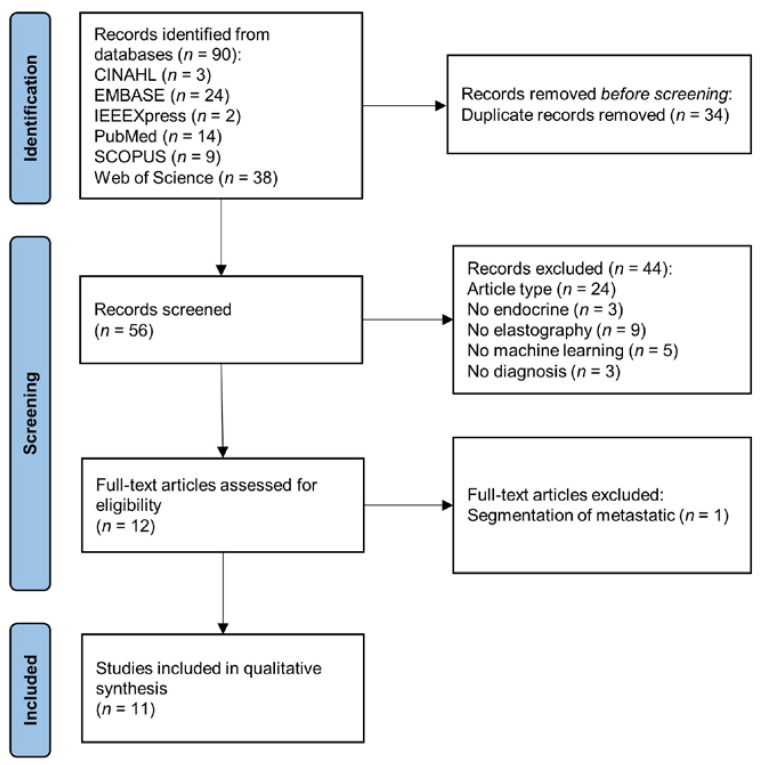
Elastography complements traditional medical imaging modalities by mapping tissue stiffness to identify tumors in the endocrine system, and machine learning models can further improve diagnostic accuracy and reliability. Our objective in this review was to summarize the applications and performance of machine-learning-based elastography on the classification of endocrine tumors. Two authors independently searched electronic databases, including PubMed, Scopus, Web of Science, IEEEXpress, CINAHL, and EMBASE. Eleven ( = 11) articles were eligible for the review, of which eight ( = 8) focused on thyroid tumors and three ( = 3) considered pancreatic tumors. In all thyroid studies, the researchers used shear-wave ultrasound elastography, whereas the pancreas researchers applied strain elastography with endoscopy. Traditional machine learning approaches or the deep feature extractors were used to extract the predetermined features, followed by classifiers. The applied deep learning approaches included the convolutional neural network (CNN) and multilayer perceptron (MLP). Some researchers considered the mixed or sequential training of B-mode and elastographic ultrasound data or fusing data from different image segmentation techniques in machine learning models. All reviewed methods achieved an accuracy of ≥80%, but only three were ≥90% accurate. The most accurate thyroid classification (94.70%) was achieved by applying sequential training CNN; the most accurate pancreas classification (98.26%) was achieved using a CNN-long short-term memory (LSTM) model integrating elastography with B-mode and Doppler images.
弹性成像通过绘制组织硬度图来识别内分泌系统中的肿瘤,从而补充了传统医学成像方式,而机器学习模型可以进一步提高诊断的准确性和可靠性。本综述的目的是总结基于机器学习的弹性成像在内分泌肿瘤分类中的应用和性能。两位作者独立检索了电子数据库,包括PubMed、Scopus、Web of Science、IEEEXpress、CINAHL和EMBASE。有11篇文章符合综述要求,其中8篇聚焦于甲状腺肿瘤,3篇关注胰腺肿瘤。在所有甲状腺研究中,研究人员使用了剪切波超声弹性成像,而胰腺研究人员则在内窥镜检查中应用了应变弹性成像。使用传统机器学习方法或深度特征提取器来提取预定特征,然后进行分类。应用的深度学习方法包括卷积神经网络(CNN)和多层感知器(MLP)。一些研究人员考虑在机器学习模型中对B模式和弹性成像超声数据进行混合或顺序训练,或者融合来自不同图像分割技术的数据。所有综述方法的准确率均≥80%,但只有三种方法的准确率≥90%。应用顺序训练CNN实现了最准确的甲状腺分类(94.70%);使用将弹性成像与B模式和多普勒图像相结合的CNN-长短期记忆(LSTM)模型实现了最准确的胰腺分类(98.26%)。