Cheng Ethan Shiu-Wang, Lai Derek Ka-Hei, Mao Ye-Jiao, Lee Timothy Tin-Yan, Lam Wing-Kai, Cheung James Chung-Wai, Wong Duo Wai-Chi
Department of Biomedical Engineering, Faculty of Engineering, The Hong Kong Polytechnic University, Hong Kong.
Department of Electronic and Information Engineering, Faculty of Engineering, The Hong Kong Polytechnic University, Hong Kong.
Bioengineering (Basel). 2023 Aug 2;10(8):917. doi: 10.3390/bioengineering10080917.
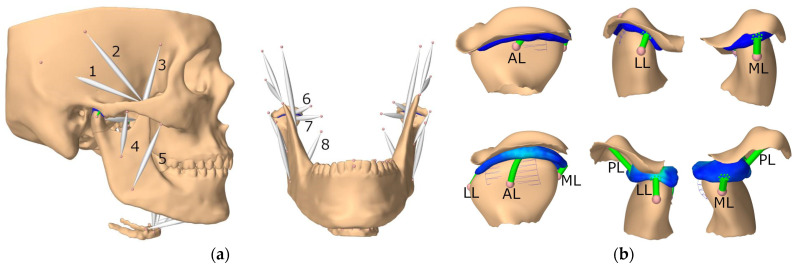
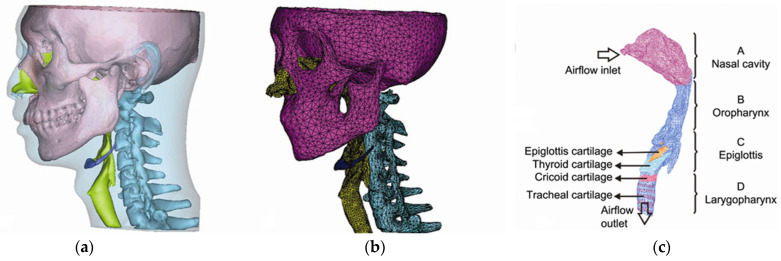
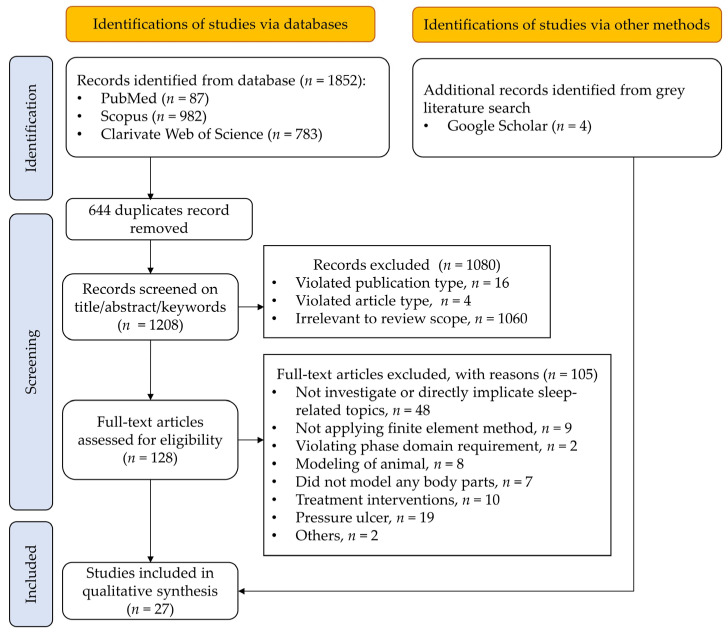
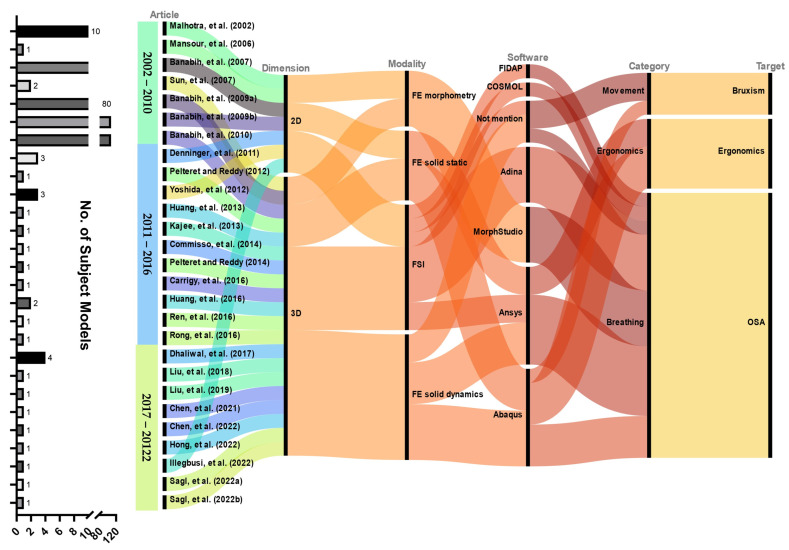
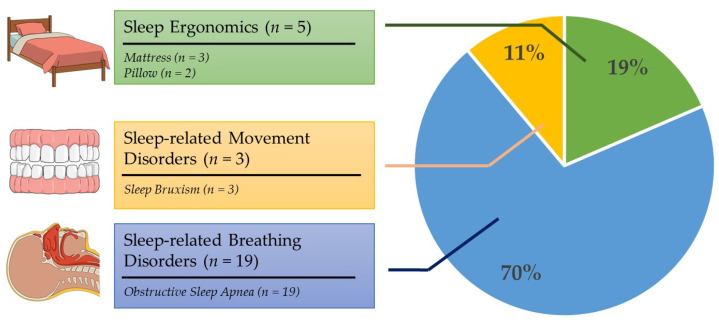
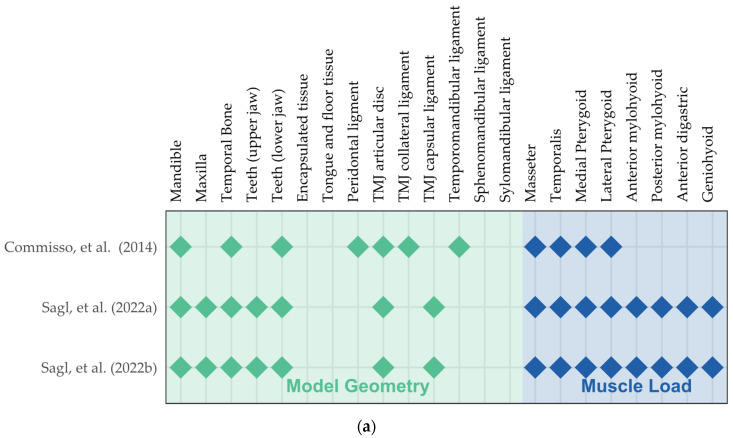
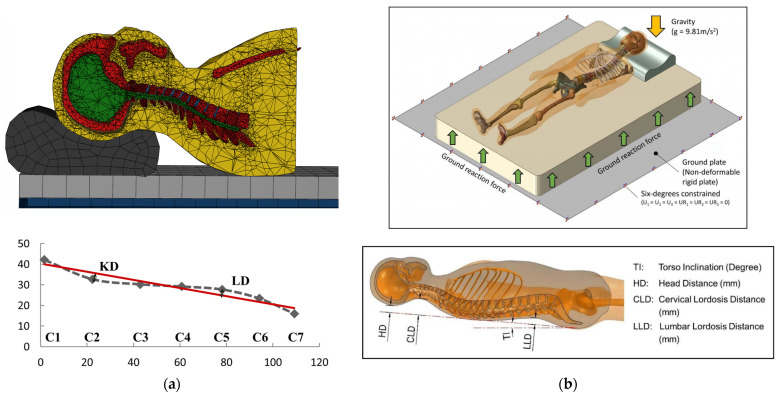
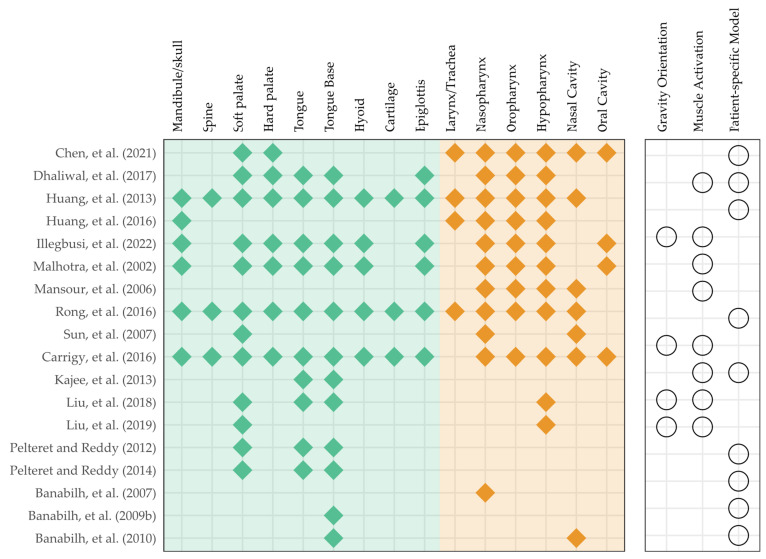
Biomechanical studies play an important role in understanding the pathophysiology of sleep disorders and providing insights to maintain sleep health. Computational methods facilitate a versatile platform to analyze various biomechanical factors in silico, which would otherwise be difficult through in vivo experiments. The objective of this review is to examine and map the applications of computational biomechanics to sleep-related research topics, including sleep medicine and sleep ergonomics. A systematic search was conducted on PubMed, Scopus, and Web of Science. Research gaps were identified through data synthesis on variants, outcomes, and highlighted features, as well as evidence maps on basic modeling considerations and modeling components of the eligible studies. Twenty-seven studies ( = 27) were categorized into sleep ergonomics ( = 2 on pillow; = 3 on mattress), sleep-related breathing disorders ( = 19 on obstructive sleep apnea), and sleep-related movement disorders ( = 3 on sleep bruxism). The effects of pillow height and mattress stiffness on spinal curvature were explored. Stress on the temporomandibular joint, and therefore its disorder, was the primary focus of investigations on sleep bruxism. Using finite element morphometry and fluid-structure interaction, studies on obstructive sleep apnea investigated the effects of anatomical variations, muscle activation of the tongue and soft palate, and gravitational direction on the collapse and blockade of the upper airway, in addition to the airflow pressure distribution. Model validation has been one of the greatest hurdles, while single-subject design and surrogate techniques have led to concerns about external validity. Future research might endeavor to reconstruct patient-specific models with patient-specific loading profiles in a larger cohort. Studies on sleep ergonomics research may pave the way for determining ideal spine curvature, in addition to simulating side-lying sleep postures. Sleep bruxism studies may analyze the accumulated dental damage and wear. Research on OSA treatments using computational approaches warrants further investigation.
生物力学研究在理解睡眠障碍的病理生理学以及为维持睡眠健康提供见解方面发挥着重要作用。计算方法为在计算机上分析各种生物力学因素提供了一个通用平台,否则通过体内实验很难做到这一点。本综述的目的是研究和梳理计算生物力学在与睡眠相关的研究主题中的应用,包括睡眠医学和睡眠工效学。我们在PubMed、Scopus和科学网进行了系统检索。通过对变量、结果和突出特征的数据综合,以及关于符合条件研究的基本建模考虑因素和建模组件的证据图谱,确定了研究差距。27项研究(n = 27)被分为睡眠工效学(n = 2关于枕头;n = 3关于床垫)、睡眠相关呼吸障碍(n = 19关于阻塞性睡眠呼吸暂停)和睡眠相关运动障碍(n = 3关于睡眠磨牙症)。探讨了枕头高度和床垫硬度对脊柱曲率的影响。颞下颌关节的应力及其紊乱是睡眠磨牙症研究的主要关注点。除了气流压力分布外,关于阻塞性睡眠呼吸暂停的研究利用有限元形态测量和流固相互作用,研究了解剖变异、舌和软腭的肌肉激活以及重力方向对上气道塌陷和阻塞的影响。模型验证一直是最大的障碍之一,而单受试者设计和替代技术引发了对外部有效性的担忧。未来的研究可能会努力在更大的队列中重建具有患者特定负荷曲线的患者特异性模型。睡眠工效学研究除了模拟侧卧位睡眠姿势外,可能为确定理想的脊柱曲率铺平道路。睡眠磨牙症研究可能会分析累积的牙齿损伤和磨损。使用计算方法对阻塞性睡眠呼吸暂停治疗的研究值得进一步探讨。