Thangamuthu Madasamy, Vankayala Kiran, Xiong Lunqiao, Conroy Stuart, Zhang Xiaolei, Tang Junwang
Department of Chemical Engineering, University College London, Torrington Place, London WC1E 7JE, U.K.
Department of Chemical and Process Engineering, University of Strathclyde, Glasgow G1 1XL, U.K.
ACS Catal. 2023 Jun 26;13(13):9113-9124. doi: 10.1021/acscatal.3c01312. eCollection 2023 Jul 7.
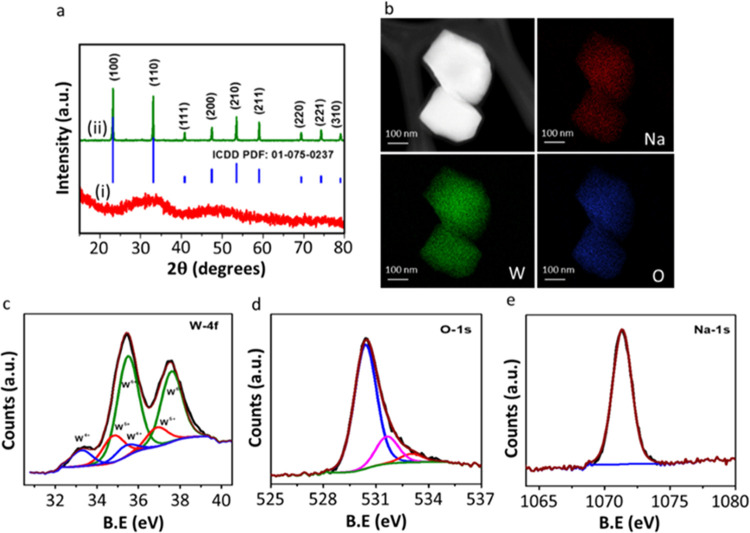
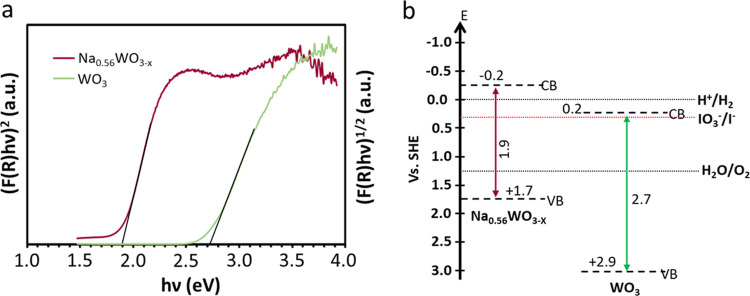
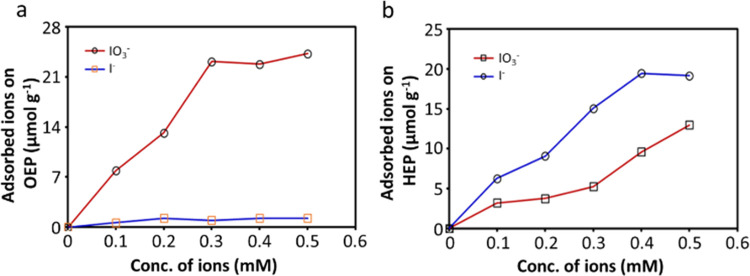
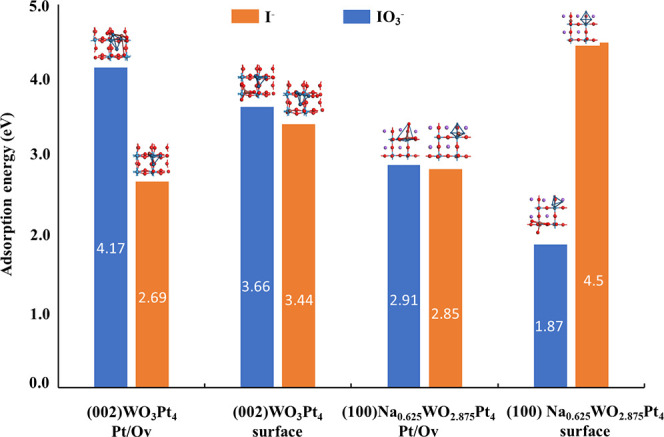
The stoichiometric water splitting using a solar-driven Z-scheme approach is an emerging field of interest to address the increasing renewable energy demand and environmental concerns. So far, the reported Z-scheme must comprise two populations of photocatalysts. In the present work, only tungsten oxides are used to construct a robust Z-scheme system for complete visible-driven water splitting in both neutral and alkaline solutions, where sodium tungsten oxide bronze (NaWO) is used as a H evolution photocatalyst and two-dimensional (2D) tungsten trioxide (WO) nanosheets as an O evolution photocatalyst. This system efficiently produces H (14 μmol h) and O (6.9 μmol h) at an ideal molar ratio of 2:1 in an aqueous solution driven by light, resulting in a remarkably high apparent quantum yield of 6.06% at 420 nm under neutral conditions. This exceptional selective H and O production is due to the preferential adsorption of iodide (I) on NaWO and iodate (IO) on WO, which is evidenced by both experiments and density functional theory calculation. The present liquid Z-scheme in the presence of efficient shuttle molecules promises a separated H and O evolution by applying a dual-bed particle suspension system, thus a safe photochemical process.
利用太阳能驱动的Z型方案进行化学计量比的水分解是一个新兴的研究领域,旨在满足不断增长的可再生能源需求并解决环境问题。到目前为止,已报道的Z型方案必须包含两种光催化剂。在本工作中,仅使用氧化钨构建了一个强大的Z型系统,用于在中性和碱性溶液中实现完全可见光驱动的水分解,其中钨酸钠青铜(NaWO)用作析氢光催化剂,二维(2D)三氧化钨(WO)纳米片用作析氧光催化剂。该系统在光驱动的水溶液中以理想的2:1摩尔比高效产生H(14 μmol h)和O(6.9 μmol h),在中性条件下于420 nm处具有高达6.06%的表观量子产率。这种优异的选择性产氢和产氧归因于碘化物(I)在NaWO上以及碘酸盐(IO)在WO上的优先吸附,实验和密度泛函理论计算均证实了这一点。在存在高效穿梭分子的情况下,当前的液相Z型方案通过应用双床颗粒悬浮系统有望实现氢和氧的分离析出,从而实现安全的光化学过程。