Dempsey Kendra, Mottola Michelle F, Atkinson Stephanie A
Department of Pediatrics, McMaster University, Hamilton, Ontario, Canada.
School of Kinesiology, The University of Western Ontario, London, Ontario, Canada.
Curr Dev Nutr. 2023 May 13;7(6):100097. doi: 10.1016/j.cdnut.2023.100097. eCollection 2023 Jun.
In trials testing the efficacy of diet and exercise modifications during pregnancy on health outcomes, assessment of participant adherence to interventions of diet and exercise is rarely reported, with few standard methods existing to measure adherence.
We aimed to assess the maternal diet quality and create an algorithm to evaluate adherence to an intervention of high protein/dairy nutrition and walking exercise from early pregnancy to birth.
In Be Healthy in Pregnancy randomized trial (NCT01693510), diet quality was measured using scores from an adapted PrimeScreen food frequency questionnaire, nutrient intake assessed by 3-day diet records, and physical activity using accelerometry at 14-17 (early), 26-28 (middle), and 36-38 (late) weeks' gestation. A novel adherence score was derived by combining data for compliance with prescribed protein and energy intakes and daily step counts in the intervention group. Between-group diet quality scores and changes in adherence scores in the intervention group across pregnancy were analyzed using generalized estimating equations adjusted for prepregnancy body mass index and study site.
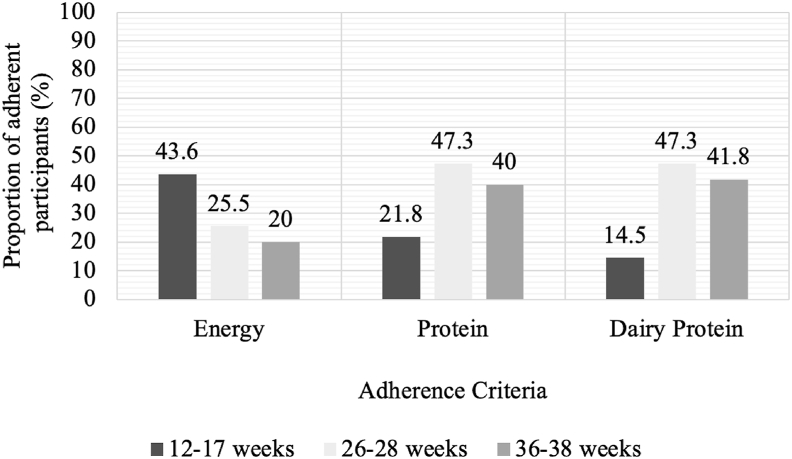
Diet scores were similar for intervention ( = 55) and control ( = 56) groups at baseline but only the intervention group significantly improved and maintained their scores from early to middle (18.7 ± 7.6 vs. 22.9 ± 6.1; < 0.001) and late (22.5 ± 6.9; < 0.008) pregnancy. Protein intake was significantly ( < 0.001) higher but energy intakes were similar in the intervention group compared with those in the control group. Adherence scores for the intervention increased significantly ( < 0.01) from early (1.52 ± 0.70) to midpregnancy (1.89 ± 0.82) but declined from midpregnancy to late (1.55 ± 0.78; < 0.0005) pregnancy primarily owing to lower step counts.
Adherence to an intervention may decline toward the end of pregnancy, particularly in maintaining physical activity. Creation of adherence scores is a feasible approach to measure combined intervention compliance for diet and physical activity and may increase transparency in interpreting results of randomized trials in pregnancy.This trial was registered at clinicaltrials.gov as NCT01689961 (https://clinicaltrials.gov/ct2/show/NCT01689961?cond=NCT01689961&rank=1; registered on 21 September 2012).
在测试孕期饮食和运动调整对健康结局疗效的试验中,很少有研究报告参与者对饮食和运动干预的依从性评估情况,且几乎没有衡量依从性的标准方法。
我们旨在评估孕妇的饮食质量,并创建一种算法,以评估从孕早期到分娩期间对高蛋白/乳制品营养和步行运动干预的依从性。
在“孕期健康”随机试验(NCT01693510)中,饮食质量通过改编后的PrimeScreen食物频率问卷得分来衡量,营养素摄入量通过3天饮食记录进行评估,身体活动通过在妊娠14 - 17周(早期)、26 - 28周(中期)和36 - 38周(晚期)使用加速度计进行测量。通过合并干预组中符合规定蛋白质和能量摄入量以及每日步数的数据,得出一个新的依从性得分。使用针对孕前体重指数和研究地点进行调整的广义估计方程,分析干预组和对照组之间的饮食质量得分以及整个孕期干预组依从性得分的变化。
干预组(n = 55)和对照组(n = 56)在基线时的饮食得分相似,但只有干预组在孕早期到中期(18.7 ± 7.6对22.9 ± 6.1;P < 0.001)和晚期(22.5 ± 6.9;P < 0.008)显著提高并维持了得分。与对照组相比,干预组的蛋白质摄入量显著更高(P < 0.001),但能量摄入量相似。干预组的依从性得分从孕早期(1.52 ± 0.70)到孕中期显著增加(P < 0.01)(1.89 ± 0.82),但从孕中期到晚期下降(1.55 ± 0.78;P < 0.0005),主要是由于步数减少。
对干预措施的依从性在妊娠末期可能会下降,尤其是在维持身体活动方面。创建依从性得分是衡量饮食和身体活动综合干预依从性的一种可行方法,并且可能会提高解释孕期随机试验结果的透明度。
该试验在clinicaltrials.gov上注册为NCT01689961(https://clinicaltrials.gov/ct2/show/NCT01689961?cond=NCT01689961&rank=1;于2012年9月21日注册)。