Kalogeropoulou Flora, Papailiou Dimitra, Protopapa Chrystalla, Siamidi Angeliki, Tziveleka Leto-Aikaterini, Pippa Natassa, Vlachou Marilena
Section of Pharmaceutical Technology, Department of Pharmacy, School of Health Sciences, National and Kapodistrian University of Athens, Panepistimioupolis Zografou, 15771 Athens, Greece.
3rd Department of Internal Medicine, 'Sotiria' Hospital, 11527 Athens, Greece.
Materials (Basel). 2023 Jun 29;16(13):4715. doi: 10.3390/ma16134715.
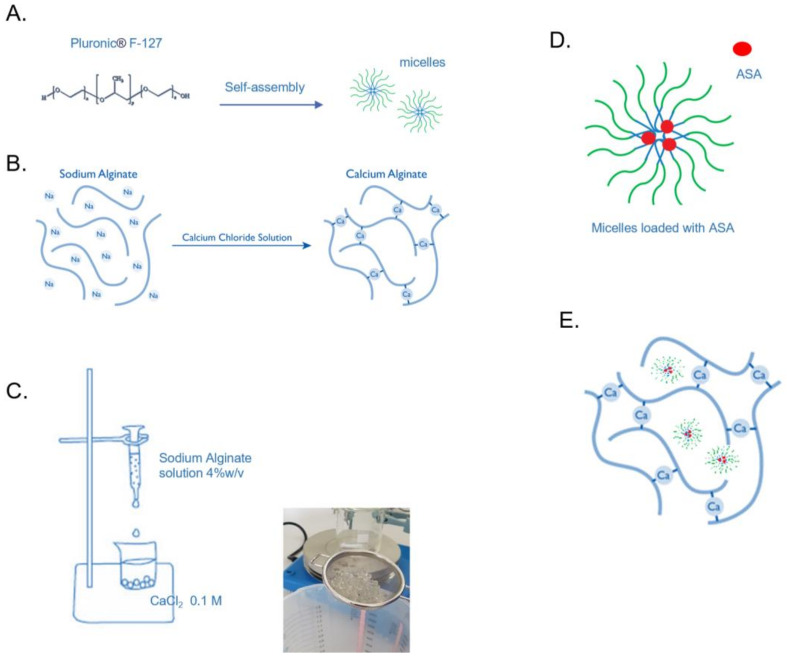
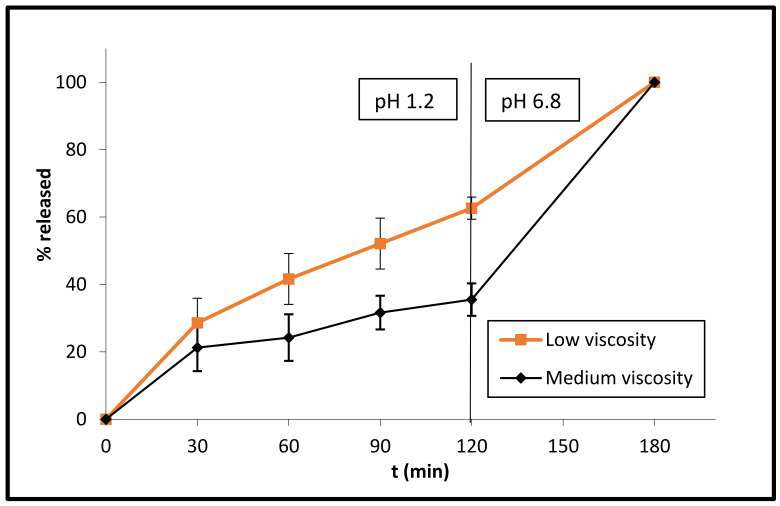
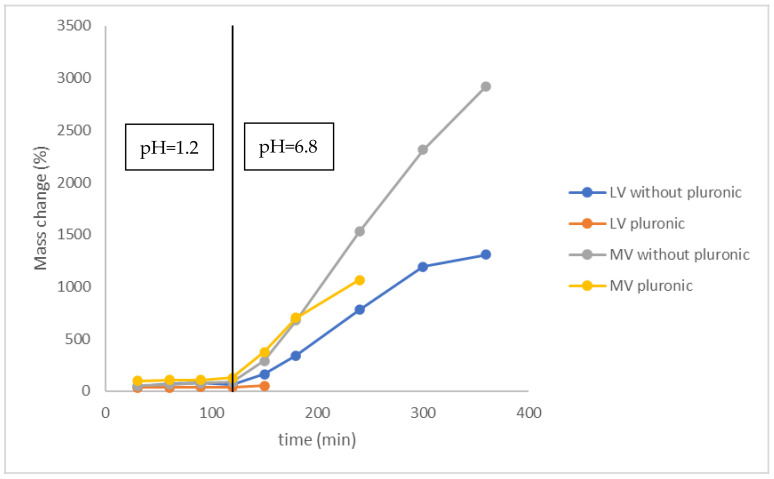
The anionic polymer sodium alginate, a linear copolymer of guluronic and mannuronic acids, is primarily present in brown algae. Copolymers are used in the sodium alginate preparation process to confer on the material strength and flexibility. Micelles and other polymeric nanoparticles are frequently made using the triblock copolymer Pluronic F-127. The purpose of the present study is to determine the effect of sodium alginate's viscosity (low and medium) and the presence of Pluronic F-127 micelles on the swelling behavior of the prepared pure beads and those loaded with Pluronic F-127 micelles. The Pluronic F-127 nanomicelles have a size of 120 nm. The swelling studies were carried out at pH = 1.2 (simulated gastric fluid-SGF) for two hours and at pH = 6.8 (simulated intestinal fluid-SIF) for four more hours. The swelling of both low- and medium-viscosity alginate beads was minor at pH = 1.2, irrespective of the use of Pluronic F-127 nanomicelles. At pH = 6.8, without Pluronic F-127, the beads showed an enhanced swelling ratio for the first four hours, which was even higher in the medium-viscosity alginate beads. With the addition of Pluronic F-127, the beads were dissolved in the first and second hour, in the case of the low- and medium-alginate's viscosity, respectively. In other words, the behavior of the mixed hydrogels was the same during the swelling experiments. Therefore, the presence of Pluronic F-127 nanomicelles and medium-viscosity sodium alginate leads to a higher swelling ratio. A model drug, acetyl salicylic acid (ASA), was also encapsulated in the mixed beads and ASA's release studies were performed. In conclusion, the prepared systems, which are well characterized, show potential as delivery platforms for the oral delivery of active pharmaceutical ingredients and biopharmaceuticals.
阴离子聚合物海藻酸钠是古洛糖醛酸和甘露糖醛酸的线性共聚物,主要存在于褐藻中。共聚物用于海藻酸钠的制备过程,以赋予材料强度和柔韧性。胶束和其他聚合物纳米颗粒通常使用三嵌段共聚物普朗尼克F-127制备。本研究的目的是确定海藻酸钠的粘度(低粘度和中粘度)以及普朗尼克F-127胶束的存在对制备的纯珠子以及负载普朗尼克F-127胶束的珠子的溶胀行为的影响。普朗尼克F-127纳米胶束的尺寸为120纳米。溶胀研究在pH = 1.2(模拟胃液-SGF)下进行两小时,然后在pH = 6.8(模拟肠液-SIF)下再进行四小时。在pH = 1.2时,无论是否使用普朗尼克F-127纳米胶束,低粘度和中粘度海藻酸钠珠子的溶胀都很小。在pH = 6.8时,不添加普朗尼克F-127,珠子在前四个小时显示出更高的溶胀率,但在中粘度海藻酸钠珠子中更高。添加普朗尼克F-127后,在低粘度和中粘度海藻酸钠的情况下,珠子分别在第一小时和第二小时溶解。换句话说,在溶胀实验中混合水凝胶的行为是相同的。因此,普朗尼克F-127纳米胶束和中粘度海藻酸钠的存在导致更高的溶胀率。一种模型药物乙酰水杨酸(ASA)也被包封在混合珠子中,并进行了ASA的释放研究。总之,所制备的系统具有良好的表征,显示出作为口服活性药物成分和生物药物递送平台的潜力。