Cacciola Giorgio, Mancino Fabio, Holzer Lukas A, De Meo Federico, De Martino Ivan, Bruschetta Antongiulio, Risitano Salvatore, Sabatini Luigi, Cavaliere Pietro
Orthopaedic Institute of Southern Italy "Franco Scalabrino", 98165 Messina, Italy.
Department of Orthopaedics, The Orthopaedic Research Foundation of Western Australia (ORFWA), Fiona Stanley Fremantle Hospitals Group, Perth, WA 6150, Australia.
J Clin Med. 2023 Jul 7;12(13):4544. doi: 10.3390/jcm12134544.
C-reactive protein (CRP) to Albumin ratio (CAR) has been used in multiple clinical settings to predict early mortality. However, there is a lack of evidence on the predictive role of CAR in 30-day mortality after a hip fracture. The purpose of this study was to establish a potential association between CAR and 30-day mortality and to assess if the CAR Receiving Operating Characteristics curve (ROC) can be a reliable predictor of early mortality.
We retrospectively reviewed the charts of 676 patients (>65 years) treated for hip fracture between 2006 and 2018. All hip fractures were included. Treatment strategies included closed reduction and internal fixation, open reduction and internal fixation, hemiarthroplasty, or total joint arthroplasty. Statistical analysis included T-test, Pearson correlation for CAR and other markers, ROC curves and area under the curve, Youden Model, and Odds Ratio.
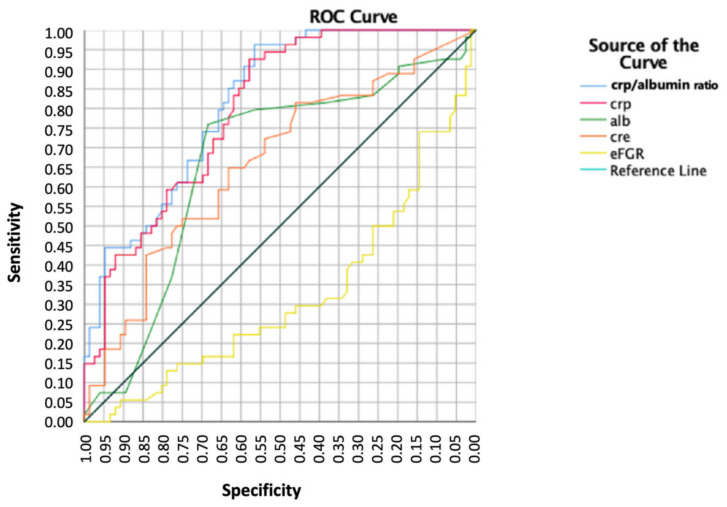
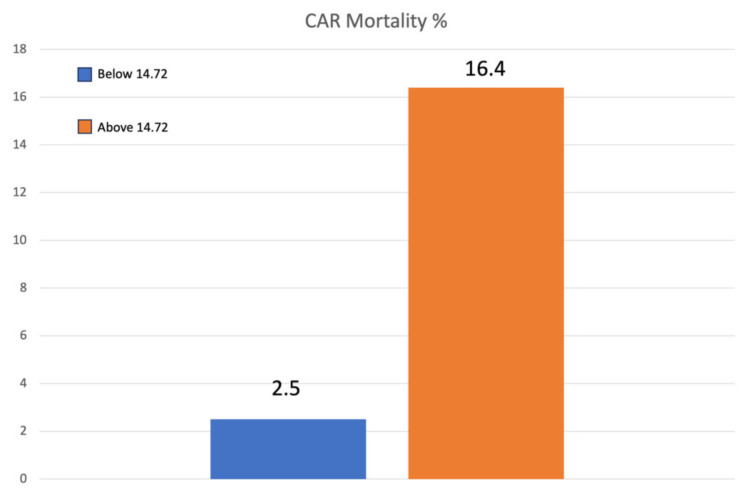
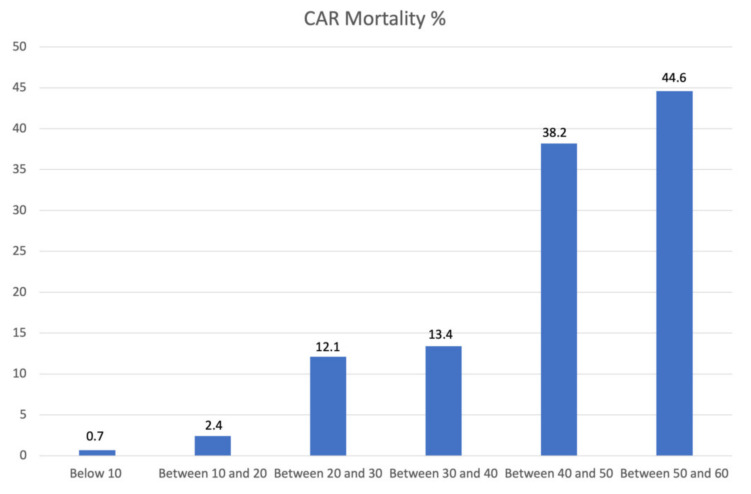
The 30-day mortality rate analysis showed that higher preoperative levels of CAR were associated with higher early mortality. When analyzing the area under the ROC curve (AUROC) for 30-day mortality, the reported value was 0.816. The point of the ROC curve corresponding to 14.72 was considered a cut-off with a specificity of 87% and a sensibility of 40.8%. When analyzing values higher than 14.72, the 30-day mortality rate was 17.9%, whilst, for values lower than 14.72, the 30-day mortality rate was 1.8%.
Patients older than 65 years affected by a hip fracture with increased preoperative levels of CAR are associated with higher 30-day mortality. Despite a moderate sensibility, considering the low cost and the predictivity of CAR, it should be considered a standard predictive marker.
C反应蛋白(CRP)与白蛋白比值(CAR)已在多种临床环境中用于预测早期死亡率。然而,关于CAR在髋部骨折后30天死亡率中的预测作用,目前缺乏证据。本研究的目的是确定CAR与30天死亡率之间的潜在关联,并评估CAR接受操作特征曲线(ROC)是否可以作为早期死亡率的可靠预测指标。
我们回顾性分析了2006年至2018年间676例(>65岁)接受髋部骨折治疗患者的病历。纳入所有髋部骨折病例。治疗策略包括闭合复位内固定、切开复位内固定、半髋关节置换术或全关节置换术。统计分析包括T检验、CAR与其他标志物的Pearson相关性、ROC曲线及曲线下面积、约登指数模型和比值比。
30天死亡率分析显示,术前CAR水平较高与早期死亡率较高相关。分析30天死亡率的ROC曲线下面积(AUROC)时,报告值为0.816。ROC曲线上对应14.72的点被视为临界值,特异性为87%,敏感性为40.8%。分析高于14.72的值时,30天死亡率为17.9%,而低于14.72的值时,30天死亡率为1.8%。
术前CAR水平升高的65岁以上髋部骨折患者,其30天死亡率较高。尽管敏感性一般,但考虑到CAR成本低且具有预测性,应将其视为标准的预测标志物。