Laboratorio de Farmacología Molecular y Química Medicinal, Departamento de Ciencias Química y Recursos Naturales, Facultad de Ingeniería y Ciencias, Universidad de La Frontera, Temuco 4811230, Chile.
Programa de Doctorado en Ciencias de Recursos Naturales, Universidad de la Frontera, Temuco 4811230, Chile.
Int J Mol Sci. 2023 Jun 25;24(13):10635. doi: 10.3390/ijms241310635.
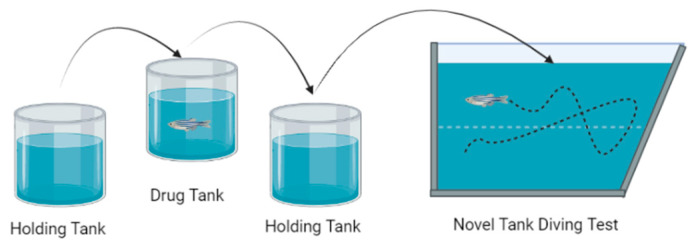
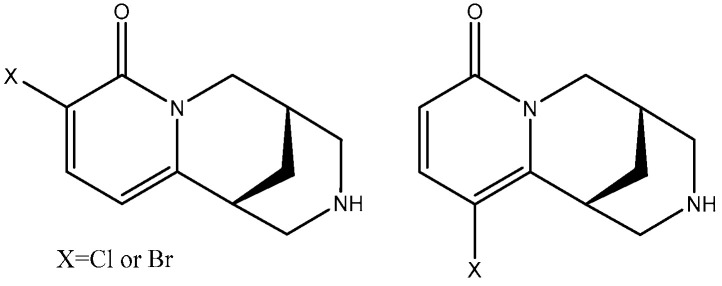
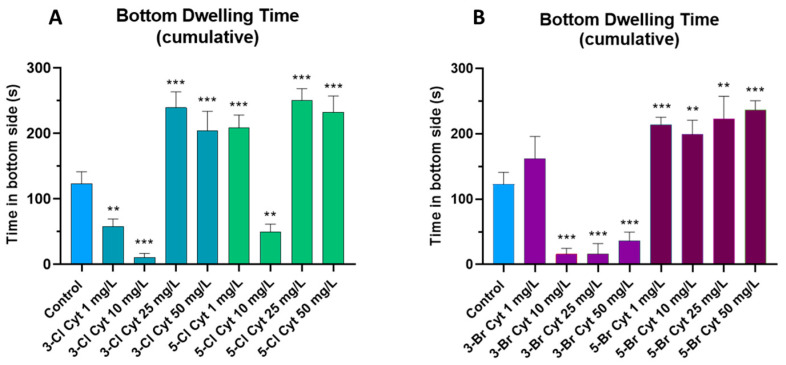
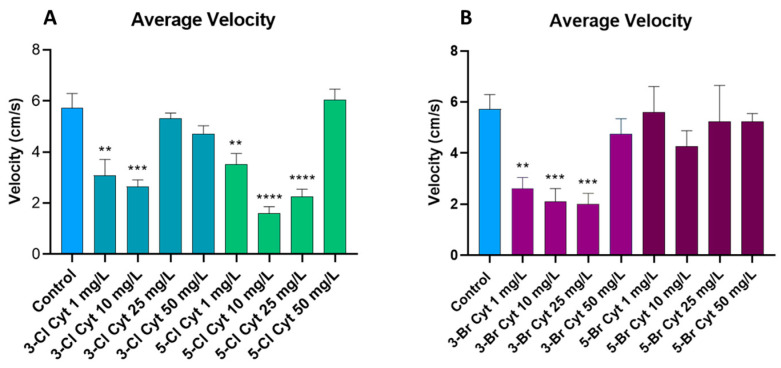
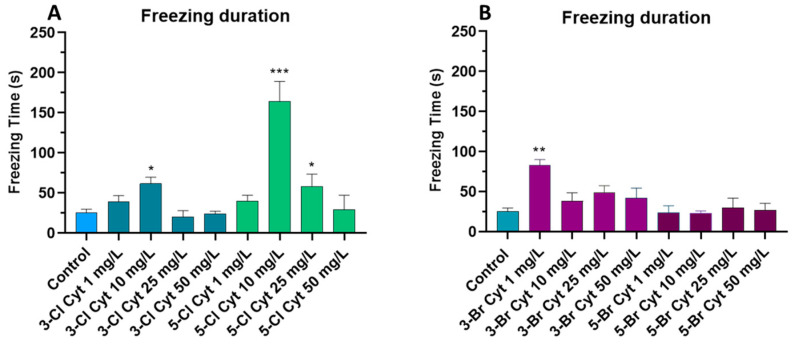
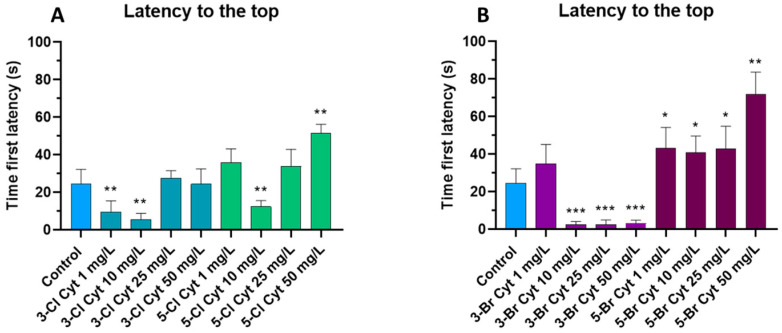
Anxiety is a serious mental disorder, and recent statistics have determined that 35.12% of the global population had an anxiety disorder during the COVID-19 pandemic. A mechanism associated with anxiolytic effects is related to nicotinic acetylcholine receptor (nAChR) agonists, principally acting on the α4β2 nAChR subtype. nAChRs are present in different animal models, including murine and teleosteos ones. Zebrafish has become an ideal animal model due to its high human genetic similarities (70%), giving it high versatility in different areas of study, among them in behavioral studies related to anxiety. The novel tank diving test (NTT) is one of the many paradigms used for studies on new drugs related to their anxiolytic effect. In this work, an adult zebrafish was used to determine the behavioral effects of 3- and 5-halocytisine derivatives, using the NTT at different doses. Our results show that substitution at position 3 by chlorine or bromine decreases the time spent by the fish at the bottom compared to the control. However, the 3-chloro derivative at higher doses increases the bottom dwelling time. In contrast, substitution at the 5 position increases bottom dwelling at all concentrations showing no anxiolytic effects in this model. Unexpected results were observed with the 5-chlorocytisine derivative, which at a concentration of 10 mg/L produced a significant decrease in bottom dwelling and showed high times of freezing. In conclusion, the 3-chloro and 3-bromo derivatives show an anxiolytic effect, the 3-chlorocytisine derivative being more potent than the 3-bromo derivative, with the lowest time at the bottom of the tank at 1mg/L. On the other hand, chlorine, and bromine at position 5 produce an opposite effect.
焦虑是一种严重的精神障碍,最近的统计数据表明,在 COVID-19 大流行期间,全球有 35.12%的人口患有焦虑症。与抗焦虑作用相关的机制与烟碱型乙酰胆碱受体(nAChR)激动剂有关,主要作用于α4β2 nAChR 亚型。nAChRs 存在于不同的动物模型中,包括鼠类和硬骨鱼类。由于斑马鱼与人的基因相似度高达 70%,因此成为理想的动物模型,在包括与焦虑相关的行为研究在内的不同研究领域具有很高的多功能性。新的鱼缸潜水试验(NTT)是用于研究与抗焦虑作用相关的新药的众多范式之一。在这项工作中,使用 NTT 在不同剂量下,使用成年斑马鱼来确定 3-和 5-卤代胞嘧啶衍生物的行为效应。我们的结果表明,与对照组相比,氯或溴在 3 位的取代会降低鱼在底部的时间。然而,在较高剂量下,3-氯衍生物会增加底部停留时间。相比之下,在所有浓度下,5 位的取代都会增加底部停留时间,在该模型中没有表现出抗焦虑作用。令人意外的是,5-氯代胞嘧啶衍生物观察到了相反的结果,在 10mg/L 的浓度下,它会显著减少在底部的停留时间,并表现出长时间的冻结。总之,3-氯和 3-溴衍生物表现出抗焦虑作用,3-氯代胞嘧啶衍生物比 3-溴代衍生物更有效,在 1mg/L 时在鱼缸底部停留的时间最短。另一方面,氯和溴在 5 位产生相反的效果。