Department of Occupational Therapy, Faculty of Associated Medical Sciences, Chiang Mai University, Chiang Mai 50200, Thailand.
Department of Community Medicine, Faculty of Medicine, Chiang Mai University, Chiang Mai 50200, Thailand.
Nutrients. 2023 Jun 23;15(13):2849. doi: 10.3390/nu15132849.
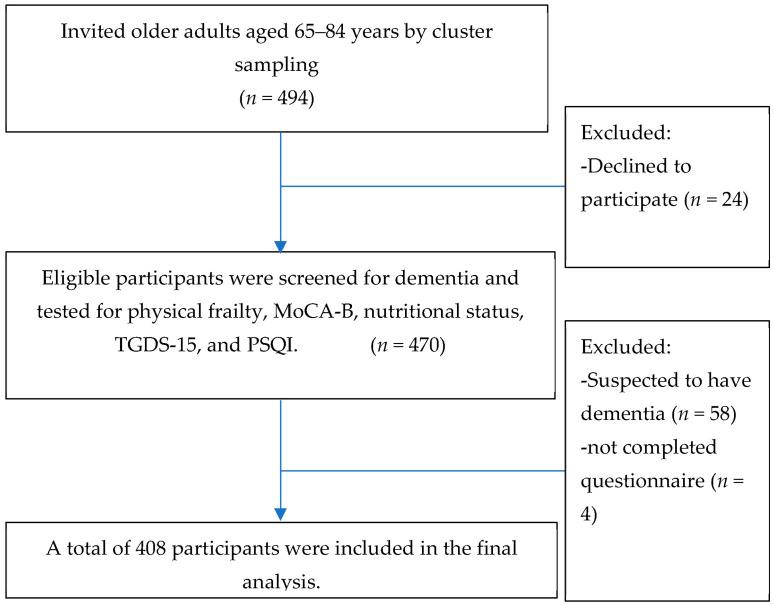
The COVID-19 restrictions, such as social isolation and disruption of daily routines, can have detrimental effects, including increased stress, anxiety, sleep disturbance, and physical and cognitive decline among older adults. This study aimed to examine the association between nutritional status, depression, sleep quality, falling asleep at night, and cognitive frailty (CF) among older Thai adults during the COVID-19 pandemic. This cross-sectional study included 408 older adults with an average age of 70.54 (5.49) years. CF was determined using Fried's frailty phenotype and the Montreal Cognitive Assessment Basic. The Mini Nutritional Assessment-Short Form, Pittsburgh Sleep Quality Index, and geriatric depression assessment were used for assessment. Multiple logistic regression analysis demonstrated that participants who were malnourished (OR 3.786; 95%CI 1.719-8.335), depressed (OR 5.003; 95%CI 2.399-10.434), had poor sleep quality (OR 1.613; 95%CI 1.041-2.500), and engaged in difficulty falling asleep (OR 1.809; 95%CI 1.022-3.203) had a higher risk of CF compared to those who did not exhibit these factors. Therefore, malnutrition, depression, poor sleep quality, and difficulty falling asleep were identified as risk factors for CF among older adults in Thailand linked to the impact of the COVID-19 pandemic. It is crucial to develop interventions to prevent CF resulting from the mentioned variables.
新型冠状病毒肺炎(COVID-19)限制措施,如社交隔离和日常生活中断,可能会对老年人造成有害影响,包括增加压力、焦虑、睡眠障碍以及身体和认知能力下降。本研究旨在探讨 COVID-19 大流行期间泰国老年人营养状况、抑郁、睡眠质量、夜间入睡困难与认知脆弱(CF)之间的关系。这项横断面研究纳入了 408 名平均年龄为 70.54(5.49)岁的老年人。采用 Fried 的衰弱表型和蒙特利尔认知评估基础版来确定 CF。使用微型营养评定简表、匹兹堡睡眠质量指数和老年抑郁评估量表进行评估。多因素逻辑回归分析显示,与未出现这些因素的参与者相比,营养不良(OR 3.786;95%CI 1.719-8.335)、抑郁(OR 5.003;95%CI 2.399-10.434)、睡眠质量差(OR 1.613;95%CI 1.041-2.500)和入睡困难(OR 1.809;95%CI 1.022-3.203)的参与者 CF 风险更高。因此,营养不良、抑郁、睡眠质量差和入睡困难是泰国老年人 CF 的危险因素,与 COVID-19 疫情的影响有关。必须制定干预措施,以预防这些变量导致的 CF。