Department of Nutrition Science, Purdue University, West Lafayette, IN 47907, USA.
Department of Statistics, Purdue University, West Lafayette, IN 47907, USA.
Nutrients. 2023 Jun 25;15(13):2870. doi: 10.3390/nu15132870.
The Dietary Guidelines for Americans (DGA) recommends consuming a variety of "Protein Foods" based on "ounce-equivalent" (oz-eq) portions. No study has assessed the same oz-eq portions of animal- vs. plant-based protein foods on essential amino acid (EAA) bioavailability for protein anabolism in young and older adults.
We assessed the effects of consuming two oz-eq portions of pork, eggs, black beans, and almonds on postprandial EAA bioavailability in young and older adults.
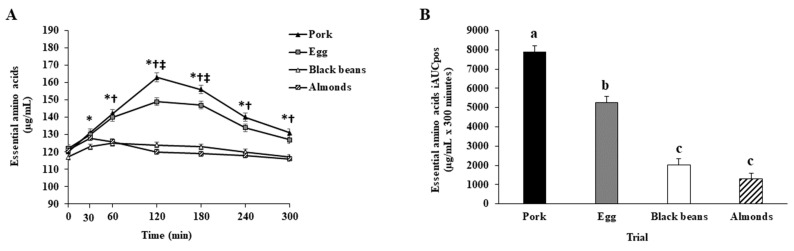
We conducted two investigator-blinded, randomized crossover trials in young ( = 30; mean age ± SD: 26.0 ± 4.9 y) and older adults ( = 25; mean age ± SD: 64.2 ± 6.6 y). Participants completed four testing sessions where they consumed a standardized meal with two oz-eq of either unprocessed lean pork, whole eggs, black beans, or sliced almonds. Blood samples were taken at baseline and 30, 60, 120, 180, 240, and 300 min postprandially. Plasma EAA bioavailability was based on postprandial integrated positive areas under the curve.
Participant age did not affect EAA bioavailability among the four protein foods tested. Two oz-eq portions of pork (7.36 g EAA) and eggs (5.38 g EAA) resulted in greater EAA bioavailability than black beans (3.02 g EAA) and almonds (1.85 g EAA) in young and older adults, separately or combined ( < 0.0001 for all). Pork resulted in greater EAA bioavailability than eggs in young adults ( < 0.0001), older adults ( = 0.0007), and combined ( < 0.0001). There were no differences in EAA bioavailability between black beans and almonds.
The same "oz-eq" portions of animal- and plant-based protein foods do not provide equivalent EAA content and postprandial bioavailability for protein anabolism in young and older adults.
《美国人膳食指南》(DGA)建议根据“盎司等效物”(oz-eq)份量来摄入各种“蛋白质食物”。尚无研究评估动物源与植物源蛋白质食物的相同 oz-eq 份量对青年和老年成年人蛋白质合成的必需氨基酸(EAA)生物利用度的影响。
我们评估了食用两份 oz-eq 的猪肉、鸡蛋、黑豆和杏仁对青年和老年成年人餐后 EAA 生物利用度的影响。
我们在青年成年人(n=30;平均年龄±标准差:26.0±4.9 岁)和老年成年人(n=25;平均年龄±标准差:64.2±6.6 岁)中进行了两项研究者设盲、随机交叉试验。参与者完成了四项测试,在这些测试中,他们摄入了一份标准化餐食,其中包含两份 oz-eq 的未经加工的瘦猪肉、全蛋、黑豆或切片杏仁。在基线和餐后 30、60、120、180、240 和 300 分钟时采集血样。血浆 EAA 生物利用度基于餐后积分正曲线下面积。
参与者年龄不影响四种蛋白质食物测试中的 EAA 生物利用度。两份 oz-eq 的猪肉(7.36 g EAA)和鸡蛋(5.38 g EAA)的 EAA 生物利用度高于青年和老年成年人的黑豆(3.02 g EAA)和杏仁(1.85 g EAA),无论是单独摄入还是混合摄入(所有比较均 <0.0001)。在青年成年人中,猪肉的 EAA 生物利用度大于鸡蛋(<0.0001),在老年成年人中(=0.0007)和混合摄入时(<0.0001)也大于鸡蛋。黑豆和杏仁的 EAA 生物利用度没有差异。
动物源和植物源蛋白质食物的相同“oz-eq”份量在青年和老年成年人中不能提供等量的 EAA 含量和餐后蛋白质合成的生物利用度。