Department of Geriatrics, Donald W. Reynolds Institute on Aging, University of Arkansas for Medical Sciences, Little Rock, AR, USA.
Department of Molecular Medicine, Lee Gil Ya Cancer and Diabetes Institute, College of Medicine, Gachon University, Incheon, South Korea.
J Nutr. 2021 May 11;151(5):1190-1196. doi: 10.1093/jn/nxaa401.
The Dietary Guidelines for Americans (DGAs) published an "ounce equivalents" recommendation to help consumers meet protein requirements with a variety of protein food sources. However, the metabolic equivalency of these varied protein food sources has not been established.
We have investigated the hypothesis that the anabolic responses to consumption of ounce equivalents of protein food sources would be directly related to the essential amino acid (EAA) content of the protein food source.
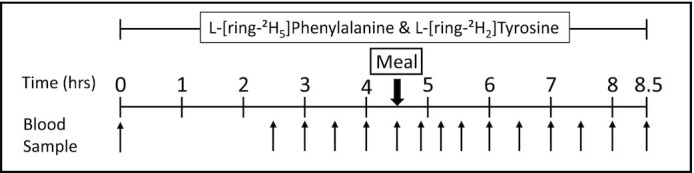
Following 3 d of dietary control, a total of 56 healthy young adults underwent an 8.5-h metabolic study using stable isotope tracer methodology. The changes from baseline following consumption of 1 of 7 different protein food sources were compared with the baseline value for that individual (n = 8 per group).
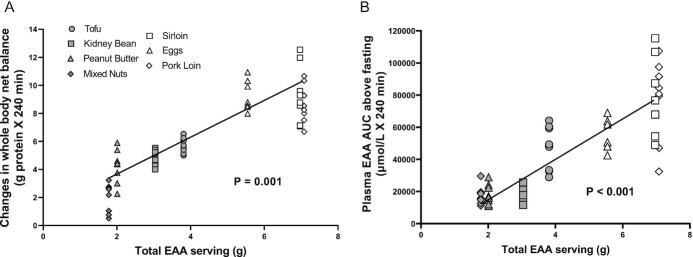
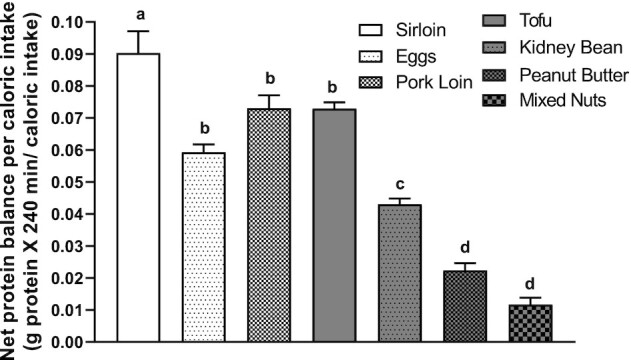
Consumption of ounce equivalents of animal-based protein food sources (beef sirloin, pork loin, eggs) resulted in a greater gain in whole-body net protein balance above baseline than the ounce equivalents of plant-based protein food sources (tofu, kidney beans, peanut butter, mixed nuts; P < 0.01). The improvement in whole-body net protein balance was due to an increase in protein synthesis (P < 0.05) with all the animal protein sources, whereas the egg and pork groups also suppressed protein breakdown compared with the plant protein sources (P < 0.01). The magnitude of the whole-body net balance (anabolic) response was correlated with the EAA content of the protein food source (P < 0.001).
The "ounce equivalents" of protein food sources as expressed in the DGAs are not metabolically equivalent in young healthy individuals. The magnitude of anabolic response to dietary proteins should be considered as the DGAs develop approaches to establish healthy eating patterns.
《美国人膳食指南》(DGAs)发布了“盎司当量”建议,以帮助消费者用各种蛋白质食物来源满足蛋白质需求。然而,这些不同蛋白质食物来源的代谢当量尚未确定。
我们假设摄入蛋白质食物源的盎司当量所引起的合成代谢反应与蛋白质食物源的必需氨基酸(EAA)含量直接相关。
在进行 3 天饮食控制后,共有 56 名健康的年轻人通过稳定同位素示踪剂方法进行了 8.5 小时的代谢研究。将 7 种不同蛋白质食物源中的 1 种消耗后与个体的基线值(每组 8 人)进行比较。
与植物性蛋白质食物源(豆腐、芸豆、花生酱、混合坚果)相比,摄入动物源性蛋白质食物源(牛里脊、猪里脊、鸡蛋)的盎司当量导致全身净蛋白质平衡较基线增加(P < 0.01)。全身净蛋白质平衡的改善归因于所有动物蛋白质来源的蛋白质合成增加(P < 0.05),而鸡蛋和猪肉组与植物蛋白质来源相比也抑制了蛋白质分解(P < 0.01)。全身净平衡(合成代谢)反应的幅度与蛋白质食物源的 EAA 含量相关(P < 0.001)。
在年轻健康个体中,DGA 中表达的蛋白质食物源的“盎司当量”在代谢上并不等效。在制定健康饮食模式时,DGA 应考虑到对膳食蛋白质的合成代谢反应的幅度。