Luo Keming, Liu Jiaxin, Abbay Kieth, Mei Yangjie, Guo Xiaowei, Song Yunhe, Guan Qingbao, You Zhengwei
State Key Laboratory for Modification of Chemical Fibers and Polymer Materials, College of Materials Science and Engineering, Institute of Functional Materials, Research Base of Textile Materials for Flexible Electronics and Biomedical Applications (China Textile Engineering Society), Shanghai Engineering Research Center of Nano-Biomaterials and Regenerative Medicine, Donghua University, Shanghai 201620, China.
Heilongjiang EPPEN New Materials Co., Ltd., Daqing 166299, China.
Polymers (Basel). 2023 Jun 29;15(13):2877. doi: 10.3390/polym15132877.
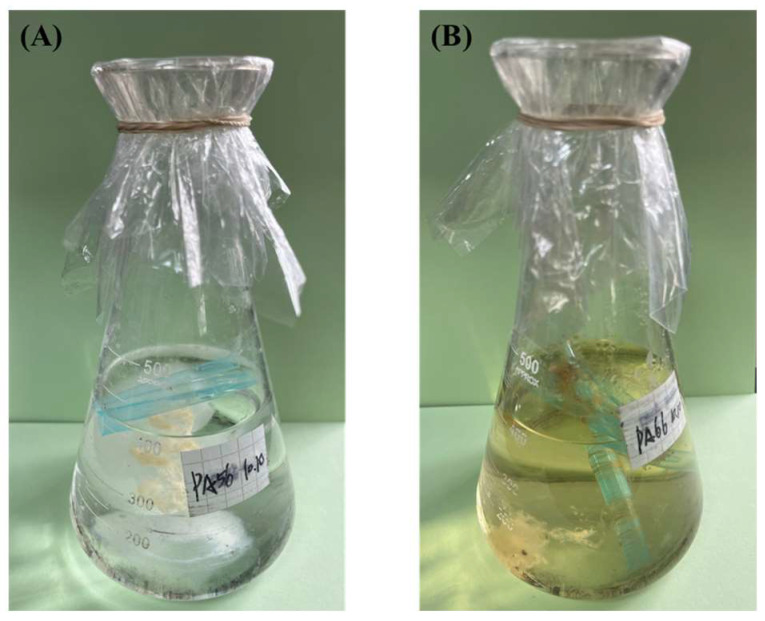
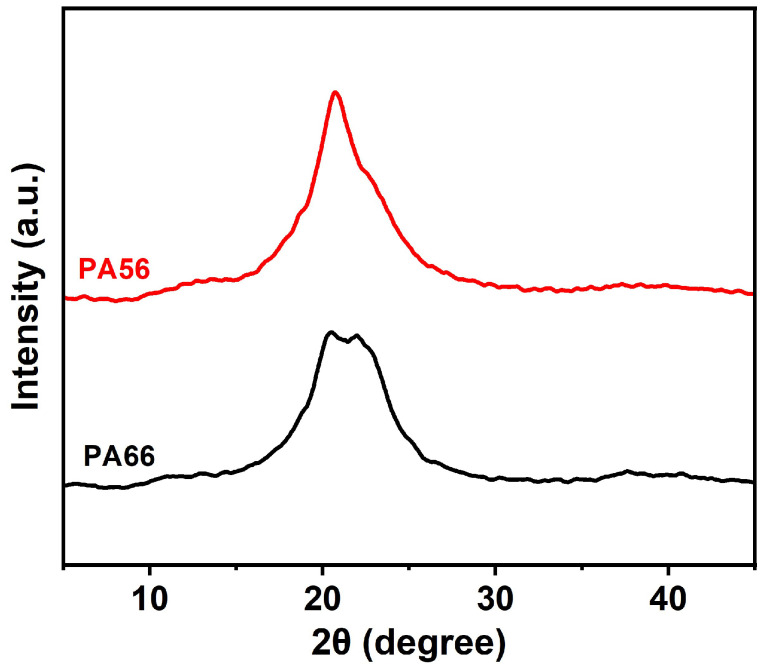
Bio-based polymers can reduce dependence on nonrenewable petrochemical resources and will be beneficial for future sustainable developments due to their low carbon footprint. In this work, the feasibility of bio-based polyamide 56 (PA56) substituting petroleum-based PA66 is systematically investigated. The crystallization, melting, and decomposition temperature of PA56 were all lower than that of PA66. PA56 formed a γ crystal type with larger grain size and took a longer amount of time to complete the crystallization process since its crystallization rate was lower than that of PA66. Compared with PA66, PA56 exhibited a higher tensile strength of 71.3 ± 1.9 MPa and specific strength of 64.8 ± 2.0 MPa but lower notched impact strength. More importantly, the limited oxygen index and vertical combustion measurement results indicated that the flame retardancy of PA56 was better than PA66, and the LOI values and the UL94 result of PA56 were 27.6% ± 0.9% and V-2. It is worth noting that the PA56 fiber had superior biodegradability compared to the PA66 fiber. PA56 showed significant biodegradation from the eighth week, whereas PA66 remained clean until the sixteenth week (without obvious biodegradation taking place). Eventually, PA56 did not show significant differences compared to PA66 in terms of thermal and mechanical properties. However, PA56 had great advantages in flame retardancy and biodegradability, indicating that the bio-based PA56 could potentially replace petroleum-based PA66 in many fields.
生物基聚合物可以减少对不可再生石化资源的依赖,并且由于其低碳足迹,将有利于未来的可持续发展。在这项工作中,系统地研究了生物基聚酰胺56(PA56)替代石油基PA66的可行性。PA56的结晶温度、熔点和分解温度均低于PA66。PA56形成了晶粒尺寸较大的γ晶型,由于其结晶速率低于PA66,因此完成结晶过程所需的时间更长。与PA66相比,PA56表现出更高的拉伸强度,为71.3±1.9MPa,比强度为64.8±2.0MPa,但缺口冲击强度较低。更重要的是,极限氧指数和垂直燃烧测试结果表明,PA56的阻燃性优于PA66,PA56的LOI值和UL94结果分别为27.6%±0.9%和V-2。值得注意的是,与PA66纤维相比,PA56纤维具有优异的生物降解性。PA56从第八周开始出现明显的生物降解,而PA66直到第十六周仍保持清洁(没有明显的生物降解发生)。最终,PA56在热性能和机械性能方面与PA66相比没有显著差异。然而,PA56在阻燃性和生物降解性方面具有很大优势,这表明生物基PA56有可能在许多领域取代石油基PA66。