Smart Systems Engineering Laboratory, Department of Communications and Networks, College of Engineering, Prince Sultan University, Riyadh 11586, Saudi Arabia.
School of Computing and Engineering, University of West London, London W5 5RF, UK.
Sensors (Basel). 2023 Jun 25;23(13):5882. doi: 10.3390/s23135882.
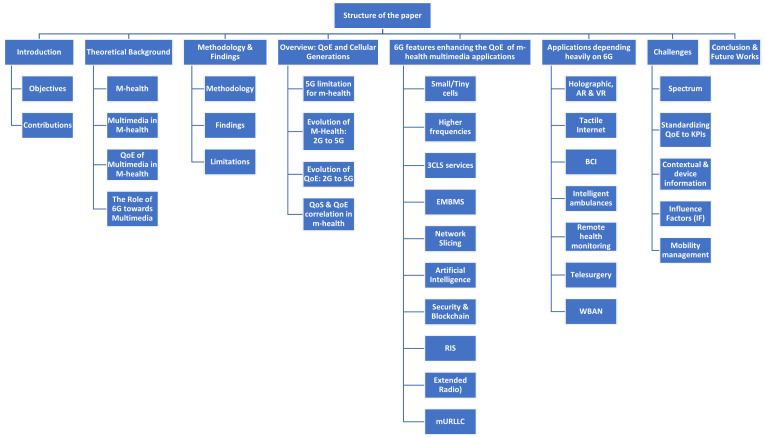
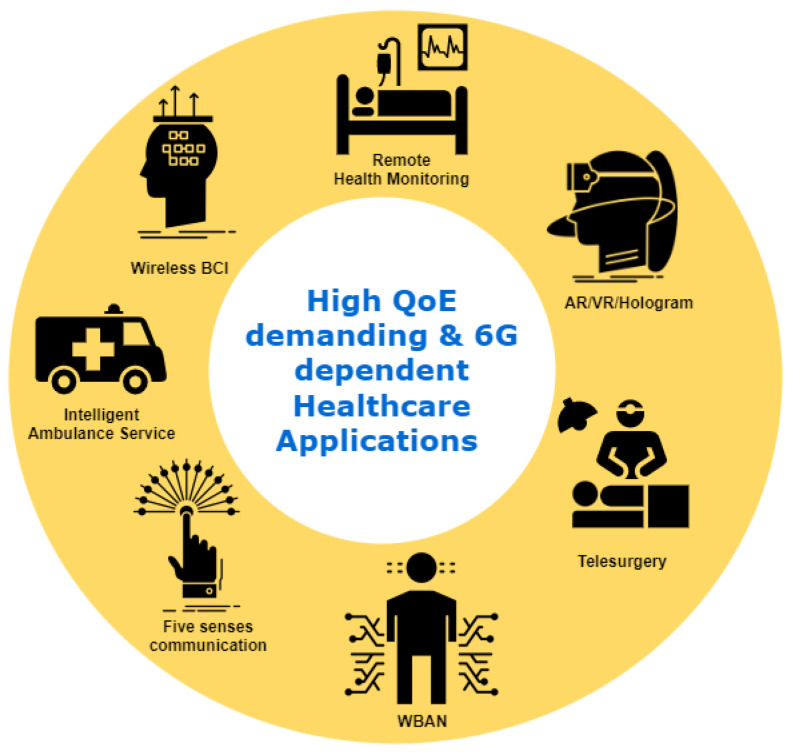
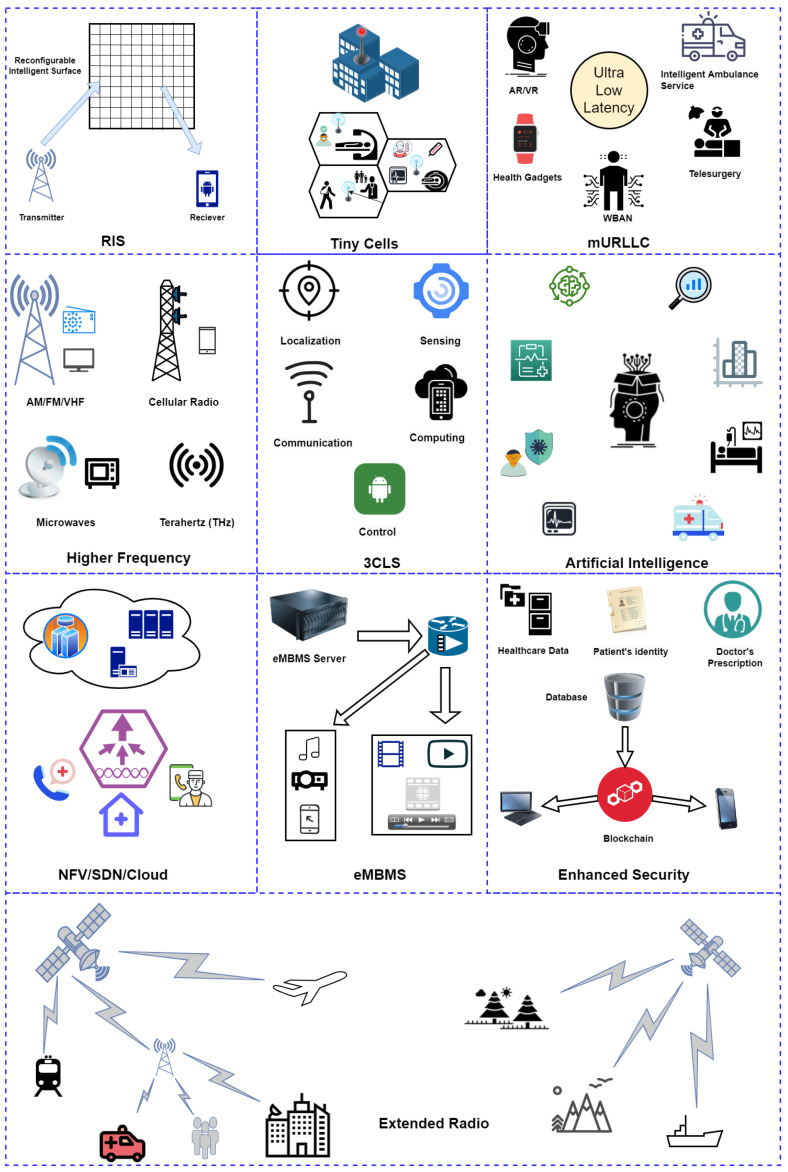
Mobile-health (m-health) is described as the application of medical sensors and mobile computing to the healthcare provision. While 5G networks can support a variety of m-health services, applications such as telesurgery, holographic communications, and augmented/virtual reality are already emphasizing their limitations. These limitations apply to both the Quality of Service (QoS) and the Quality of Experience (QoE). However, 6G mobile networks are predicted to proliferate over the next decade in order to solve these limitations, enabling high QoS and QoE. Currently, academia and industry are concentrating their efforts on the 6G network, which is expected to be the next major game-changer in the telecom industry and will significantly impact all other related verticals. The exponential growth of m-health multimedia traffic (e.g., audio, video, and images) creates additional challenges for service providers in delivering a suitable QoE to their customers. As QoS is insufficient to represent the expectations of m-health end-users, the QoE of the services is critical. In recent years, QoE has attracted considerable attention and has established itself as a critical component of network service and operation evaluation. This article aims to provide the first thorough survey on a promising research subject that exists at the intersection of two well-established domains, i.e., QoE and m-health, and is driven by the continuing efforts to define 6G. This survey, in particular, creates a link between these two seemingly distinct domains by identifying and discussing the role of 6G in m-health applications from a QoE viewpoint. We start by exploring the vital role of QoE in m-health multimedia transmission. Moreover, we examine how m-health and QoE have evolved over the cellular network's generations and then shed light on several critical 6G technologies that are projected to enable future m-health services and improve QoE, including reconfigurable intelligent surfaces, extended radio communications, terahertz communications, enormous ultra-reliable and low-latency communications, and blockchain. In contrast to earlier survey papers on the subject, we present an in-depth assessment of the functions of 6G in a variety of anticipated m-health applications via QoE. Multiple 6G-enabled m-health multimedia applications are reviewed, and various use cases are illustrated to demonstrate how 6G-enabled m-health applications are transforming human life. Finally, we discuss some of the intriguing research challenges associated with burgeoning multimedia m-health applications.
移动医疗(m-health)被描述为医疗传感器和移动计算在医疗保健提供中的应用。虽然 5G 网络可以支持各种 m-health 服务,但诸如远程手术、全息通信和增强/虚拟现实等应用已经强调了它们的局限性。这些限制适用于服务质量(QoS)和体验质量(QoE)。然而,预计在未来十年内,6G 移动网络将大量普及,以解决这些限制,实现高 QoS 和 QoE。目前,学术界和工业界都在集中精力研究 6G 网络,预计它将成为电信行业的下一个重大变革者,并将对所有其他相关垂直行业产生重大影响。m-health 多媒体流量(例如音频、视频和图像)的指数级增长给服务提供商向客户提供合适的 QoE 带来了额外的挑战。由于 QoS 不足以代表 m-health 最终用户的期望,因此服务的 QoE 至关重要。近年来,QoE 引起了相当多的关注,并已成为网络服务和运营评估的关键组成部分。本文旨在提供一个关于一个有前途的研究课题的首次全面调查,该课题存在于两个成熟领域的交叉点,即 QoE 和 m-health,并由继续努力定义 6G 驱动。特别是,本文通过从 QoE 的角度来识别和讨论 6G 在 m-health 应用中的作用,在这两个看似不同的领域之间建立了联系。我们首先探讨了 QoE 在 m-health 多媒体传输中的重要作用。此外,我们研究了 m-health 和 QoE 如何随着蜂窝网络的发展而发展,然后探讨了几项预计将使未来 m-health 服务和提高 QoE 的关键 6G 技术,包括可重构智能表面、扩展无线电通信、太赫兹通信、巨大的超高可靠和低延迟通信以及区块链。与该主题的早期调查论文相比,我们通过 QoE 对各种预期的 m-health 应用中的 6G 功能进行了深入评估。我们回顾了多个 6G 支持的 m-health 多媒体应用,并举例说明了各种用例,展示了 6G 支持的 m-health 应用如何改变人类生活。最后,我们讨论了与新兴多媒体 m-health 应用相关的一些有趣的研究挑战。