Department of Radiation Therapy, Cancer Care Services, Royal Brisbane and Women's Hospital, Metro North Hospital and Health Service, Brisbane, Queensland, Australia.
Statistics Unit, QIMR Berghofer Medical Research Institute, Brisbane, Queensland, Australia.
J Med Radiat Sci. 2023 Dec;70(4):436-443. doi: 10.1002/jmrs.705. Epub 2023 Jul 13.
The paediatric radiation therapy group (PRTG) provided a multidisciplinary network to support patients accessing radiation therapy (RT). This study aims to evaluate the use and efficacy of behaviour therapy practices used by the PRTG.
A retrospective cross-sectional review of general anaesthetic (GA) utilisation for paediatric patients was completed between 1 January 2010 and 30 June 2014. The PRTG incorporated behavioural therapy techniques into all appointments but offered additional play appointments to children unable to comply with the requirements of RT. This aimed to increase their compliance and minimise GA use.
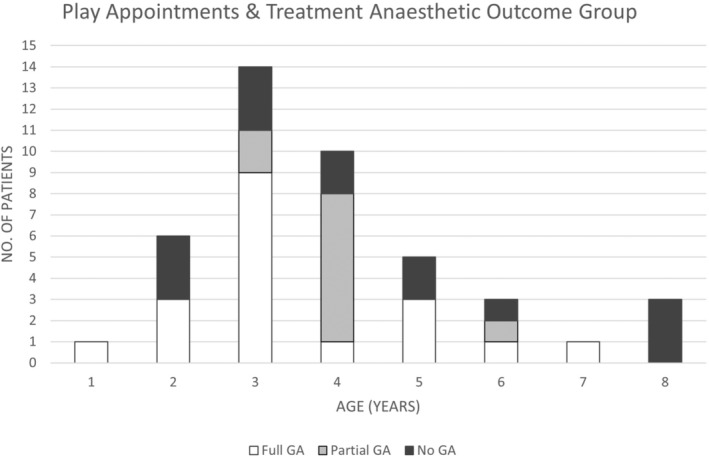
Two-hundred and seventy-four patients had 5402 occasions of service, of which 1361 were delivered under GA (25.2%). Two-hundred and fifty-seven patients met the eligibility criteria. Patients under 8 years who required GA for their entire treatment reduced for each year of increase in age (odds ratio 0.37, 95% confidence interval 0.27-0.51, P < 0.001). Participants 3 years and younger were shown not as likely to change their GA requirements with the use of play appointments. Seventy-eight per cent (83/106) of 3-8-year-olds used no GA or ceased GA during treatment.
Most paediatric patients <3 years will gain minimal benefit to reduce GA use from additional play appointments. Children older than nine were not likely to require play appointments to be compliant with RT. Encouragingly, 53.3% of 3-8-year-olds who were categorised as full GA after CT planning did not continue to a full course of GA due to the behavioural therapy interventions of the PRTG.
儿科放射治疗组(PRTG)提供了一个多学科网络,以支持患者接受放射治疗(RT)。本研究旨在评估 PRTG 采用的行为治疗实践的使用情况和疗效。
对 2010 年 1 月 1 日至 2014 年 6 月 30 日期间接受全身麻醉(GA)的儿科患者进行了回顾性横断面研究。PRTG 将行为治疗技术纳入所有预约,但为无法遵守 RT 要求的儿童提供额外的游戏预约。这旨在提高他们的依从性并尽量减少 GA 的使用。
274 名患者有 5402 次服务,其中 1361 次在 GA 下进行(25.2%)。257 名患者符合入选标准。需要 GA 进行整个治疗的 8 岁以下患者,每年增加的 GA 使用率降低(优势比 0.37,95%置信区间 0.27-0.51,P<0.001)。研究表明,3 岁及以下的患者不太可能因使用游戏预约而改变其 GA 需求。78%(83/106)的 3-8 岁儿童在治疗过程中无需 GA 或停止 GA。
大多数<3 岁的儿科患者从额外的游戏预约中减少 GA 使用率获益甚少。9 岁以上的儿童不太可能需要游戏预约才能遵守 RT。令人鼓舞的是,由于 PRTG 的行为治疗干预,53.3%在 CT 计划后被归类为完全 GA 的 3-8 岁儿童并未继续全疗程 GA。