Javanbakht Marjan, Khan Lamia, Mustanski Brian, Shoptaw Steve, Baum Marianna K, Mehta Shruti H, Kirk Gregory D, Lai Shenghan, Moore Richard, Milloy M-J, Kipke Michele, Hayashi Kanna, DeBeck Kora, Siminski Suzanne, White Lisa M, Gorbach Pamina
Department of Epidemiology, Fielding School of Public Health, University of California, Los Angeles, Los Angeles, CA, USA.
Institute for Sexual and Gender Minority Health and Wellbeing and Department of Medical Social Sciences, Northwestern University, Chicago, IL, USA.
Prev Med Rep. 2023 Jun 24;35:102300. doi: 10.1016/j.pmedr.2023.102300. eCollection 2023 Oct.
We describe the prevalence of COVID-19 vaccine uptake, substance use, and other factors associated with vaccine hesitancy among participants from nine North American cohort studies following a diverse group of individuals at risk for or living with HIV.
Between May 2021 and January 2022, participants completed a survey related to COVID-19 vaccination. Participants included those with and without substance use. Those responding as 'no' or 'undecided' to the question "Do you plan on getting the COVID-19 vaccine?" were categorized as vaccine hesitant. Differences between groups were evaluated using chi-square methods and multivariable log-binomial models were used to calculate prevalence ratios (PR) of COVID-19 vaccine hesitancy with separate models for each substance.
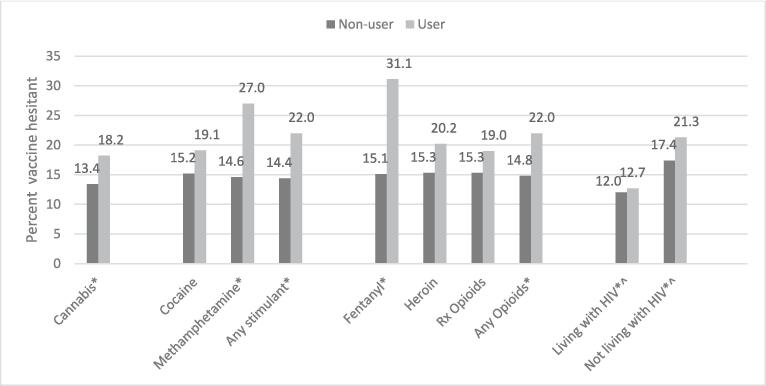
Among 1,696 participants, COVID-19 vaccination was deferred or declined by 16%. Vaccine hesitant participants were younger, with a greater proportion unstably housed (14.8% vs. 10.0%; p = 0.02), and not living with HIV (48.% vs. 36.6%; p <.01). Vaccine hesitant participants were also more likely to report cannabis (50.0% vs. 42.4%; p = 0.03), methamphetamine (14.0% vs. 8.2%; p <.01), or fentanyl use (5.5% vs. 2.8%; p = 0.03). Based on multivariable analyses methamphetamine or fentanyl use remained associated with COVID-19 vaccine hesitancy (Adjusted PR = 1.4; 95% CI 1.1-1.9 and Adjusted PR = 1.6; 95% CI 1.0-2.6, respectively).
As new COVID-19 vaccines and booster schedules become necessary, people who use drugs (PWUD) may remain vaccine hesitant. Strategies to engage hesitant populations such as PWUD will need to be tailored to include special types of outreach such as integration with substance use programs such as safe injection sites or recovery programs.
我们描述了来自九项北美队列研究的参与者中新冠病毒疾病2019(COVID-19)疫苗接种率、物质使用情况以及与疫苗犹豫相关的其他因素,这些研究跟踪了一群有感染人类免疫缺陷病毒(HIV)风险或感染了HIV的不同个体。
在2021年5月至2022年1月期间,参与者完成了一项与COVID-19疫苗接种相关的调查。参与者包括有物质使用和无物质使用的人群。对“你是否计划接种COVID-19疫苗?”这个问题回答“否”或“不确定”的人被归类为疫苗犹豫者。使用卡方方法评估组间差异,并使用多变量对数二项式模型计算每种物质单独模型下COVID-19疫苗犹豫的患病率比(PR)。
在1696名参与者中,16%的人推迟或拒绝接种COVID-19疫苗。疫苗犹豫的参与者更年轻,住房不稳定的比例更高(14.8%对10.0%;p = 0.02),且未感染HIV(48.%对36.6%;p <.01)。疫苗犹豫的参与者也更有可能报告使用大麻(50.0%对42.4%;p = 0.03)、甲基苯丙胺(14.0%对8.2%;p <.01)或芬太尼(5.5%对2.8%;p = 0.03)。基于多变量分析,使用甲基苯丙胺或芬太尼仍与COVID-19疫苗犹豫相关(调整后的PR分别为1.4;95%置信区间1.1 - 1.9和调整后的PR为1.6;95%置信区间1.0 - 2.6)。
随着新的COVID-19疫苗和加强针接种计划变得必要,吸毒者(PWUD)可能仍然对疫苗犹豫不决。针对犹豫人群(如PWUD)的策略需要量身定制,包括特殊类型的外展服务,如与物质使用项目(如安全注射点或康复项目)相结合。