Guangdong Provincial Key Laboratory of Advanced Drug Delivery, Guangdong Provincial Engineering Center of Topical Precise Drug Delivery System, Guangdong Pharmaceutical University, Guangzhou, People's Republic of China.
The Innovation Team for Integrating Pharmacy with Entrepreneurship, Guangdong Pharmaceutical University, Guangzhou, People's Republic of China.
Int J Nanomedicine. 2023 Jul 10;18:3745-3760. doi: 10.2147/IJN.S415728. eCollection 2023.
The tight structure of the blood-brain barrier severely limits the level of drug therapy for central nervous system disorders. In this study, a novel composite delivery system combining nanocarrier and microneedle technology was prepared to explore the possibility of transdermal delivery of drugs to work in the brain.
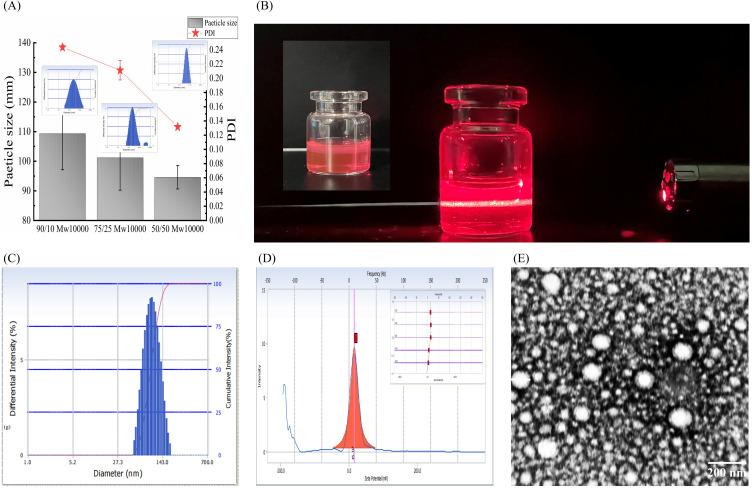
Nanoparticle solutions containing paroxetine and rhodamine-B were prepared using PLGA as a carrier by the emulsification-solvent volatilization method. Then, they were mixed with hyaluronic acid and the PLGA nanoparticulate-based microneedle system (Rh-NPs-DMNs) was prepared by a multi-step decompression-free diffusion method. The particle size, zeta potential, and micromorphology of the nano solution were measured; the appearance, mechanical strength, dissolution properties, and puncture effect of the Rh-NPs-DMNs were evaluated; also, it was evaluated for in vivo live imaging properties and in vitro skin layer transport and distribution properties.
The mean particle size of Rh-NPs was 96.25 ± 2.26 nm; zeta potential of 15.89 ± 1.97 mV; PDI of 0.120 ± 0.079. Rh-NPs-DMNs had a high needle content of 96.11 ± 1.27% and a tip height of 651.23 ± 1.28 μm, with excellent mechanical properties (fracture force of 299.78 ± 1.74 N). H&E skin tissue staining showed that Rh-NPs-DMNs produced micron-sized mechanical pores approximately 550 μm deep immediately after drug administration, allowing for efficient circulation of the drug; and the results of in vivo imaging showed that Rh-B NPs DMNs had a faster transport rate than Rh-B DMNs, with strong fluorescent signals in both brain (<0.01) and hippocampus (<0.05) 48 h after drug administration.
Nanoparticles can prolong blood circulation time and intracerebral retention time and have certain brain-targeting properties due to their excellent physical properties. The use of microneedle technology combined with nanocarriers provides new ideas for delivery systems for the treatment of central neurological diseases.
血脑屏障的紧密结构严重限制了中枢神经系统疾病的药物治疗水平。在这项研究中,制备了一种新型的复合递药系统,将纳米载体和微针技术结合在一起,探索药物经皮递送至大脑的可能性。
采用 PLGA 作为载体,通过乳化-溶剂挥发法制备载有帕罗西汀和罗丹明 B 的纳米粒子溶液。然后,将其与透明质酸混合,采用多步无压扩散法制备 PLGA 纳米粒基微针系统(Rh-NPs-DMNs)。测量纳米溶液的粒径、Zeta 电位和微观形态;评价 Rh-NPs-DMNs 的外观、力学强度、溶解性能和穿刺效果;评价体内活体成像性能和体外皮肤层转运及分布性能。
Rh-NPs 的平均粒径为 96.25±2.26nm;Zeta 电位为 15.89±1.97mV;PDI 为 0.120±0.079。Rh-NPs-DMNs 的针含量高达 96.11±1.27%,针尖高度为 651.23±1.28μm,具有优异的力学性能(断裂力为 299.78±1.74N)。H&E 皮肤组织染色显示,给药后 Rh-NPs-DMNs 立即产生约 550μm 深的微米级机械孔,使药物能够有效循环;体内成像结果表明,与 Rh-B DMNs 相比,Rh-B NPs DMNs 的转运速度更快,给药后 48h 脑(<0.01)和海马(<0.05)均有较强的荧光信号。
纳米粒子由于其优异的物理性能,可延长血液循环时间和脑内滞留时间,并具有一定的脑靶向性。微针技术与纳米载体联合使用为中枢神经系统疾病治疗的递药系统提供了新的思路。