Vergados Panagiotis, Krishnamoorthy Siddharth, Martire Léo, Mrak Sebastijan, Komjáthy Attila, Morton Yu T Jade, Vilibić Ivica
Jet Propulsion Laboratory, California Institute of Technology, Pasadena, CA USA.
University of Colorado Boulder, Boulder, CO USA.
GPS Solut. 2023;27(4):169. doi: 10.1007/s10291-023-01492-8. Epub 2023 Jul 12.
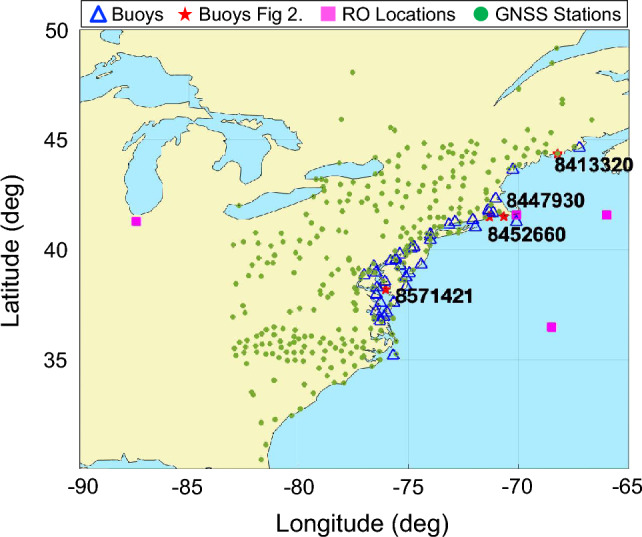
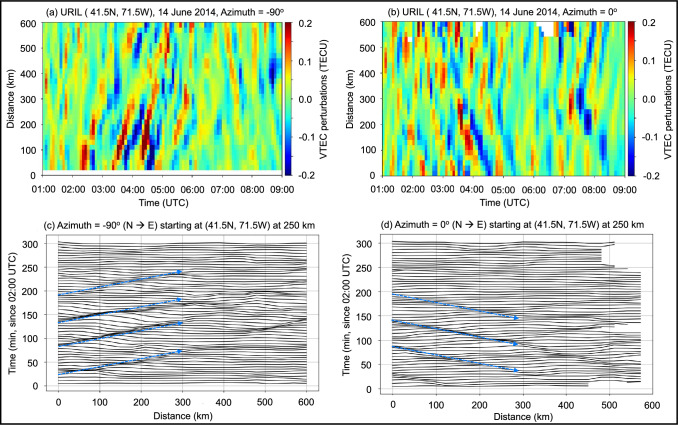
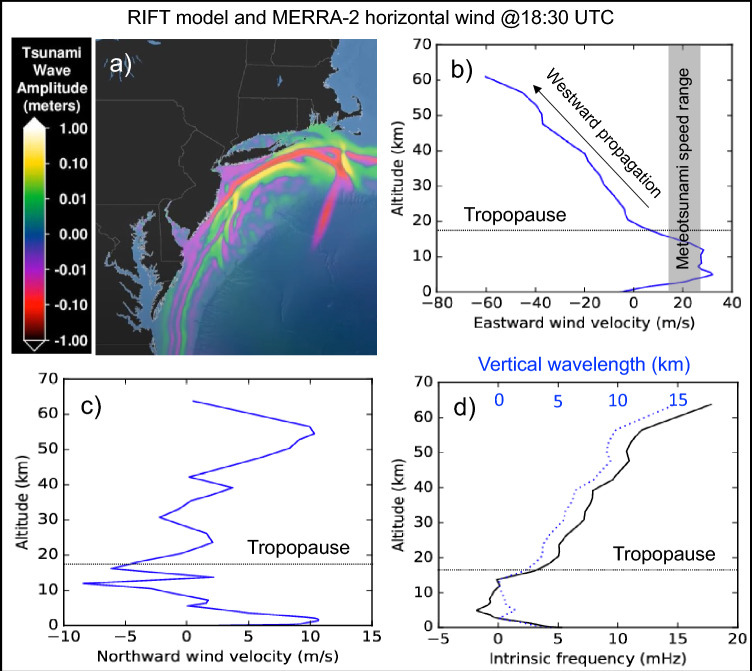
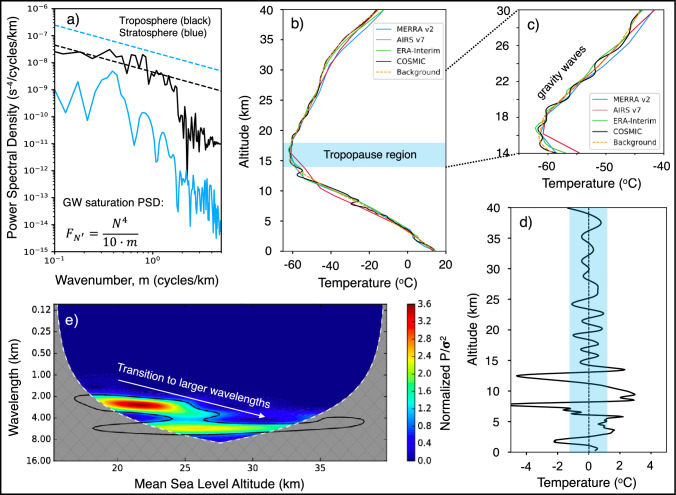
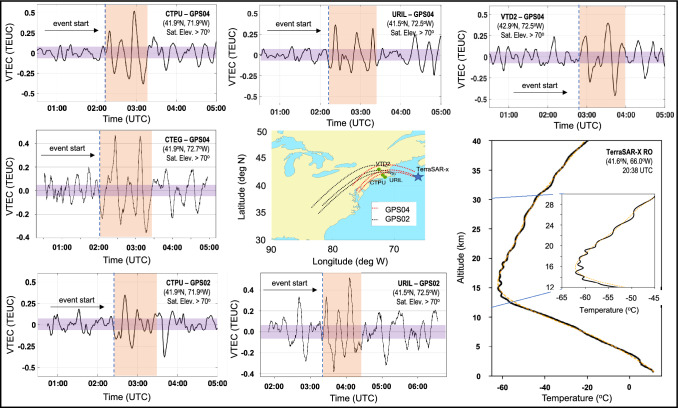
We study, for the first time, the physical coupling and detectability of meteotsunamis in the earth's atmosphere. We study the June 13, 2013 event off the US East Coast using Global Navigation Satellite System (GNSS) radio occultation (RO) measurements, Sounding of the Atmosphere using Broadband Emission Radiometry (SABER) temperatures, and ground-based GNSS ionospheric total electron content (TEC) observations. Hypothesizing that meteotsunamis also generate gravity waves (GWs), similar to tsunamigenic earthquakes, we use linear GW theory to trace their dynamic coupling in the atmosphere by comparing theory with observations. We find that RO data exhibit distinct stratospheric GW activity at near-field that is captured by SABER data in the mesosphere with increased vertical wavelength. Ground-based GNSS-TEC data also detect a far-field ionospheric response 9 h later, as expected by GW theory. We conclude that RO measurements could increase understanding of meteotsunamis and how they couple with the earth's atmosphere, augmenting ground-based GNSS TEC observations.
我们首次研究了地球大气中气象海啸的物理耦合及可探测性。我们利用全球导航卫星系统(GNSS)无线电掩星(RO)测量、宽带发射辐射计大气探测(SABER)温度以及地基GNSS电离层总电子含量(TEC)观测,对2013年6月13日美国东海岸附近的事件展开研究。假设气象海啸也会像海啸地震一样产生重力波(GWs),我们运用线性重力波理论,通过对比理论与观测结果来追踪它们在大气中的动态耦合。我们发现,RO数据在近场显示出明显的平流层重力波活动,中层大气中的SABER数据捕捉到了这种活动,且垂直波长有所增加。正如重力波理论所预期的那样,地基GNSS-TEC数据在9小时后也探测到了远场电离层响应。我们得出结论,RO测量有助于增进对气象海啸及其与地球大气耦合方式的理解,从而补充地基GNSS TEC观测。