Department of Psychology, Tsinghua University, Beijing, China.
Department of Health Policy and Management, School of Public Health, Peking University, Beijing, China.
JAMA Netw Open. 2023 Jul 3;6(7):e2324025. doi: 10.1001/jamanetworkopen.2023.24025.
Although rapid urbanization in China provided improved economic prosperity and educational opportunities, it was associated with increased internalizing and externalizing problems among youths, with negative outcomes for mental well-being. Previous studies suggested that factors in individual, school, and regional levels were associated with mental well-being, and comprehensively examining these factors may provide evidence for policies for improving youth mental health.
To investigate factors associated with mental well-being at individual, school, and province levels among Chinese youths.
DESIGN, SETTING, AND PARTICIPANTS: This cross-sectional study analyzed nationally representative data collected December 1, 2021, to January 1, 2022, from schools in China. Among 435 schools, 144 institutions had primary school students, 107 institutions had middle school students, 95 institutions had primary and middle school students, and 89 institutions had high school students. A total of 398 520 students were included.
Characteristics at individual, school, and province levels.
The main outcome was mental well-being, assessed by the Short Warwick-Edinburgh Mental Well-being Scale. Linear mixed-effects models were used to investigate individual, school, and regional disparities in mental well-being among youths.
There were 398 520 participants (194 460 females [48.80%]; mean [SD; range] age, 13.78 [2.40; 9-20] years). At the school level, 352 443 students (88.44%) were in public school and 291 354 students (73.11%) were in urban schools. Drinking (coefficient = -1.08; 95% CI, -1.12 to -1.05; P < .001), smoking (coefficient = -0.89; 95% CI, -0.96 to -0.83; P < .001), and increased age (coefficient per 1-year increase in age = -0.02; 95% CI, -0.03 to -0.01; P < .001) were associated with worse mental well-being. Male sex (coefficient = 1.01; 95% CI, 0.98 to 1.04; P < .001), being in a 1-child family (coefficient = 0.17; 95% CI, 0.13 to 0.20; P < .001), being in the Han group (coefficient vs other ethnic groups = 0.20; 95% CI, 0.14 to 0.26; P < .001), a higher frequency and coverage of psychological courses (eg, ≥2/wk for all students vs none: coefficient = 1.02; 95% CI, 0.36 to 1.69; P = .003), and a higher level of self-rated popularity in school (coefficient per 1-unit increase in score = 0.89; 95% CI, 0.88 to 0.89; P < .001) were associated with improved mental well-being. However, age (eg, age and 1 courses/2 wk for all students: coefficient per 1-year increase in age = -0.047; 95% CI, -0.089 to -0.005; P = .03) and sex (eg, female sex and ≥2 courses/wk for some students: coefficient = -0.184; 95% CI, -0.323 to -0.046; P = .009) had interactions with the association between psychological courses and mental well-being.
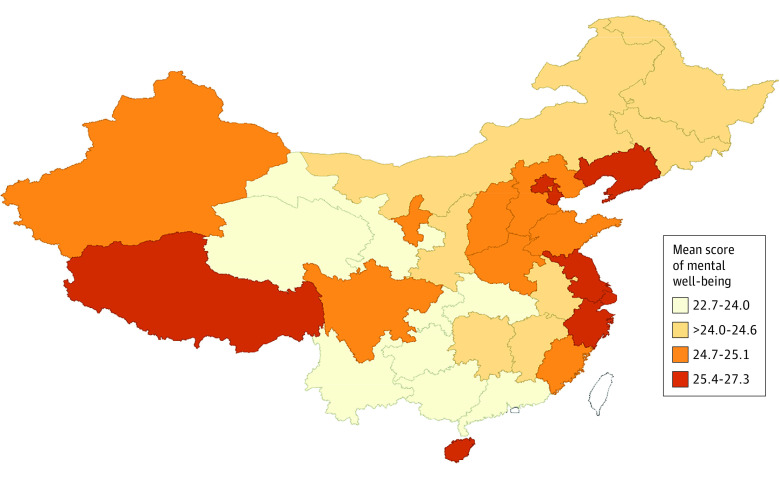
This study found that social disparities in mental well-being existed and that various factors at different levels were associated with mental well-being among Chinese youths. These findings suggest that public mental health programs may be recommended for associated improvements in regional disparities in mental health resources.
尽管中国的快速城市化带来了经济繁荣和教育机会的增加,但它也导致年轻人的内化和外化问题增加,对心理健康产生负面影响。先前的研究表明,个体、学校和地区层面的因素与心理健康有关,全面研究这些因素可为改善青年心理健康的政策提供证据。
调查中国青少年在个体、学校和省级层面与心理健康相关的因素。
设计、设置和参与者:这是一项横断面研究,分析了 2021 年 12 月 1 日至 2022 年 1 月 1 日期间在中国学校收集的具有全国代表性的数据。在 435 所学校中,有 144 所学校有小学生,107 所学校有中学生,95 所学校有中小学生,89 所学校有高中生。共纳入 398520 名学生。
个体、学校和省级特征。
主要结果是通过短沃里克-爱丁堡心理健康量表评估的心理健康。使用线性混合效应模型调查了青少年心理健康在个体、学校和地区之间的差异。
共有 398520 名参与者(女性 194460 名[48.80%];平均[标准差;范围]年龄为 13.78[2.40;9-20]岁)。在学校层面,352443 名学生(88.44%)就读于公立学校,291354 名学生(73.11%)就读于城市学校。饮酒(系数=-1.08;95%CI,-1.12 至-1.05;P<.001)、吸烟(系数=-0.89;95%CI,-0.96 至-0.83;P<.001)和年龄增长(每增加 1 岁的系数为-0.02;95%CI,-0.03 至-0.01;P<.001)与心理健康状况较差相关。男性(系数=1.01;95%CI,0.98 至 1.04;P<.001)、独生子家庭(系数=0.17;95%CI,0.13 至 0.20;P<.001)、汉族群体(与其他民族群体相比的系数=0.20;95%CI,0.14 至 0.26;P<.001)、更高频率和更广泛的心理课程(例如,所有学生每周≥2 次与无:系数=1.02;95%CI,0.36 至 1.69;P=.003)和更高的学校自评受欢迎程度(每增加 1 分的系数=0.89;95%CI,0.88 至 0.89;P<.001)与心理健康状况改善相关。然而,年龄(例如,所有学生的年龄和每 2 周 1 次课程:系数每增加 1 岁为-0.047;95%CI,-0.089 至-0.005;P=.03)和性别(例如,女生和一些学生每周≥2 次课程:系数= -0.184;95%CI,-0.323 至-0.046;P=.009)与心理课程与心理健康之间的关联存在交互作用。
本研究发现,中国青少年的心理健康存在社会差异,不同层面的各种因素与心理健康有关。这些发现表明,可能需要推荐公共心理健康计划来改善心理健康资源的地区差异。
