Toronto General Research Institute - University Health Network, 101 College Street, Max Bell Research Centre, suite 5R406, Toronto, ON, M5G 1L7, Canada.
Laboratory Medicine & Pathobiology, University of Toronto, Toronto, ON, Canada.
Nat Commun. 2023 Jul 18;14(1):4313. doi: 10.1038/s41467-023-39935-y.
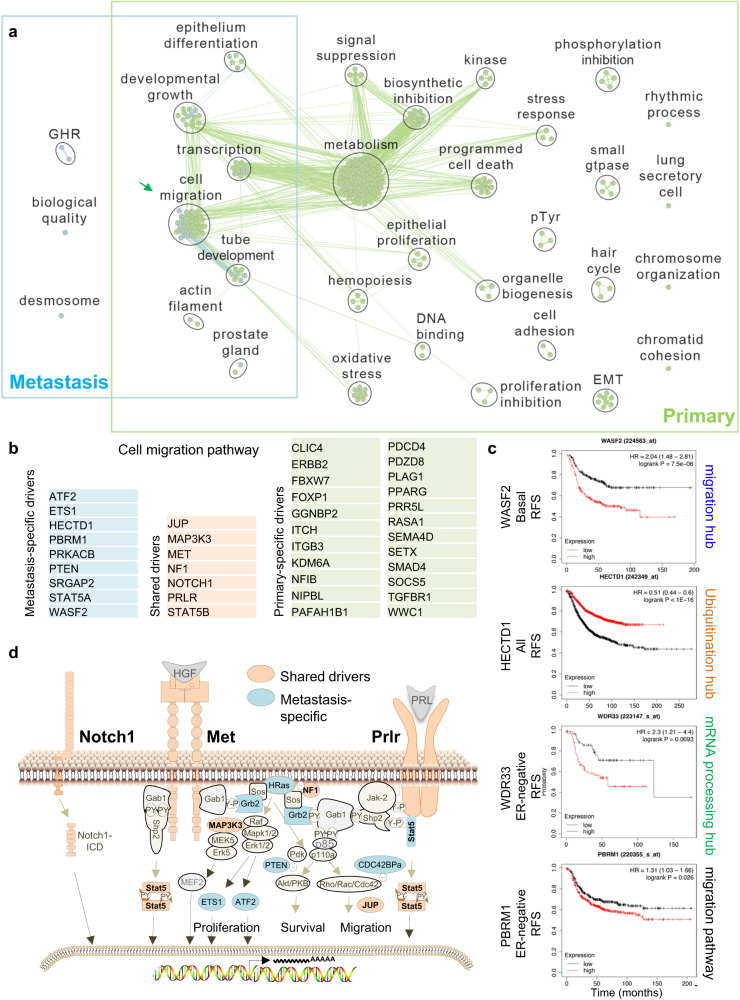
Metastatic breast-cancer is a major cause of death in women worldwide, yet the relationship between oncogenic drivers that promote metastatic versus primary cancer is still contentious. To elucidate this relationship in treatment-naive animals, we hereby describe mammary-specific transposon-mutagenesis screens in female mice together with loss-of-function Rb, which is frequently inactivated in breast-cancer. We report gene-centric common insertion-sites (gCIS) that are enriched in primary-tumors, in metastases or shared by both compartments. Shared-gCIS comprise a major MET-RAS network, whereas metastasis-gCIS form three additional hubs: Rho-signaling, Ubiquitination and RNA-processing. Pathway analysis of four clinical cohorts with paired primary-tumors and metastases reveals similar organization in human breast-cancer with subtype-specific shared-drivers (e.g. RB1-loss, TP53-loss, high MET, RAS, ER), primary-enriched (EGFR, TGFβ and STAT3) and metastasis-enriched (RHO, PI3K) oncogenic signaling. Inhibitors of RB1-deficiency or MET plus RHO-signaling cooperate to block cell migration and drive tumor cell-death. Thus, targeting shared- and metastasis- but not primary-enriched derivers offers a rational avenue to prevent metastatic breast-cancer.
转移性乳腺癌是全世界女性死亡的主要原因,但促进转移性和原发性癌症的致癌驱动因素之间的关系仍存在争议。为了在未经治疗的动物中阐明这种关系,我们在此描述了雌性小鼠中的乳腺特异性转座子诱变筛选以及经常在乳腺癌中失活的 RB 功能丧失。我们报告了在原发性肿瘤、转移瘤或两者中都富集的以基因为中心的常见插入位点(gCIS)。共享-gCIS 包含一个主要的 MET-RAS 网络,而转移-gCIS 则形成另外三个枢纽:Rho 信号、泛素化和 RNA 处理。对四个具有配对原发性肿瘤和转移瘤的临床队列的通路分析显示,人类乳腺癌具有相似的组织,具有亚型特异性的共享驱动因素(例如 RB1 缺失、TP53 缺失、高 MET、RAS、ER)、原发性富集(EGFR、TGFβ 和 STAT3)和转移富集(RHO、PI3K)致癌信号。RB1 缺陷或 MET 加 RHO 信号抑制剂的联合作用可阻断细胞迁移并导致肿瘤细胞死亡。因此,针对共享和转移但不是原发性富集的驱动因素提供了一种合理的途径来预防转移性乳腺癌。