Department of Gastroenterology, Tonan Hospital, North 4, West 7, Chuo-ku, 060-0004, Sapporo, Hokkaido, Japan.
Department of Gastroenterology, Rumoi Municipal Hospital, Rumoi, Hokkaido, Japan.
BMC Gastroenterol. 2023 Jul 18;23(1):243. doi: 10.1186/s12876-023-02880-7.
Gastric anisakiasis typically causes severe abdominal symptoms; however, we incidentally detected asymptomatic gastric anisakiasis cases during esophagogastroduodenoscopy. The factors associated with developing acute abdominal symptoms induced by gastric anisakiasis remain unclear. Therefore, this study aimed to investigate the clinical factors associated with abdominal symptoms of gastric anisakiasis by comparing symptomatic and asymptomatic cases.
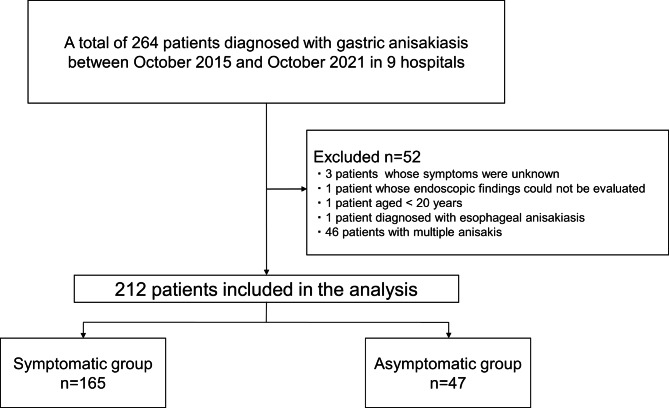
This was a retrospective cohort study involving 264 patients diagnosed with gastric anisakiasis at nine hospitals in Japan between October 2015 and October 2021. We analyzed patients' medical records and endoscopic images and compared the clinical factors between the symptomatic and asymptomatic groups.
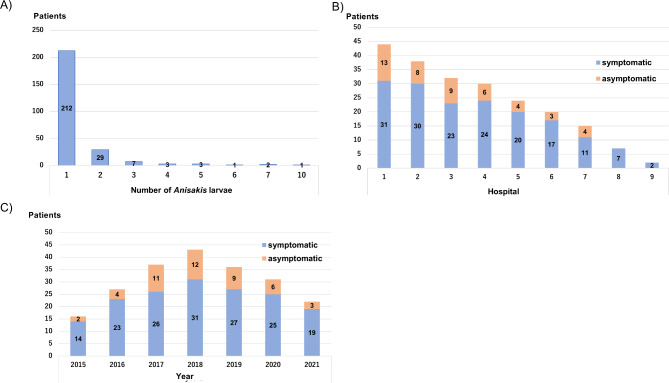
One hundred sixty-five patients (77.8%) were diagnosed with abdominal symptoms, whereas 47 (22.2%) were asymptomatic. Older age, male sex, diabetes mellitus, gastric mucosal atrophy, and gastric mucosal atrophy of the Anisakis penetrating area were significantly more common in the asymptomatic group than in the symptomatic group. Multivariate analysis revealed that age (p = 0.007), sex (p = 0.017), and presence or absence of mucosal atrophy (p = 0.033) were independent factors for the occurrence of acute abdominal symptoms. In addition, cases that were Helicobacter pylori naïve, with an elevation of white blood cells, or without an elevation of eosinophils were more common in the symptomatic group than in the asymptomatic group.
Age, sex, and presence or absence of gastric mucosal atrophy were the clinical factors associated with the occurrence of acute abdominal symptoms. Older and male patients and those with gastric mucosal atrophy were less likely to show abdominal symptoms. The mechanisms of the occurrence of symptoms induced by gastric anisakiasis remain unclear; however, our results will help clarify this issue in the future.
胃内异尖线虫病通常会引起严重的腹部症状;然而,我们在食管胃十二指肠镜检查中偶然发现了无症状的胃内异尖线虫病病例。导致胃内异尖线虫病引起急性腹痛症状的相关因素尚不清楚。因此,本研究旨在通过比较有症状和无症状病例,探讨与胃内异尖线虫病腹部症状相关的临床因素。
这是一项回顾性队列研究,纳入了 2015 年 10 月至 2021 年 10 月在日本 9 家医院诊断为胃内异尖线虫病的 264 例患者。我们分析了患者的病历和内镜图像,并比较了有症状和无症状组的临床因素。
165 例(77.8%)患者被诊断为有腹部症状,而 47 例(22.2%)为无症状。无症状组中年龄较大、男性、糖尿病、胃黏膜萎缩和异尖线虫穿透区的胃黏膜萎缩更为常见。多变量分析显示,年龄(p=0.007)、性别(p=0.017)和黏膜萎缩的存在与否(p=0.033)是发生急性腹痛症状的独立因素。此外,在有症状组中,幽门螺杆菌初治、白细胞升高或无嗜酸性粒细胞升高的病例更为常见。
年龄、性别和胃黏膜萎缩的存在与否是与急性腹痛症状发生相关的临床因素。年龄较大和男性患者以及存在胃黏膜萎缩的患者不太可能出现腹部症状。胃内异尖线虫病引起症状的发生机制尚不清楚;然而,我们的研究结果将有助于在未来阐明这一问题。