Kotrschal Alexander, Szorkovszky Alexander, Herbert-Read James, Bloch Natasha I, Romenskyy Maksym, Buechel Séverine Denise, Eslava Ada Fontrodona, Alòs Laura Sánchez, Zeng Hongli, Le Foll Audrey, Braux Ganaël, Pelckmans Kristiaan, Mank Judith E, Sumpter David, Kolm Niclas
Department of Zoology/Ethology, Stockholm University, Stockholm, Sweden.
Behavioural Ecology, Wageningen University, Wageningen, Netherlands.
Sci Adv. 2020 Dec 2;6(49). doi: 10.1126/sciadv.aba3148. Print 2020 Dec.
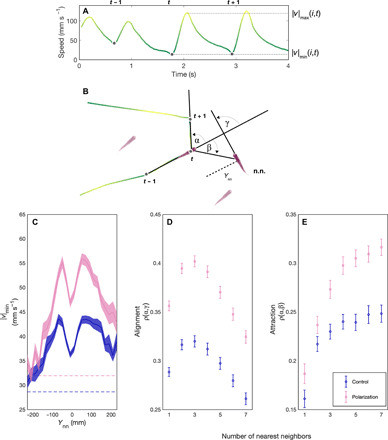
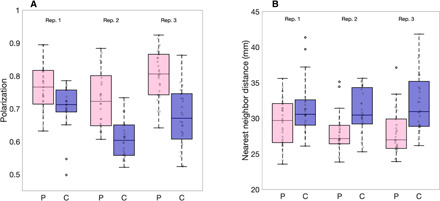
Collective motion occurs when individuals use social interaction rules to respond to the movements and positions of their neighbors. How readily these social decisions are shaped by selection remains unknown. Through artificial selection on fish (guppies, ) for increased group polarization, we demonstrate rapid evolution in how individuals use social interaction rules. Within only three generations, groups of polarization-selected females showed a 15% increase in polarization, coupled with increased cohesiveness, compared to fish from control lines. Although lines did not differ in their physical swimming ability or exploratory behavior, polarization-selected fish adopted faster speeds, particularly in social contexts, and showed stronger alignment and attraction responses to multiple neighbors. Our results reveal the social interaction rules that change when collective behavior evolves.
当个体利用社会互动规则对邻居的运动和位置做出反应时,就会发生集体运动。这些社会决策在多大程度上容易受到选择的影响仍然未知。通过对鱼类(孔雀鱼)进行人工选择以增加群体极化,我们证明了个体使用社会互动规则的方式会迅速进化。与对照品系的鱼相比,在仅三代之内,经过极化选择的雌性群体的极化增加了15%,同时凝聚力也增强了。尽管品系在其物理游泳能力或探索行为方面没有差异,但经过极化选择的鱼采用了更快的速度,尤其是在社会环境中,并且对多个邻居表现出更强的对齐和吸引反应。我们的结果揭示了集体行为进化时会发生变化的社会互动规则。