Department of Medicine, The Ottawa Hospital, Ottawa, Canada.
Weight Management Clinic, The Ottawa Hospital, Ottawa, Canada.
Sci Rep. 2023 Jul 19;13(1):11629. doi: 10.1038/s41598-023-38683-9.
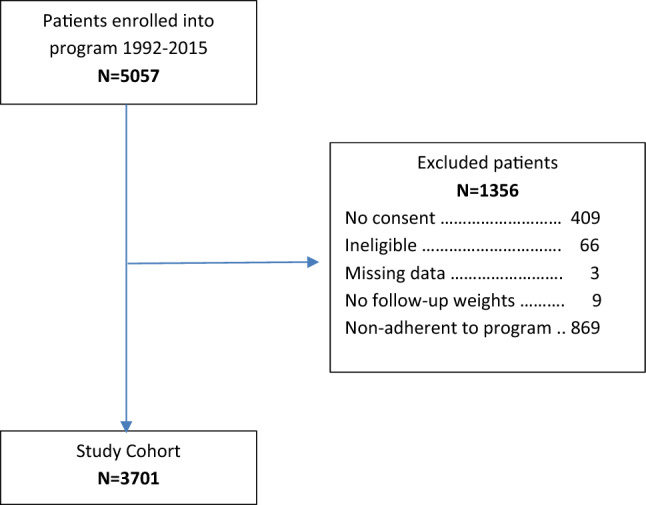
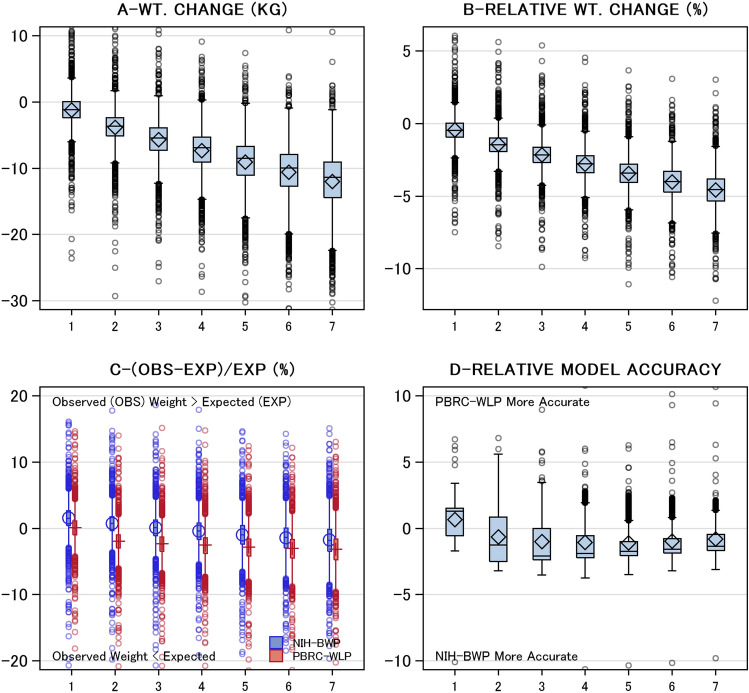
Models predicting individual body weights over time clarify patient expectations in weight loss programs. The accuracy of two commonly used weight prediction models in community living people is unclear. All eligible people entering a weight management program between 1992 and 2015 were included. Patients' diet was 1200 kcal/day for week 0 followed by 900 kcal/day for weeks 1-7 and were excluded from the analysis if they were nonadherent. We generated expected weights using the National Institutes of Health Body Weight Planner (NIH-BWP) and the Pennington Biomedical Research Center Weight Loss Predictor (PBRC-WLP). 3703 adherent people were included (mean age 46 years, 72.6% women, mean [SD] weight 262.3 pounds [54.2], mean [SD] BMI 42.4 [7.6]). Mean (SD) relative body weight differences (100*[observed-expected]/expected) for NIH-BWP and PBRC-WLP models was - 1.5% (3.8) and - 2.9% (3.2), respectively. At week 7, mean squared error with NIH-BWP (98.8, 83%CI 89.7-108.8) was significantly lower than that with PBRC-WLP (117.7, 83%CI 112.4-123.4). Notable variation in relative weight difference were seen (for NIH-BWP, 5th-95th percentile was - 6.2%, + 3.7%; Δ 9.9%). During the first 7 weeks of a weight loss program, both weight prediction models returned expected weights that were very close to observed values with the NIH-BWP being more accurate. However, notable variability between expected and observed weights in individual patients were seen. Clinicians can monitor patients in weight loss programs by comparing their progress with these data.
模型预测个体体重随时间的变化,可以明确减肥计划中患者的预期。在社区生活人群中,两种常用的体重预测模型的准确性尚不清楚。本研究纳入了 1992 年至 2015 年间参加体重管理计划的所有符合条件的患者。患者的饮食方案为第 0 周摄入 1200 千卡/天,第 1 至 7 周摄入 900 千卡/天,如果患者不遵守饮食方案,则将其排除在分析之外。我们使用美国国立卫生研究院体重计划器(NIH-BWP)和彭宁顿生物医学研究中心体重减轻预测器(PBRC-WLP)生成预期体重。共纳入 3703 名依从性患者(平均年龄 46 岁,72.6%为女性,平均[标准差]体重为 262.3 磅[54.2],平均[标准差]BMI 为 42.4[7.6])。NIH-BWP 和 PBRC-WLP 模型的平均(标准差)相对体重差异(100*[观察值-预期值]/预期值)分别为-1.5%(3.8)和-2.9%(3.2)。第 7 周时,NIH-BWP 的均方误差为 98.8(83%CI 89.7-108.8),显著低于 PBRC-WLP 的 117.7(83%CI 112.4-123.4)。NIH-BWP 预测体重的相对差异存在显著差异(第 5 至 95 百分位数为-6.2%,+3.7%;差值为 9.9%)。在减肥计划的前 7 周,两种体重预测模型的预期体重都非常接近观察值,NIH-BWP 更准确。然而,在个体患者中,预期体重与观察体重之间存在显著差异。临床医生可以通过将患者的进展与这些数据进行比较,来监测减肥计划中的患者。