Division of Endocrinology, Department of Medicine, University of Ottawa, OTTAWA, Canada.
Epidemiology and Community Medicine, Ottawa Hospital Research Institute, University of Ottawa, Carling Ave, Ottawa, ON, ASB1-003 1053K1Y 4E9, Canada.
Sci Rep. 2024 Aug 5;14(1):18120. doi: 10.1038/s41598-024-68454-z.
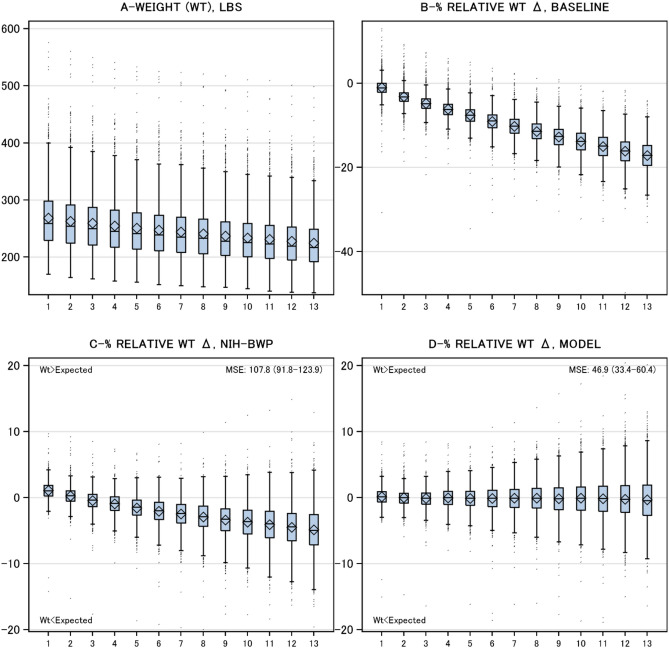
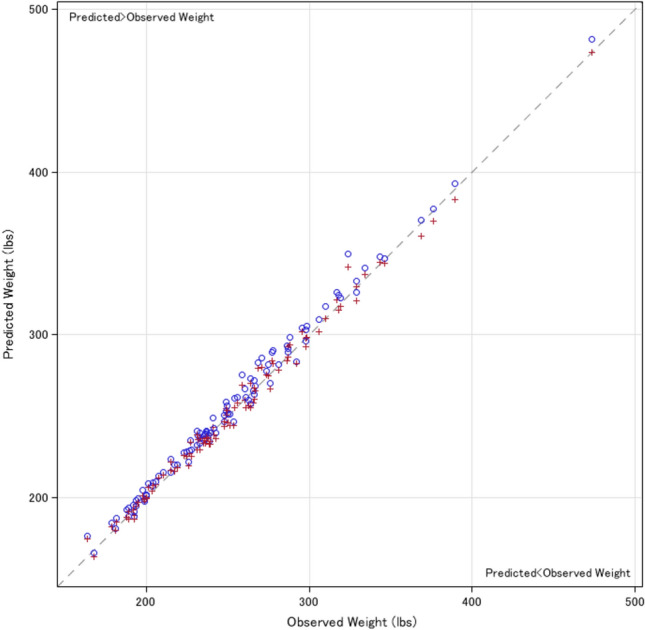
Accurate weight predictions are essential for weight management program patients. The freely available National Institutes of Health Body Weight Planner (NIH-BWP) returns expected weights over time but overestimates weight when patients consume a low-calorie diet. This study sought to increase the accuracy of NIH-BWP predicted weights for people on low-calorie diets. People enrolled in a weight management program were included if they received meal replacements with defined caloric content for the 3 months of the weight loss phase of the program. The Ottawa Weight Loss Prediction Model (OWL-PM) modelled the relative difference between observed and NIH-BWP predicted weights using longitudinal analysis methods based on patient factors. OWL-PM was externally validated. 1761 people were included (mean age 46 years, 73.3% women) with a mean (SD) baseline weight in pounds and body mass index of 271.9 (55.6) and 43.9 (7.4), respectively. At the end of the program's weight loss phase, people lost a median (IQR) of 17.1% (14.8-19.5) of their baseline weight. Observed weight relative to NIH-BWP predicted weights had a median value of - 4.9% but ranged from - 32.1% to + 28.5%. After adjustment, weight overestimation by NIH-BWP was most pronounced in male patients, people without diabetes and with increased observation time. OWL-PM returned expected weights at 3 months that were significantly more accurate than those from NIH-BWP alone (mean difference observed vs. expected [95% CI] 6.7lbs [6.4-7.0] vs. 12.6lbs [12.1-13.0]). In the external validation cohort (n = 106), OWL-PM was significantly more accurate than NIH-BWP (mean squared error 24.3 vs. 40.0, p = 0.0018). OWL-PM incorporated patient-level covariates to significantly increase weight prediction accuracy of NIH-BWP in patients consuming a low-calorie diet.
准确的体重预测对于体重管理计划的患者至关重要。免费的国立卫生研究院体重预测器(NIH-BWP)可以根据时间预测预期体重,但当患者摄入低热量饮食时会高估体重。本研究旨在提高 NIH-BWP 对低热量饮食人群体重预测的准确性。如果患者在体重管理计划的减肥阶段接受了 3 个月热量明确的代餐,则纳入该研究。渥太华减肥预测模型(OWL-PM)使用基于患者因素的纵向分析方法,对观察体重与 NIH-BWP 预测体重之间的相对差异进行建模。OWL-PM 进行了外部验证。共纳入 1761 人(平均年龄 46 岁,73.3%为女性),基线体重(磅)和体重指数(BMI)的平均值(标准差)分别为 271.9(55.6)和 43.9(7.4)。在计划减肥阶段结束时,参与者平均体重减轻了基线体重的 17.1%(14.8-19.5)。观察体重与 NIH-BWP 预测体重的中位数比值为-4.9%,但范围为-32.1%至+28.5%。调整后,NIH-BWP 的体重高估在男性患者、无糖尿病且观察时间延长的患者中最为明显。OWL-PM 在 3 个月时返回的预期体重明显比 NIH-BWP 单独预测的体重更准确(观察值与预期值的差值的平均值[95%CI]为 6.7 磅[6.4-7.0] vs. 12.6 磅[12.1-13.0])。在外部验证队列(n=106)中,OWL-PM 比 NIH-BWP 更准确(均方误差 24.3 与 40.0,p=0.0018)。OWL-PM 纳入了患者水平的协变量,显著提高了 NIH-BWP 在低热量饮食人群中的体重预测准确性。