
目标设定与体重减轻之间的关联:社区减肥计划的前瞻性分析。
The Association Between Goal Setting and Weight Loss: Prospective Analysis of a Community Weight Loss Program.
机构信息
Nuffield Department of Primary Care Health Sciences, University of Oxford, Oxford, United Kingdom.
NIHR Oxford Biomedical Research Centre, Oxford University Hospitals NHS Foundation Trust, Oxford, United Kingdom.
出版信息
J Med Internet Res. 2023 Jul 5;25:e43869. doi: 10.2196/43869.
BACKGROUND
Goal setting aids health-related behavior changes; however, the influence of different types of goals on weight loss remains unclear.
OBJECTIVE
We aimed to investigate the association of 3 aspects of goal setting with weight and program dropout over a 24-week period.
METHODS
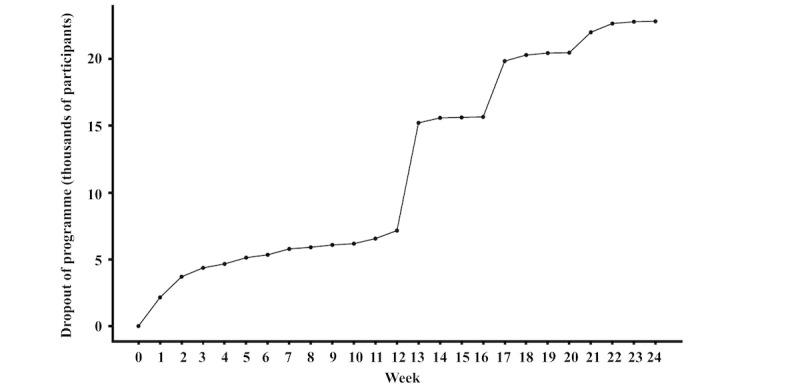
This study was a prospective longitudinal analysis of participants in a 12-week digital behavioral weight loss program. Weight and engagement data for eligible participants (N=36,794) were extracted from the database. Eligible participants were adults in the United Kingdom who had enrolled in the program, had a BMI ≥25 kg/m, and a weight reading recorded at baseline. Three aspects of goal setting were self-reported at enrollment: weight loss motivation (appearance, health, fitness, or self-efficacy), overall goal preference (low, medium, or high), and percentage weight loss goal (<5%, 5%-10%, or >10%). Weight was measured at 4, 12, and 24 weeks. Mixed models for repeated measures were used to explore the association between goals and weight across the 24-week period. To measure sustained weight change, the primary outcome was weight at 24 weeks. We explored dropout rates over the 24-week period by goal and whether engagement mediated the association between goals and weight loss.
RESULTS
Of the 36,794 participants (mean 46.7, SD 11.1 years; 33,902/36,794, 92.14% female) included in the cohort, 13.09% (n=4818) reported weight at 24 weeks. Most participants set goals of 5%-10% weight loss (23,629/36,794, 64.22%), but setting goals for >10% was associated with greater weight loss (mean difference 5.21 kg, 95% CI 5.01-5.41; P<.001). There was no difference between goals of 5%-10% and <5% (mean difference 0.59 kg, 95% CI 0.00-1.18; P=.05). Appearance was the most prevalent motivational factor (14,736/36,794, 40.05%), but health and fitness were associated with greater weight losses (mean difference health vs appearance 1.40 kg, 95% CI 1.15-1.65; P<.001 and mean difference fitness vs appearance 0.38 kg, 95% CI 0.05-0.70; P=.03). Goal preference had no association with weight. Engagement was an independent predictor of weight loss but not a mediator of the effect of goal setting. At 24 weeks, those who set goals of >10% were less likely to drop out compared with 5%-10% goals (odds ratio [OR] 0.40, 95% CI 0.38-0.42; P<.001); those who liked to set overall high goals were more likely to drop out compared with medium goals (OR 1.20, 95% CI 1.11-1.29; P<.001); and those motivated by fitness or health were less likely to drop out compared with appearance (OR 0.92, 95% CI 0.85-0.995; P=.04 and OR 0.84, 95% CI 0.78-0.89; P<.001, respectively).
CONCLUSIONS
Setting higher weight loss goals and being motivated by health or fitness were associated with greater weight loss and lower likelihood of dropout. Randomized trials for setting these types of goals are required to confirm causality.
背景
目标设定有助于促进与健康相关的行为改变,但不同类型的目标对减肥的影响尚不清楚。
目的
我们旨在研究目标设定的 3 个方面与 24 周体重和项目退出率之间的关系。
方法
这是一项对参加为期 12 周的数字行为减肥计划的参与者进行的前瞻性纵向分析。从数据库中提取了符合条件的参与者(N=36794)的体重和参与数据。符合条件的参与者为英国成年人,已注册该计划,BMI≥25 kg/m2,并且在基线时记录了体重读数。目标设定的 3 个方面在注册时报告:减肥动机(外貌、健康、健身或自我效能)、总体目标偏好(低、中、高)和体重减轻目标百分比(<5%、5%-10%或>10%)。体重在第 4、12 和 24 周进行测量。使用重复测量混合模型探索 24 周期间目标与体重之间的关系。为了衡量持续的体重变化,主要结果是 24 周时的体重。我们通过目标和参与度是否介导目标与体重减轻之间的关系来探索 24 周期间的退出率。
结果
在包含的 36794 名参与者(平均年龄 46.7,标准差 11.1 岁;33902/36794,92.14%为女性)中,13.09%(n=4818)报告了 24 周时的体重。大多数参与者设定了 5%-10%的体重减轻目标(23629/36794,64.22%),但设定>10%的目标与更大的体重减轻相关(平均差异 5.21kg,95%置信区间 5.01-5.41;P<.001)。5%-10%和<5%的目标之间没有差异(平均差异 0.59kg,95%置信区间 0.00-1.18;P=.05)。外貌是最常见的激励因素(14736/36794,40.05%),但健康和健身与更大的体重减轻相关(健康与外貌的平均差异 1.40kg,95%置信区间 1.15-1.65;P<.001和健身与外貌的平均差异 0.38kg,95%置信区间 0.05-0.70;P=.03)。目标偏好与体重无关。参与度是体重减轻的独立预测因素,但不是目标设定效果的中介因素。24 周时,与设定 5%-10%目标的人相比,设定>10%目标的人退出的可能性更小(比值比[OR]0.40,95%置信区间 0.38-0.42;P<.001);与设定中等目标的人相比,喜欢设定总体高目标的人更有可能退出(OR 1.20,95%置信区间 1.11-1.29;P<.001);与以外貌为动机的人相比,以健康或健身为动机的人更不可能退出(OR 0.92,95%置信区间 0.85-0.995;P=.04 和 OR 0.84,95%置信区间 0.78-0.89;P<.001,分别)。
结论
设定更高的减肥目标和以健康或健身为动机与更大的体重减轻和较低的退出率相关。需要进行设定这些类型目标的随机试验来确认因果关系。


 Zotero 插件