Department of Orthodontics, Peking University School and Hospital of Stomatology, Beijing, China.
National Center of Stomatology & National Clinical Research Center for Oral Diseases & National Engineering Research Center of Oral Biomaterials and Digital Medical Devices, Beijing, China.
BMC Oral Health. 2023 Jul 19;23(1):500. doi: 10.1186/s12903-023-03167-9.
We used three-dimensional (3D) virtual images to undertake a subjective evaluation of how different factors affect the perception of facial asymmetry among orthodontists and laypersons with the aim of providing a quantitative reference for clinics.
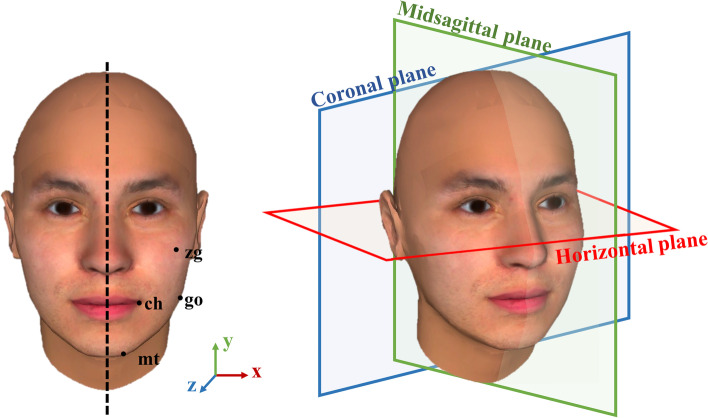
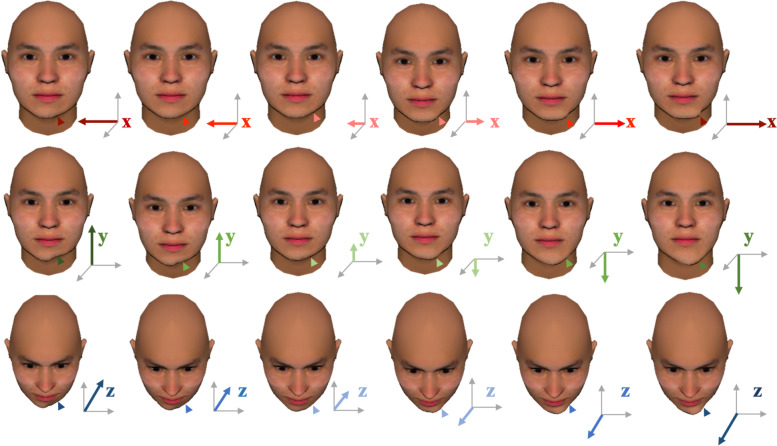
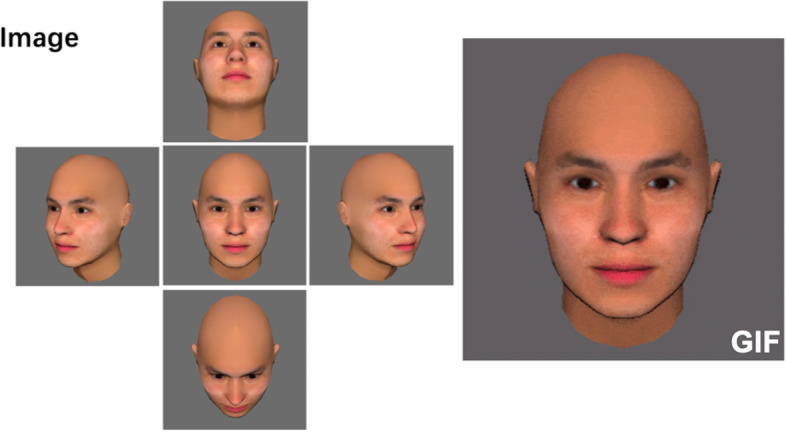
A 3D virtual symmetrical facial image was acquired using FaceGen Modeller software. The left chin, mandible, lip and cheek of the virtual face were simulated in the horizontal (interior/exterior), vertical (up/down), or sagittal (forward or backward) direction in 3, 5, and 7 mm respectively with Maya software to increase asymmetry for the further subjective evaluation. A pilot study was performed among ten volunteers and 30 subjects of each group were expected to be included based on 80% sensitivity in this study. The sample size was increased by 60% to exclude incomplete and unqualified questionnaires. Eventually, a total of 48 orthodontists and 40 laypersons evaluated these images with a 10-point visual analog scale (VAS). The images were presented in random order. Each image would stop for 30 s for observers with a two-second interval between images. Asymmetry ratings and recognition accuracy for asymmetric virtual faces were analyzed to explore how different factors affect the subjective evaluation of facial asymmetry. Multivariate linear regression and multivariate logistic regression models were used for statistical data analysis.
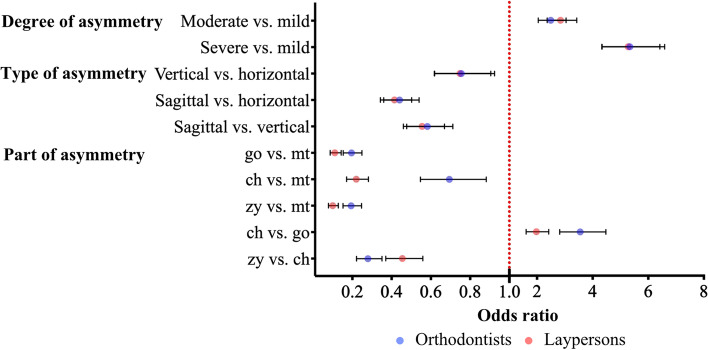
Orthodontists were found to be more critical of asymmetry than laypersons. Our results showed that observers progressively decreased ratings by 1.219 on the VAS scale and increased recognition rates by 2.301-fold as the degree of asymmetry increased by 2 mm; asymmetry in the sagittal direction was the least noticeable compared with the horizontal and vertical directions; and chin asymmetry turned out to be the most sensitive part among the four parts we simulated. Mandible asymmetry was easily confused with cheek asymmetry in the horizontal direction.
The degree, types and parts of asymmetry can affect ratings for facial deformity as well as the accuracy rate of identifying the asymmetrical part. Although orthodontists have higher accuracy in diagnosing asymmetrical faces than laypersons, they fail to correctly distinguish some specific asymmetrical areas.
我们使用三维(3D)虚拟图像,对正畸医生和非专业人士对面部不对称感知的不同影响因素进行主观评估,旨在为临床提供定量参考。
使用 FaceGen Modeller 软件获取 3D 虚拟对称面部图像。使用 Maya 软件,将虚拟面部的左侧下巴、下颌、嘴唇和脸颊分别在水平(内外)、垂直(上下)或矢状(前后)方向上模拟 3、5 和 7mm 的位移,以增加不对称度,进行进一步的主观评估。在 10 名志愿者中进行了预试验研究,预计每组将纳入 30 名受试者,本研究的敏感性为 80%。为排除不完整和不合格的问卷,样本量增加了 60%。最终,共有 48 名正畸医生和 40 名非专业人士对这些图像进行了 10 分制视觉模拟量表(VAS)评估。图像以随机顺序呈现。每个图像会停留 30 秒,观察者之间有两秒钟的间隔。分析不对称虚拟面部的不对称评分和识别准确性,以探讨不同因素如何影响面部不对称的主观评估。采用多元线性回归和多元逻辑回归模型进行统计数据分析。
正畸医生比非专业人士对不对称更挑剔。结果显示,观察者的 VAS 评分逐渐降低 1.219 分,识别率提高 2.301 倍,不对称度增加 2mm;与水平和垂直方向相比,矢状方向的不对称最不明显;在我们模拟的四个部分中,下巴不对称是最敏感的部分。水平方向的下颌不对称容易与脸颊不对称混淆。
不对称的程度、类型和部位会影响对面部畸形的评分以及识别不对称部位的准确率。虽然正畸医生对面部不对称的诊断准确率高于非专业人士,但他们无法正确区分某些特定的不对称区域。