Yona Sri, Edison Chiyar, Nursasi Astuti Yuni, Ismail Rita
Department of Medical Surgical Nursing, Faculty of Nursing, Universitas Indonesia, Depok, West Java, Indonesia.
Department of Community Nursing, Faculty of Nursing, Universitas Indonesia, Depok, West Java, Indonesia.
Belitung Nurs J. 2023 Apr 18;9(2):176-183. doi: 10.33546/bnj.2480. eCollection 2023.
Adherence to antiretroviral therapy (ART) continues to pose a significant challenge for people living with HIV (PLWH). Non-adherence to ART can have far-reaching implications for patient well-being, particularly in increasing the risk of opportunistic infections when medication is not taken as prescribed.
This study aimed to develop a theoretical model that explains how PLWH in Indonesia adhere to their ART regimen and the strategies they follow to maintain adherence.
The study used a grounded theory approach. Data were collected through face-to-face in-depth interviews with 21 PLWH who had been taking ART for six months or more at a non-governmental organization (NGO) in Jakarta, Indonesia, between July 2019 and November 2019. Theoretical sampling was used, and the data analysis method of Corbin and Strauss was utilized, including open coding, axis coding, and selective coding.
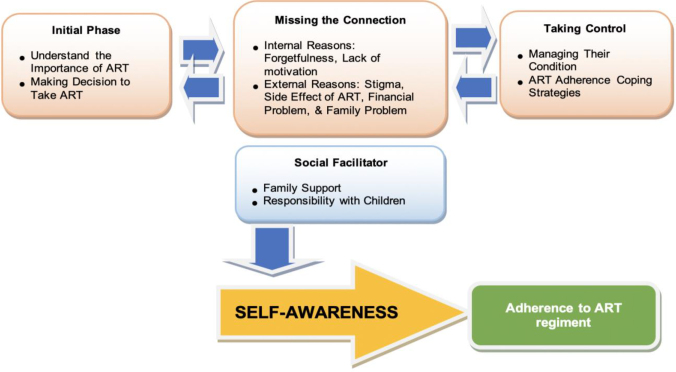
Three stages were identified as a process of adherence to the ART regimen: 1) initiating ART, 2) missing the connection, and 3) taking control. Self-awareness was identified as the central core theme describing the ART adherence process.
Having adequate self-awareness to take ART regularly is crucial to improving adherence to ART. Moreover, social support from one's spouse and family members can help patients maintain adherence. Therefore, self-awareness and support systems should be included as components in nursing interventions when starting ART therapy. In addition, nurses can help identify potential support persons and provide information related to ART therapy.
坚持抗逆转录病毒疗法(ART)对艾滋病毒感染者(PLWH)来说仍然是一项重大挑战。不坚持ART治疗会对患者的健康产生深远影响,尤其是在未按规定服药时增加机会性感染的风险。
本研究旨在建立一个理论模型,解释印度尼西亚的艾滋病毒感染者如何坚持其ART治疗方案以及他们为维持依从性所采取的策略。
本研究采用扎根理论方法。2019年7月至2019年11月期间,通过对印度尼西亚雅加达一家非政府组织中21名接受ART治疗六个月或更长时间的艾滋病毒感染者进行面对面深入访谈来收集数据。采用理论抽样,并运用Corbin和Strauss的数据分析方法,包括开放编码、轴心编码和选择性编码。
确定了坚持ART治疗方案过程的三个阶段:1)开始ART治疗,2)失去联系,3)掌控局面。自我意识被确定为描述ART依从性过程的核心主题。
有足够的自我意识定期服用ART对于提高ART依从性至关重要。此外,配偶和家庭成员的社会支持可以帮助患者维持依从性。因此,在开始ART治疗时,自我意识和支持系统应作为护理干预措施的组成部分。此外,护士可以帮助确定潜在的支持人员并提供与ART治疗相关的信息。