Department of Internal Medicine, Division of Endocrinology, Leiden University Medical Center, Leiden, the Netherlands.
Center for Bone Quality, Leiden University Medical Center, Leiden, the Netherlands.
Orphanet J Rare Dis. 2023 Jul 21;18(1):206. doi: 10.1186/s13023-023-02831-1.
Chronic nonbacterial osteomyelitis (CNO) is a rare, and impactful auto-inflammatory bone disease occurring in children and adults. Clinical care for CNO is challenging, as the condition lacks validated classification criteria and evidence-based therapies. This study aimed to map the current diagnostic and therapeutic practices for CNO in adults, as a first step towards a standardized disease definition and future consensus treatment plans.
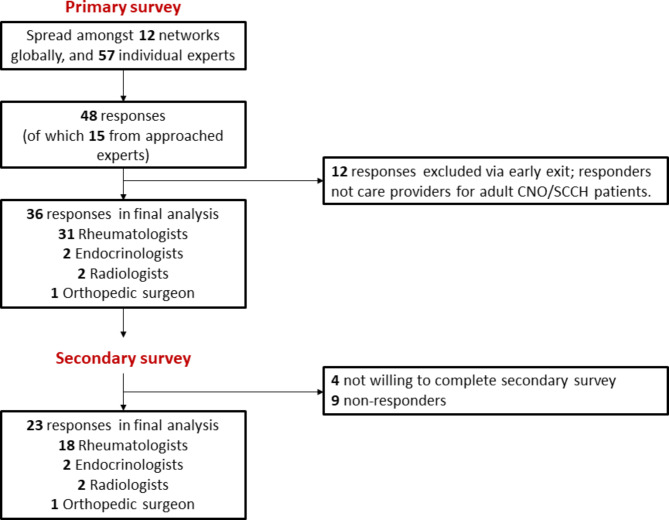
A primary survey was spread among global rheumatological/bone networks and 57 experts as identified from literature (May 2022), covering terminology, diagnostic tools (clinical, radiological, biochemical) and treatment steps. A secondary survey (sent to primary survey responders in August 2022) further queried key diagnostic features, treatment motivations, disease activity and treatment response monitoring.
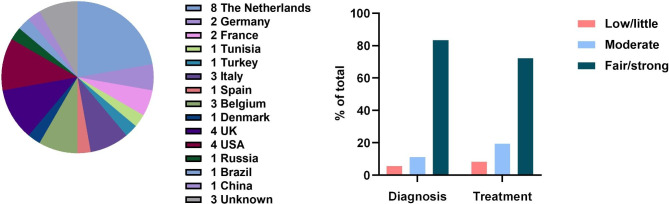
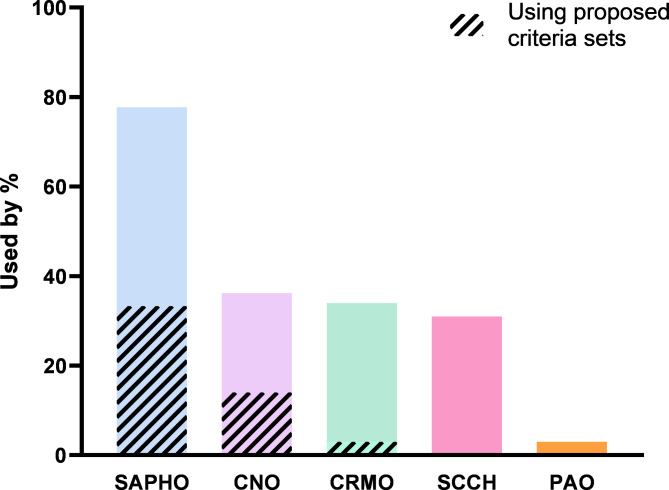
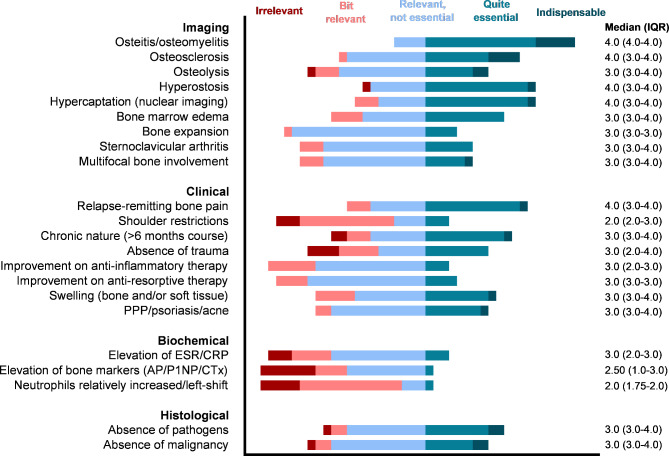
36 and 23 physicians completed the primary and secondary survey respectively. Diagnosis was mainly based on individual physician assessment, in which the combination of chronic relapsing-remitting bone pain with radiologically-proven osteitis/osteomyelitis, sclerosis, hyperostosis and increased isotope uptake on bone scintigraphy were reported indicative of CNO. Physicians appeared more likely to refer to the condition as synovitis, acne, pustulosis, hyperostosis, osteitis (SAPHO) syndrome in the presence of joint and skin pathology. MRI was most frequently performed, and the preferred diagnostic test for 47%. X-rays were second-most frequently used, although considered least informative of all available tools. Typical imaging features reported were hyperostosis, osteitis, osteosclerosis, bone marrow edema, while degeneration, soft tissue calcification, and ankylosis were not regarded characteristic. Inflammation markers and bone markers were generally regarded unhelpful for diagnostic and monitoring purposes and physicians infrequently performed bone biopsies. Management strategies diverged, including indications for treatment, response monitoring and declaration of remission. Step-1 treatment consisted of non-steroidal anti-inflammatory drugs/COX-2 inhibitors (83%). Common step 2-3 treatments were pamidronate, methotrexate, and TNF-a-inhibition (anti-TNFα), the latter two regarded especially convenient to co-target extra-skeletal inflammation in SAPHO syndrome. Overall pamidronate and anti-TNFα and were considered the most effective treatments.
Following from our survey data, adult CNO is a broad and insufficiently characterized disease spectrum, including extra-osseous features. MRI is the favoured imaging diagnostic, and management strategies vary significantly. Overall, pamidronate and anti-TNFα are regarded most successful. The results lay out current practices for adult CNO, which may serve as backbone for a future consensus clinical guideline.
慢性非细菌性骨髓炎(CNO)是一种罕见且影响深远的自身炎症性骨病,发生于儿童和成人。由于缺乏经过验证的分类标准和循证治疗方法,CNO 的临床治疗极具挑战性。本研究旨在绘制成人 CNO 的当前诊断和治疗实践图,以此作为制定标准化疾病定义和未来共识治疗计划的第一步。
2022 年 5 月,通过全球风湿病/骨网络和 57 名文献中确定的专家分发了一份主要调查问卷,涵盖术语、诊断工具(临床、放射学、生化)和治疗步骤。2022 年 8 月向主要调查响应者发送了第二份调查问卷,进一步询问了关键诊断特征、治疗动机、疾病活动度和治疗反应监测。
分别有 36 名和 23 名医生完成了主要和次要调查。诊断主要基于个别医生的评估,报告称慢性复发性骨痛与放射学证实的骨炎/骨髓炎、硬化、骨质增生和骨闪烁扫描中摄取增加相结合,提示 CNO。当存在关节和皮肤病理学时,医生更倾向于将其称为滑膜炎、痤疮、脓疱病、骨质增生、骨炎(SAPHO)综合征。MRI 是最常进行的检查,也是首选的诊断测试,占 47%。X 射线是第二常用的检查,尽管被认为是所有可用工具中最不具信息性的。报告的典型影像学特征是骨质增生、骨炎、骨硬化、骨髓水肿,而退化、软组织钙化和强直则不被认为是特征性的。炎症标志物和骨标志物通常被认为对诊断和监测目的没有帮助,医生很少进行骨活检。管理策略存在差异,包括治疗指征、反应监测和缓解声明。一线治疗包括非甾体抗炎药/环氧化酶-2 抑制剂(83%)。常见的二线和三线治疗药物是帕米膦酸二钠、甲氨蝶呤和 TNF-α 抑制剂(抗 TNFα),后两者被认为特别方便同时针对 SAPHO 综合征的骨骼外炎症。总体而言,帕米膦酸二钠和抗 TNFα 被认为是最有效的治疗方法。
根据我们的调查数据,成人 CNO 是一种广泛且特征不足的疾病谱,包括骨骼外特征。MRI 是首选的影像学诊断方法,管理策略差异很大。总体而言,帕米膦酸二钠和抗 TNFα 被认为是最成功的治疗方法。结果展示了成人 CNO 的当前实践,可为未来的共识临床指南提供基础。