Department of Neurology, Fujita Health University School of Medicine, 1-98 Dengakugakugo, Kutsukake-Cho, Toyoake, Aichi, 470-1192, Japan.
Department of Functional Brain Imaging, Institute for Quantum Medical Science, National Institutes for Quantum Science and Technology, Chiba, Chiba, Japan.
J Neurol. 2023 Nov;270(11):5461-5474. doi: 10.1007/s00415-023-11875-z. Epub 2023 Jul 22.
Parkinson's disease (PD) is associated with cognitive decline through multiple mechanisms, including Alzheimer's disease (AD) pathology and cortical Lewy body involvement. However, its underlying mechanisms remain unclear. Recently, AD-related plasma biomarkers have emerged as potential tools for predicting abnormal pathological protein accumulation. We aimed to investigate the association between AD-related plasma biomarkers and cognitive decline in PD patients.
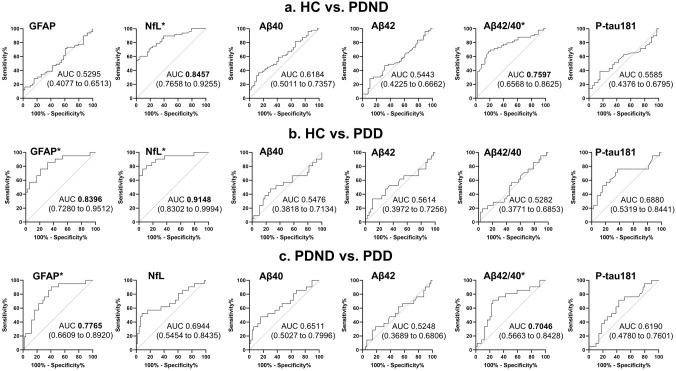
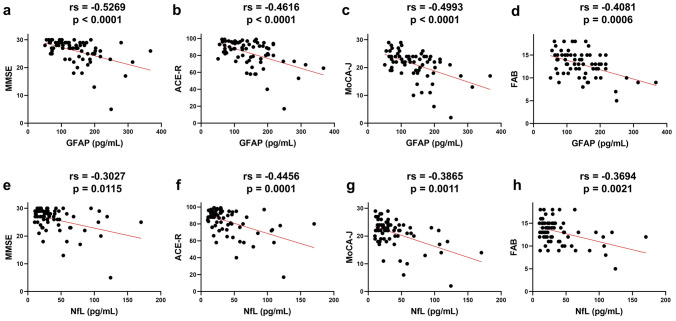
Plasma biomarkers were measured in 70 PD patients (49 with nondemented Parkinson's disease (PDND) and 21 with Parkinson's disease dementia (PDD)) and 38 healthy controls (HCs) using a single-molecule array. The study evaluated (1) the correlation between plasma biomarkers and clinical parameters, (2) receiver operating characteristic curves and areas under the curve to evaluate the discrimination capacity of plasma biomarkers among groups, and (3) a generalized linear model to analyze associations with Addenbrooke's Cognitive Examination-Revised and Montreal Cognitive Assessment-Japanese version scores.
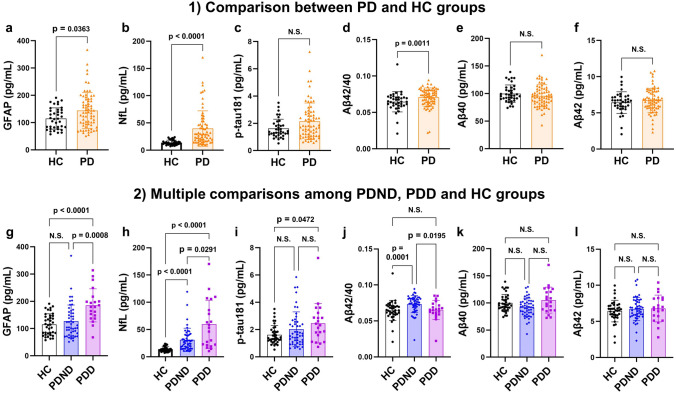
Plasma glial fibrillary acidic protein significantly correlated with cognitive function tests, including all subdomains, with a notable increase in the PDD group compared with the HC and PDND groups, while plasma neurofilament light chain captured both cognitive decline and disease severity in the PDND and PDD groups. Plasma beta-amyloid 42/40 and pholphorylated-tau181 indicated AD pathology in the PDD group, but plasma beta-amyloid 42/40 was increased in the PDND group compared with HCs and decreased in the PDD group compared with the PDND group.
AD-related plasma biomarkers may predict cognitive decline in PD and uncover underlying mechanisms suggesting astrocytic pathologies related to cognitive decline in PD.
帕金森病(PD)通过多种机制与认知能力下降相关,包括阿尔茨海默病(AD)病理和皮质路易体受累。然而,其潜在机制尚不清楚。最近,AD 相关的血浆生物标志物已成为预测异常病理性蛋白积累的潜在工具。我们旨在研究 PD 患者中 AD 相关血浆生物标志物与认知能力下降之间的关系。
使用单分子阵列测量了 70 名 PD 患者(49 名非痴呆性帕金森病(PDND)和 21 名帕金森病痴呆(PDD))和 38 名健康对照者(HCs)的血浆生物标志物。该研究评估了(1)血浆生物标志物与临床参数之间的相关性,(2)接收者操作特征曲线和曲线下面积来评估血浆生物标志物在各组之间的区分能力,(3)广义线性模型来分析与 Addenbrooke 认知评估修订版和蒙特利尔认知评估-日本版评分的关联。
血浆神经胶质纤维酸性蛋白与认知功能测试显著相关,包括所有子域,与 PDD 组相比,HC 和 PDND 组的明显增加,而血浆神经丝轻链在 PDND 和 PDD 组中均捕获了认知能力下降和疾病严重程度。血浆β-淀粉样蛋白 42/40 和磷酸化 tau181 表明 PDD 组存在 AD 病理,但 PDND 组的血浆β-淀粉样蛋白 42/40 增加,与 HCs 相比,PDD 组的血浆β-淀粉样蛋白 42/40 减少。
AD 相关的血浆生物标志物可能预测 PD 中的认知能力下降,并揭示潜在机制,提示与 PD 认知能力下降相关的星形胶质细胞病理学。