Université Nice Côte d'Azur, IRCAN, CNRS, INSERM, Centre Antoine Lacassagne, IHU RespirERA, FHU-Oncoage, Nice, France.
Biomedical Department, Centre Scientifique de Monaco, Monaco, Monaco.
Autophagy. 2023 Oct;19(10):2800-2806. doi: 10.1080/15548627.2023.2214960. Epub 2023 Jul 23.
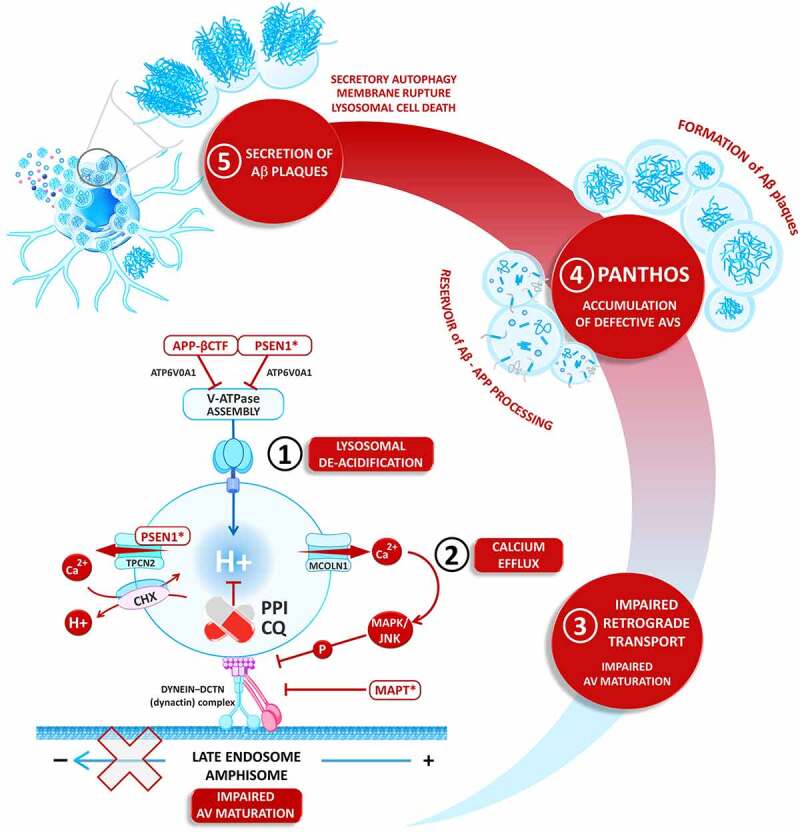
Nearly fifty million older people suffer from neurodegenerative diseases, including Alzheimer (AD) and Parkinson (PD) disease, a global burden expected to triple by 2050. Such an imminent "neurological pandemic" urges the identification of environmental risk factors that are hopefully avoided to fight the disease. In 2022, strong evidence in mouse models incriminated defective lysosomal acidification and impairment of the autophagy pathway as modifiable risk factors for dementia. To date, the most prescribed lysosomotropic drugs are proton pump inhibitors (PPIs), chloroquine (CQ), and the related hydroxychloroquine (HCQ), which belong to the group of disease-modifying antirheumatic drugs (DMARDs). This commentary aims to open the discussion on the possible mechanisms connecting the long-term prescribing of these drugs to the elderly and the incidence of neurodegenerative diseases.: AD: Alzheimer disease; APP-βCTF: amyloid beta precursor protein-C-terminal fragment; BACE1: beta-secretase 1; BBB: brain blood barrier; CHX: Ca/H exchanger; CMI: cognitive mild impairment; CQ: chloroquine; DMARD: disease-modifying antirheumatic drugs; GBA1: glucosylceramidase beta 1; HCQ: hydroxychloroquine; HPLC: high-performance liquid chromatography; LAMP: lysosomal associated membrane protein; MAPK/JNK: mitogen-activated protein kinase; MAPT: microtubule associated protein tau; MCOLN1/TRPML1: mucolipin TRP cation channel 1; NFE2L2/NRF2: NFE2 like bZIP transcription factor 2; NRBF2: nuclear receptor binding factor 2; PANTHOS: poisonous flower; PD: Parkinson disease; PIK3C3: phosphatIdylinositol 3-kinase catalytic subunit type 3; PPI: proton pump inhibitor; PSEN1: presenilin 1, RUBCN: rubicon autophagy regulator; RUBCNL: rubicon like autophagy enhancer; SQSTM1: sequestosome 1; TMEM175: transmembrane protein 175; TPCN2: two pore segment channel 2; VATPase: vacuolar-type H-translocating ATPase; VPS13C: vacuolar protein sorting ortholog 13 homolog C; VPS35: VPS35 retromer complex component; WDFY3: WD repeat and FYVE domain containing 3; ZFYVE1: zinc finger FYVE-type containing 1.
近 5000 万老年人患有神经退行性疾病,包括阿尔茨海默病(AD)和帕金森病(PD),预计到 2050 年,这一全球负担将增加两倍。这种迫在眉睫的“神经流行病”促使人们寻找环境风险因素,希望能够避免这些因素以对抗疾病。2022 年,在小鼠模型中强有力的证据表明,溶酶体酸化缺陷和自噬途径受损是痴呆症的可改变风险因素。迄今为止,最常开的溶酶体靶向药物是质子泵抑制剂(PPIs)、氯喹(CQ)和相关的羟氯喹(HCQ),它们属于疾病修饰抗风湿药物(DMARDs)。本评论旨在就长期开这些药物给老年人和神经退行性疾病发病率之间可能存在的机制展开讨论。: AD:阿尔茨海默病;APP-βCTF:淀粉样前体蛋白-C 端片段;BACE1:β-分泌酶 1;BBB:血脑屏障;CHX:Ca/H 交换器;CMI:认知轻度损害;CQ:氯喹;DMARD:疾病修饰抗风湿药物;GBA1:β-葡糖苷酶β1;HCQ:羟氯喹;HPLC:高效液相色谱;LAMP:溶酶体相关膜蛋白;MAPK/JNK:丝裂原激活蛋白激酶;MAPT:微管相关蛋白 tau;MCOLN1/TRPML1:粘脂素 TRP 阳离子通道 1;NFE2L2/NRF2:NFE2 样 bZIP 转录因子 2;NRBF2:核受体结合因子 2;PANTHOS:毒花;PD:帕金森病;PI3K3:磷脂酰肌醇 3-激酶催化亚单位 3;PPI:质子泵抑制剂;PSEN1:早老素 1,RUBCN:rubicon 自噬调节剂;RUBCNL:rubicon 样自噬增强子;SQSTM1:自噬相关蛋白 1;TMEM175:跨膜蛋白 175;TPCN2:两孔段通道 2;VATPase:液泡型 H-转运 ATP 酶;VPS13C:液泡蛋白分选同源物 13 同源物 C;VPS35:VPS35 逆行复合体成分;WDFY3:WD 重复和 FYVE 结构域包含 3;ZFYVE1:锌指 FYVE 型包含 1。