Shi Yajun, Zhao Yan, Lu Likui, Gao Qinqin, Yu Dongyi, Sun Miao
Key Laboratory of Birth Defect Prevention and Genetic Medicine of Shandong Health Commission, Key Laboratory of Birth Regulation and Control Technology of National Health Commission of China, Center for Medical Genetics and Prenatal Diagnosis, Shandong Provincial Maternal and Child Health Care Hospital Affiliated to Qingdao University, Jinan, Shandong, China.
Institute for Fetology, the First Affiliated Hospital of Soochow University, Suzhou, Jiangsu, China.
Front Neurosci. 2023 Jul 6;17:1223777. doi: 10.3389/fnins.2023.1223777. eCollection 2023.
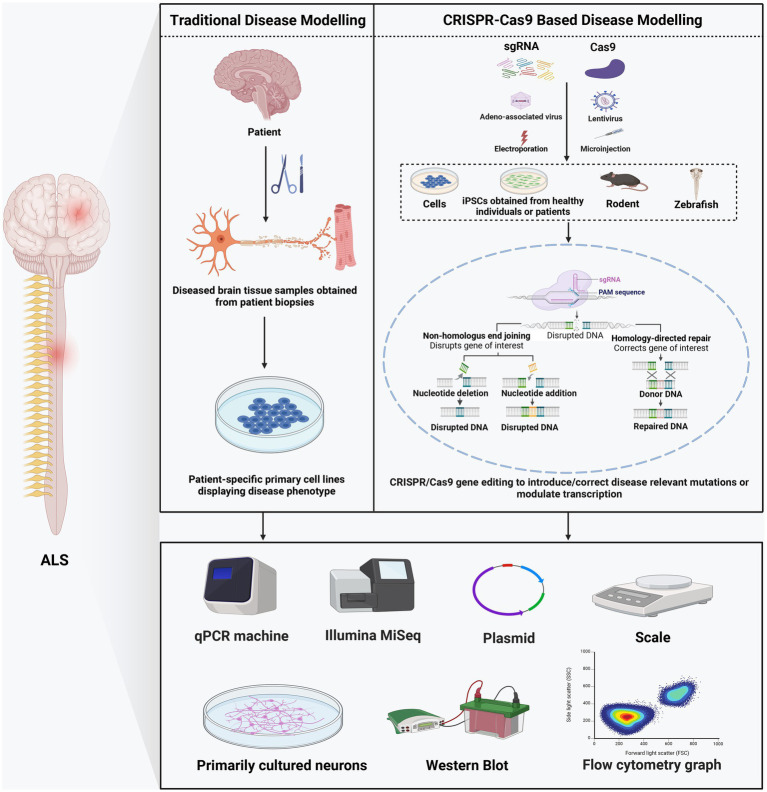
Amyotrophic lateral sclerosis (ALS) is a deadly neurological disease with a complicated and variable pathophysiology yet to be fully understood. There is currently no effective treatment available to either slow or terminate it. However, recent advances in ALS genomics have linked genes to phenotypes, encouraging the creation of novel therapeutic approaches and giving researchers more tools to create efficient animal models. Genetically engineered rodent models replicating ALS disease pathology have a high predictive value for translational research. This review addresses the history of the evolution of gene editing tools, the most recent ALS disease models, and the application of CRISPR/Cas9 against ALS disease.
肌萎缩侧索硬化症(ALS)是一种致命的神经疾病,其病理生理过程复杂多变,尚未完全明确。目前尚无有效的治疗方法来减缓或终止该疾病。然而,ALS基因组学的最新进展已将基因与表型联系起来,这鼓励了新型治疗方法的开发,并为研究人员提供了更多工具来创建高效的动物模型。复制ALS疾病病理学的基因工程啮齿动物模型对转化研究具有很高的预测价值。本文综述了基因编辑工具的发展历程、最新的ALS疾病模型以及CRISPR/Cas9在ALS疾病中的应用。