• 文献检索
  • 文档翻译
  • 深度研究
  • 学术资讯
  • Suppr Zotero 插件Zotero 插件
  • 邀请有礼
  • 套餐&价格
  • 历史记录
应用&插件
Suppr Zotero 插件Zotero 插件浏览器插件Mac 客户端Windows 客户端微信小程序
定价
高级版会员购买积分包购买API积分包
服务
文献检索文档翻译深度研究API 文档MCP 服务
关于我们
关于 Suppr公司介绍联系我们用户协议隐私条款
关注我们

Suppr 超能文献

核心技术专利:CN118964589B侵权必究
粤ICP备2023148730 号-1Suppr @ 2026

文献检索

告别复杂PubMed语法,用中文像聊天一样搜索,搜遍4000万医学文献。AI智能推荐,让科研检索更轻松。

立即免费搜索

文件翻译

保留排版,准确专业,支持PDF/Word/PPT等文件格式,支持 12+语言互译。

免费翻译文档

深度研究

AI帮你快速写综述,25分钟生成高质量综述,智能提取关键信息,辅助科研写作。

立即免费体验

使用人工智能进行远程诊断成像以诊断婴儿髋关节发育不良:一项混合方法可行性初步研究的结果。

Remote diagnostic imaging using artificial intelligence for diagnosing hip dysplasia in infants: Results from a mixed-methods feasibility pilot study.

作者信息

Libon Jackie, Ng Candice, Bailey Allan, Hareendranathan Abhilash, Joseph Reg, Dulai Sukhdeep

机构信息

Health Cities, Edmonton, Alberta.

Department of Family Medicine, University of Alberta, Edmonton, Alberta.

出版信息

Paediatr Child Health. 2023 Apr 12;28(5):285-290. doi: 10.1093/pch/pxad013. eCollection 2023 Aug.

DOI:10.1093/pch/pxad013
PMID:37484038
原文链接:https://pmc.ncbi.nlm.nih.gov/articles/PMC10362962/
Abstract

OBJECTIVES

Infant hip dysplasia or Developmental Dysplasia of the Hip (DDH) occurs in 1-2% of births worldwide and leads to hip arthritis if untreated. We sought to evaluate the feasibility of implementing an artificial intelligence-enhanced portable ultrasound tool for infant hip dysplasia (DDH) screening in primary care, through determining its effectiveness in practice and evaluating patient and provider feedback.

METHODS

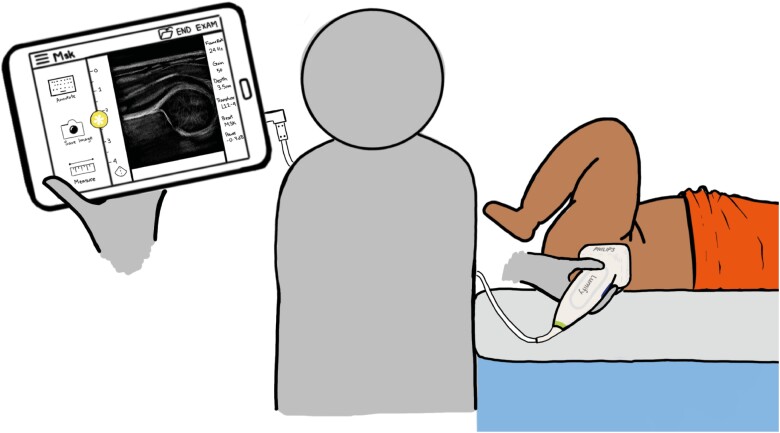
A US-FDA-cleared artificial intelligence (AI) screening device for DDH (MEDO-Hip) was added to routine well-child visits from age 6 to 10 weeks. A total of 306 infants were screened during a 1-year pilot study within three family medicine clinics in Alberta, Canada. Patient and provider satisfaction were quantified using the System Usability Survey (SUS), while provider perceptions were further investigated through semi-structured interviews.

RESULTS

Provider and user surveys commonly identified best features of the tool as immediate diagnosis, offering reassurance/knowledge and avoiding travel, and noted technical glitches most frequently as a barrier. A total of 369 scans of 306 infants were performed from Feb 1, 2021 until Mar 31, 2022. Eighty percent of hips scanned were normal on initial scans, 14% of scans required a follow-up study in the primary care clinic, and DDH cases were identified and treated at the expected 2% rate (6 infants).

CONCLUSIONS

It is feasible to implement a point-of-care ultrasound AI screening tool in primary care to screen for infants with DDH. Beyond improved screening and detection, this innovation was well accepted by patients and fee-for-service providers with a culture and history of innovation.

摘要

目的

婴儿髋关节发育不良或发育性髋关节发育不良(DDH)在全球1%-2%的出生婴儿中出现,若不治疗会导致髋关节关节炎。我们试图通过确定其在实际应用中的有效性并评估患者和医护人员的反馈,来评估在初级保健中使用人工智能增强型便携式超声工具进行婴儿髋关节发育不良(DDH)筛查的可行性。

方法

一种经美国食品药品监督管理局(US-FDA)批准用于DDH筛查的人工智能(AI)设备(MEDO-Hip)被添加到6至10周龄婴儿的常规健康检查中。在加拿大艾伯塔省的三家家庭医学诊所进行的为期1年的试点研究中,共对306名婴儿进行了筛查。使用系统可用性调查(SUS)对患者和医护人员的满意度进行量化,同时通过半结构化访谈进一步调查医护人员的看法。

结果

医护人员和用户调查普遍认为该工具的最佳特性是能够立即诊断、提供安心感/知识并避免出行,且最常指出技术故障是一个障碍。从2021年2月1日至2022年3月31日,共对306名婴儿进行了369次扫描。初始扫描时,80%的髋关节扫描结果正常,14%的扫描需要在初级保健诊所进行后续检查,并且以预期的2%的比例(6名婴儿)识别并治疗了DDH病例。

结论

在初级保健中实施即时超声AI筛查工具来筛查DDH婴儿是可行的。除了改善筛查和检测外,这项创新受到了具有创新文化和历史的患者及按服务收费的医护人员的广泛接受。
https://cdn.ncbi.nlm.nih.gov/pmc/blobs/fc02/10362962/114c8118c036/pxad013_fig1.jpg

相似文献

1
Remote diagnostic imaging using artificial intelligence for diagnosing hip dysplasia in infants: Results from a mixed-methods feasibility pilot study.使用人工智能进行远程诊断成像以诊断婴儿髋关节发育不良:一项混合方法可行性初步研究的结果。
Paediatr Child Health. 2023 Apr 12;28(5):285-290. doi: 10.1093/pch/pxad013. eCollection 2023 Aug.
2
AI aided workflow for hip dysplasia screening using ultrasound in primary care clinics.AI 辅助髋关节发育不良超声筛查在基层医疗机构的工作流程。
Sci Rep. 2023 Jun 7;13(1):9224. doi: 10.1038/s41598-023-35603-9.
3
Cochrane Review: Screening programmes for developmental dysplasia of the hip in newborn infants.Cochrane系统评价:新生儿髋关节发育不良的筛查项目
Evid Based Child Health. 2013 Jan;8(1):11-54. doi: 10.1002/ebch.1891.
4
Interobserver Variability of Hip Dysplasia Indices on Sweep Ultrasound for Novices, Experts, and Artificial Intelligence.髋关节超声扫查中新手、专家和人工智能对髋关节发育不良指标的观察者间变异性。
J Pediatr Orthop. 2022 Apr 1;42(4):e315-e323. doi: 10.1097/BPO.0000000000002065.
5
Screening for developmental dysplasia of the hip: results of a 7-year follow-up study.髋关节发育不良的筛查:一项7年随访研究的结果
Pediatr Int. 2004 Apr;46(2):162-6. doi: 10.1046/j.1442-200x.2004.01855.x.
6
Preventive health care, 2001 update: screening and management of developmental dysplasia of the hip in newborns.预防性保健,2001年更新版:新生儿髋关节发育不良的筛查与管理
CMAJ. 2001 Jun 12;164(12):1669-77.
7
Diagnosis of Developmental Dysplasia of the Hip by Ultrasound Imaging Using Deep Learning.利用深度学习通过超声成像诊断发育性髋关节发育不良
J Pediatr Orthop. 2023 Aug 1;43(7):e538-e544. doi: 10.1097/BPO.0000000000002428. Epub 2023 May 12.
8
Clinical application of artificial intelligence-assisted diagnosis using anteroposterior pelvic radiographs in children with developmental dysplasia of the hip.人工智能辅助前后位骨盆 X 线片在儿童发育性髋关节发育不良中的临床应用。
Bone Joint J. 2020 Nov;102-B(11):1574-1581. doi: 10.1302/0301-620X.102B11.BJJ-2020-0712.R2.
9
Surveillance for Developmental Dysplasia of the Hip in India: Consensus Guidelines From the Pediatric Orthopaedic Society of India, Indian Academy of Pediatrics, National Neonatology Forum of India, Indian Radiological and Imaging Association, Indian Federation of Ultrasound in Medicine and Biology, Federation of Obstetric and Gynaecological Societies of India, and Indian Orthopaedic Association.印度髋关节发育不良监测:印度儿科学会小儿矫形外科学会、印度国家新生儿学论坛、印度放射学和影像学协会、印度医学超声和生物学联合会、印度妇产科学会、印度矫形外科学会的共识指南。
Indian Pediatr. 2022 Aug 15;59(8):626-635. Epub 2022 Mar 28.
10
[Evaluation of screening for developmental dysplasia of the hip in the Liberec region in 1984-2005].[1984 - 2005年利贝雷茨地区髋关节发育不良筛查评估]
Acta Chir Orthop Traumatol Cech. 2009 Jun;76(3):218-24.

引用本文的文献

1
Artificial intelligence in orthopedics: fundamentals, current applications, and future perspectives.骨科中的人工智能:基础、当前应用及未来展望。
Mil Med Res. 2025 Aug 4;12(1):42. doi: 10.1186/s40779-025-00633-z.
2
Opportunities, challenges, and requirements for Artificial Intelligence (AI) implementation in Primary Health Care (PHC): a systematic review.初级卫生保健(PHC)中实施人工智能(AI)的机遇、挑战和要求:一项系统综述
BMC Prim Care. 2025 Jun 9;26(1):196. doi: 10.1186/s12875-025-02785-2.
3
Current and Emerging Applications of Artificial Intelligence in Medical Imaging for Paediatric Hip Disorders-A Scoping Review.

本文引用的文献

1
Use of ultrasonography to evaluate early outcomes of reduction in developmental dysplasia of the hip.超声在评估发育性髋关节发育不良复位早期疗效中的应用。
Pediatr Radiol. 2022 Jul;52(8):1521-1527. doi: 10.1007/s00247-022-05334-6. Epub 2022 Mar 25.
2
Even Experts Can Be Fooled: Reliability of Clinical Examination for Diagnosing Hip Dislocations in Newborns.即使是专家也可能犯错:临床检查诊断新生儿髋关节脱位的可靠性。
J Pediatr Orthop. 2020 Sep;40(8):408-412. doi: 10.1097/BPO.0000000000001602.
3
Developmental Dysplasia of the Hip: An Examination of Care Practices of Pediatric Orthopaedic Surgeons in North America.
人工智能在儿童髋关节疾病医学成像中的当前及新兴应用——一项范围综述
Children (Basel). 2025 May 16;12(5):645. doi: 10.3390/children12050645.
4
Artificial Intelligence (AI) Applications for Point of Care Ultrasound (POCUS) in Low-Resource Settings: A Scoping Review.资源匮乏环境下人工智能在床旁超声中的应用:一项范围综述
Diagnostics (Basel). 2024 Aug 1;14(15):1669. doi: 10.3390/diagnostics14151669.
5
Point-of-Care Ultrasound-History, Current and Evolving Clinical Concepts in Emergency Medicine.即时超声医学——急诊医学的历史、现状和不断发展的临床理念。
Medicina (Kaunas). 2023 Dec 15;59(12):2179. doi: 10.3390/medicina59122179.
发育性髋关节发育不良:北美小儿骨科医生的护理实践考察
J Pediatr Orthop. 2020 Apr;40(4):e248-e255. doi: 10.1097/BPO.0000000000001505.
4
Promoting innovation in healthcare.推动医疗保健领域的创新。
Future Healthc J. 2017 Jun;4(2):121-125. doi: 10.7861/futurehosp.4-2-121.
5
The epidemiology and demographics of hip dysplasia.髋关节发育不良的流行病学和人口统计学
ISRN Orthop. 2011 Oct 10;2011:238607. doi: 10.5402/2011/238607. eCollection 2011.
6
The costs of late detection of developmental dysplasia of the hip.髋关节发育不良延迟诊断的代价。
J Child Orthop. 2014 Aug;8(4):325-32. doi: 10.1007/s11832-014-0599-7. Epub 2014 Jun 29.
7
Cochrane Review: Screening programmes for developmental dysplasia of the hip in newborn infants.Cochrane系统评价:新生儿髋关节发育不良的筛查项目
Evid Based Child Health. 2013 Jan;8(1):11-54. doi: 10.1002/ebch.1891.
8
To screen or not to screen? A decision analysis of the utility of screening for developmental dysplasia of the hip.筛查还是不筛查?关于髋关节发育不良筛查效用的决策分析
J Bone Joint Surg Am. 2009 Jul;91(7):1705-19. doi: 10.2106/JBJS.H.00122.
9
Periodic health examination, 1990 update: 4. Well-baby care in the first 2 years of life. Canadian Task Force on the Periodic Health Examination.定期健康检查,1990年更新版:4. 生命最初2年的婴儿保健。加拿大定期健康检查特别工作组。
CMAJ. 1990 Nov 1;143(9):867-72.