Nagasaki Kazuya, Kaji Yuki, Wada Yoshiki, Sasaki Takafumi
Department of Internal Medicine, Mito Kyodo General Hospital University of Tsukuba Ibaraki Japan.
Department of General Medicine International University of Health and Welfare Narita Hospital Chiba Japan.
J Gen Fam Med. 2023 Apr 11;24(4):207-214. doi: 10.1002/jgf2.622. eCollection 2023 Jul.
Drugs are a major source of greenhouse gas (GHG) emissions from healthcare systems. Pressurized metered-dose inhalers (pMDIs) have raised concerns over their environmental impact due to GHG emissions. Evaluations and reduction strategies for GHGs have been primarily studied in Europe, but not in other regions, including Japan. Therefore, our objective was to calculate the carbon footprint of inhalers in Japan and evaluate their reduction scenarios.
Using the National Database of Health Insurance Claims, our analysis was conducted on inhaler prescriptions in Japan for the fiscal year of 2019. We calculated the number of inhalers used, GHG emissions, and total costs. Next, we simulated the environmental and economic impacts of three reduction scenarios: the first scenario replaced pMDI with dry power inhalers, followed by age-based replacements. In the last scenario, we replaced pMDI with a propellant with a lower global warming potential.
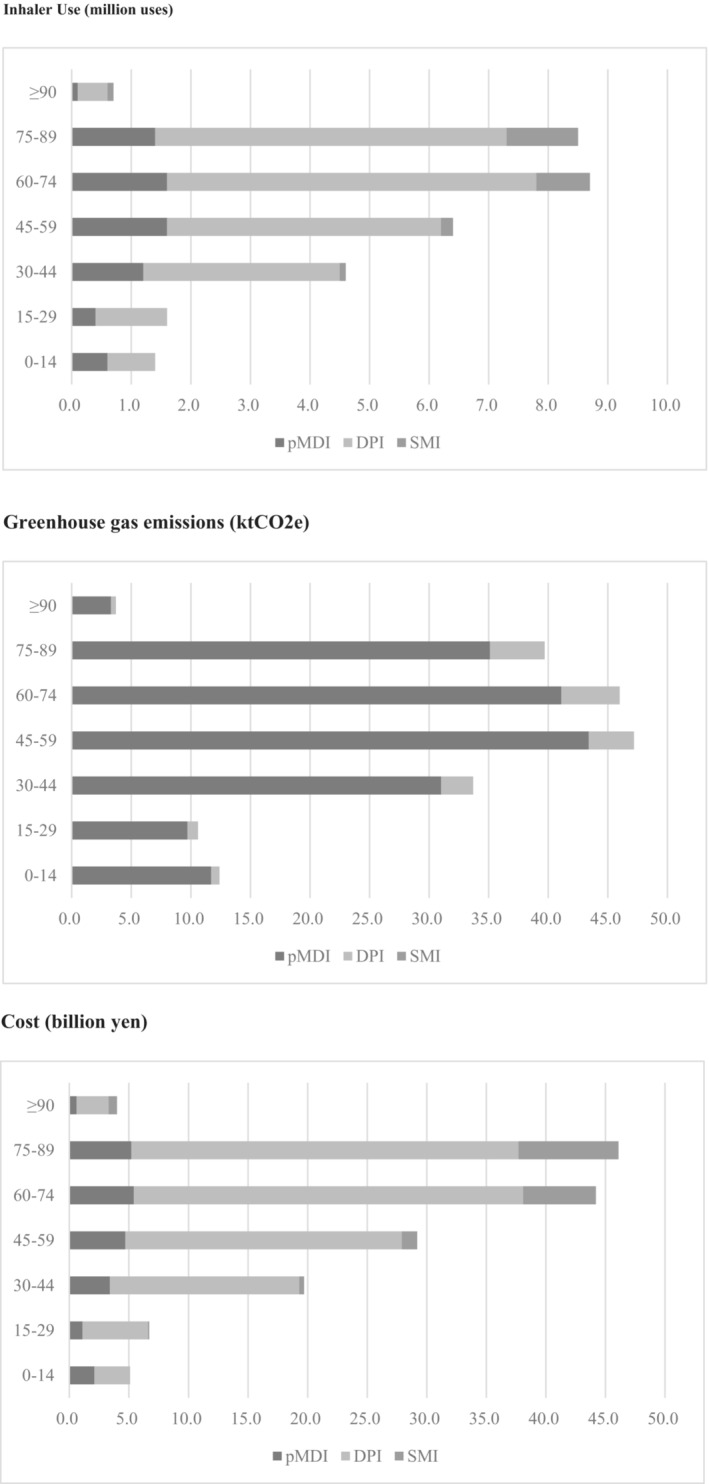
All inhaler-related GHG emissions were 202 ktCOe, of which 90.9% were attributed to pMDI use. Scenario analysis demonstrated that replacing 10% pMDI with DPI would reduce emissions by 6.7%, with a relatively modest increase in cost; substituting 10% of pMDI used by adults (excluding children and older adults) with alternative inhalers would reduce emissions by 6.1%, with a 0.7% increase in cost; and, replacing 10% of pMDI propellants with lower global warming potential would reduce emissions by 9.3%.
Selecting appropriate inhalers can mitigate GHG emissions in Japan, but its impact will be less than in other countries. Nevertheless, collaborative efforts between physicians, patients, and pharmaceutical companies are necessary to reduce GHG emissions.
药物是医疗保健系统温室气体(GHG)排放的主要来源。由于温室气体排放,压力定量吸入器(pMDIs)引发了人们对其环境影响的担忧。温室气体的评估和减排策略主要在欧洲进行了研究,但在包括日本在内的其他地区尚未开展。因此,我们的目标是计算日本吸入器的碳足迹并评估其减排方案。
利用全国健康保险索赔数据库,我们对2019财年日本的吸入器处方进行了分析。我们计算了吸入器的使用数量、温室气体排放量和总成本。接下来,我们模拟了三种减排方案的环境和经济影响:第一种方案是用干粉吸入器替代压力定量吸入器,随后按年龄进行替代。在最后一种方案中,我们用全球变暖潜能值较低的推进剂替代压力定量吸入器的推进剂。
所有与吸入器相关的温室气体排放量为202千吨二氧化碳当量,其中90.9%归因于压力定量吸入器的使用。情景分析表明,用干粉吸入器替代10%的压力定量吸入器可使排放量减少6.7%,成本相对适度增加;用替代吸入器替代10%成年人(不包括儿童和老年人)使用的压力定量吸入器可使排放量减少6.1%,成本增加0.7%;用全球变暖潜能值较低的推进剂替代10%的压力定量吸入器推进剂可使排放量减少9.3%。
选择合适的吸入器可以减轻日本的温室气体排放,但其影响将小于其他国家。尽管如此,医生、患者和制药公司之间的合作努力对于减少温室气体排放是必要的。