Aziz Ihwanul, Mulyani Emy, Yusuf Yusril
Department of Physics, Faculty of Mathematics and Natural Science, Universitas Gadjah Mada, Yogyakarta, Indonesia.
Research Center for Accelerator Technology, Research Organization of Nuclear Energy, National Research and Innovation Agency (BRIN), Yogyakarta, 55281, Indonesia.
Heliyon. 2023 Jun 10;9(6):e17170. doi: 10.1016/j.heliyon.2023.e17170. eCollection 2023 Jun.
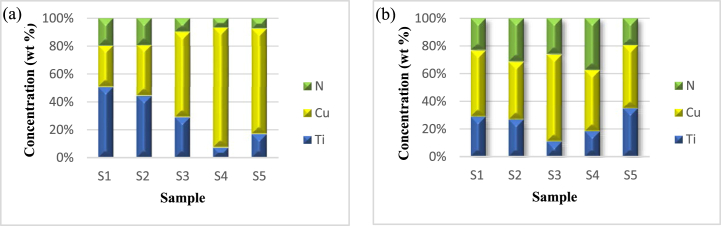
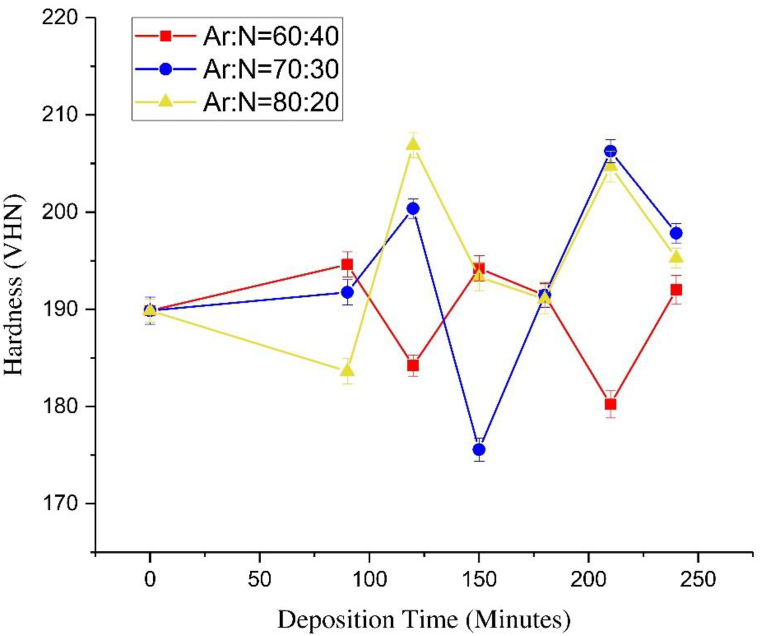
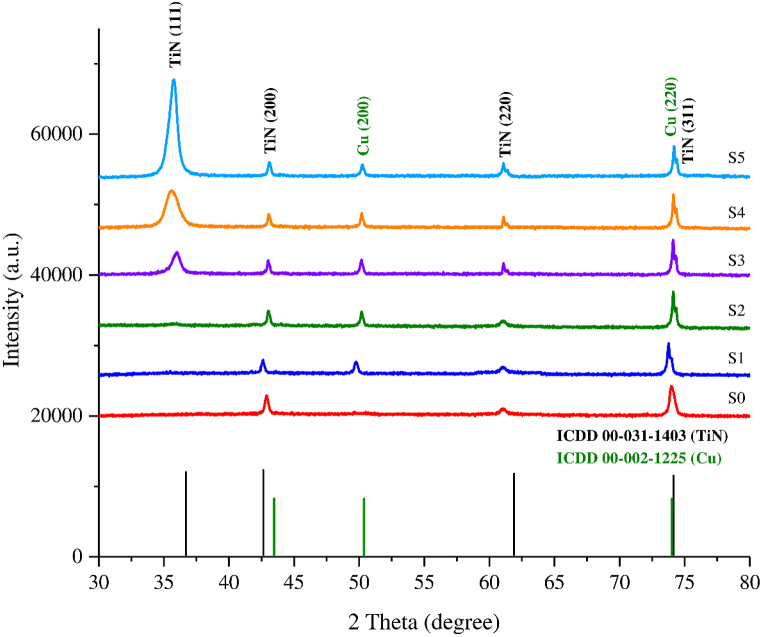
The problems associated with Stainless Steel 316 L (SS 316 L) orthopedic implants, when implanted in the human body, are infection, local inflammation, and the possibility of bacterial growth. In this study, SS 316 L was coated with copper-doped Titanium Nitride (Ti-Cu-N) using the DC Sputtering technique. This Ti-Cu-N film improved the antibacterial performance and mechanical properties of SS 316 L. The Ti-Cu-N films were deposited using reactive DC sputtering with an 80%:20% argon to nitrogen ratio. The source voltage and current were kept constant at 10 kV and 10 mA, respectively. X-Ray Diffraction (XRD) showed that the phases formed were TiN and Cu with FCC crystal structure. Results show that the surfaces of samples containing 44.34 wt% and 54.97 wt% Cu had antibacterial effectiveness against (S. Aureus). The highest hardness value of a Ti-Cu-N layer was 212.032 Vickers Hardness Number (VHN), which was an improvement of 36.63% on the raw material (155.18 VHN). Surface morphology analysis using SEM-EDS was performed on the samples before and after the antibacterial test to investigate the antibacterial mechanism of the surfaces of SS 316 L containing Ti-Cu-N against S. Aureus.
当不锈钢316L(SS 316L)骨科植入物植入人体时,与之相关的问题包括感染、局部炎症以及细菌生长的可能性。在本研究中,采用直流溅射技术在SS 316L表面涂覆了铜掺杂氮化钛(Ti-Cu-N)。这种Ti-Cu-N薄膜改善了SS 316L的抗菌性能和机械性能。Ti-Cu-N薄膜采用反应性直流溅射沉积,氩气与氮气的比例为80%:20%。源电压和电流分别保持在10 kV和10 mA不变。X射线衍射(XRD)表明形成的相为具有面心立方晶体结构的TiN和Cu。结果表明,含44.34 wt%和54.97 wt% Cu的样品表面对金黄色葡萄球菌具有抗菌效果。Ti-Cu-N层的最高硬度值为212.032维氏硬度值(VHN),比原材料(155.18 VHN)提高了36.63%。在抗菌测试前后对样品进行了扫描电子显微镜-能谱(SEM-EDS)表面形貌分析,以研究含Ti-Cu-N的SS 316L表面对金黄色葡萄球菌的抗菌机制。