Chan Yarn Kit, Cheng Ching-Yu, Sabanayagam Charumathi
Ophthalmology and Visual Sciences Academic Clinical Program (Eye ACP), Duke-NUS Medical School, Singapore.
Singapore Eye Research Institute, Singapore National Eye Centre, Singapore.
Taiwan J Ophthalmol. 2023 Jun 13;13(2):151-167. doi: 10.4103/tjo.TJO-D-23-00018. eCollection 2023 Apr-Jun.
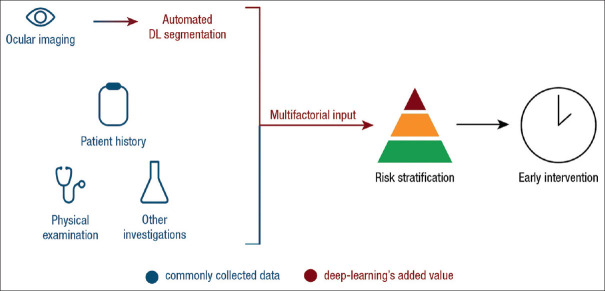
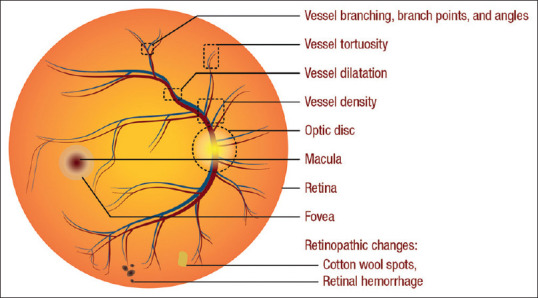
Cardiovascular disease (CVD) is a major cause of mortality and morbidity worldwide and imposes significant socioeconomic burdens, especially with late diagnoses. There is growing evidence of strong correlations between ocular images, which are information-dense, and CVD progression. The accelerating development of deep learning algorithms (DLAs) is a promising avenue for research into CVD biomarker discovery, early CVD diagnosis, and CVD prognostication. We review a selection of 17 recent DLAs on the less-explored realm of DL as applied to ocular images to produce CVD outcomes, potential challenges in their clinical deployment, and the path forward. The evidence for CVD manifestations in ocular images is well documented. Most of the reviewed DLAs analyze retinal fundus photographs to predict CV risk factors, in particular hypertension. DLAs can predict age, sex, smoking status, alcohol status, body mass index, mortality, myocardial infarction, stroke, chronic kidney disease, and hematological disease with significant accuracy. While the cardio-oculomics intersection is now burgeoning, very much remain to be explored. The increasing availability of big data, computational power, technological literacy, and acceptance all prime this subfield for rapid growth. We pinpoint the specific areas of improvement toward ubiquitous clinical deployment: increased generalizability, external validation, and universal benchmarking. DLAs capable of predicting CVD outcomes from ocular inputs are of great interest and promise to individualized precision medicine and efficiency in the provision of health care with yet undetermined real-world efficacy with impactful initial results.
心血管疾病(CVD)是全球范围内导致死亡和发病的主要原因,会带来巨大的社会经济负担,尤其是在诊断较晚的情况下。越来越多的证据表明,信息密集的眼部图像与心血管疾病进展之间存在密切关联。深度学习算法(DLA)的加速发展为心血管疾病生物标志物发现、心血管疾病早期诊断和心血管疾病预后研究提供了一条很有前景的途径。我们综述了17种最近的深度学习算法,这些算法应用于眼部图像以产生心血管疾病相关结果这一较少探索的深度学习领域,探讨它们在临床应用中可能面临的挑战以及未来的发展方向。眼部图像中心血管疾病表现的证据已有充分记录。大多数被综述的深度学习算法通过分析视网膜眼底照片来预测心血管疾病风险因素,尤其是高血压。深度学习算法能够以较高的准确性预测年龄、性别、吸烟状况、饮酒状况、体重指数、死亡率、心肌梗死、中风、慢性肾病和血液疾病。虽然心血管眼科学交叉领域目前正在蓬勃发展,但仍有很多有待探索的地方。大数据可用性的增加、计算能力的提升、技术素养的提高以及人们的接受度,都促使这个子领域快速发展。我们指出了在广泛临床应用方面需要改进的具体领域:提高通用性、外部验证和通用基准测试。能够从眼部输入预测心血管疾病结果的深度学习算法对于个性化精准医疗以及提高医疗保健效率具有重要意义,尽管其在现实世界中的疗效尚未确定,但已取得了有影响力的初步成果。