Department of Medicine, Forrest General Hospital, Hattiesburg, MS, USA.
Emory Clinical Cardiovascular Research Institute, Emory University School of Medicine, Atlanta, GA, USA.
Sci Rep. 2023 Jan 6;13(1):279. doi: 10.1038/s41598-023-27474-x.
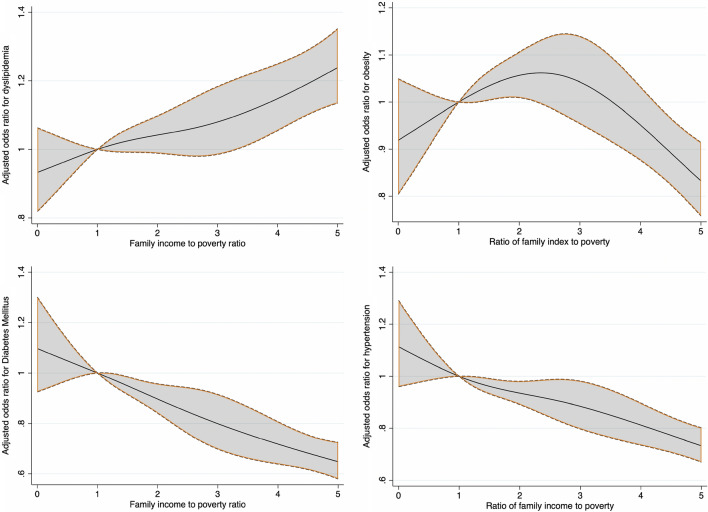
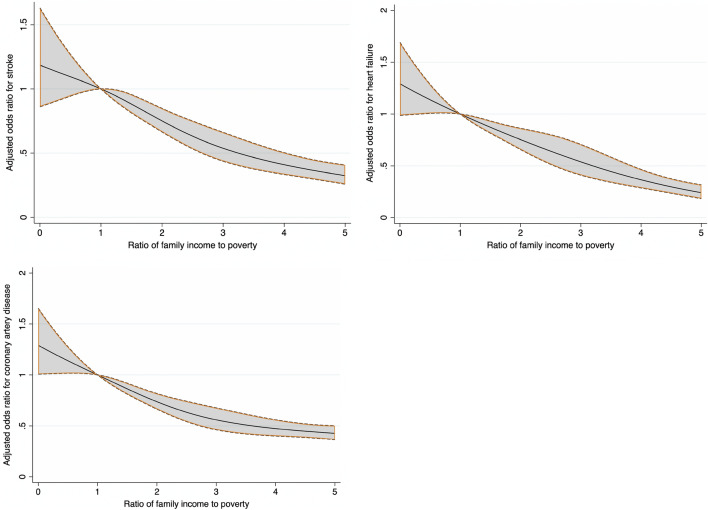
Socioeconomic status is an overlooked risk factor for cardiovascular disease (CVD). Low family income is a measure of socioeconomic status and may portend greater CVD risk. Therefore, we assessed the association of family income with cardiovascular risk factor and disease burden in American adults. This retrospective analysis included data from participants aged ≥ 20 years from the National Health and Nutrition Examination Survey (NHANES) cycles between 2005 and 2018. Family income to poverty ratio (PIR) was calculated by dividing family (or individual) income by poverty guidelines specific to the survey year and used as a measure of socioeconomic status. The association of PIR with the presence of cardiovascular risk factors and CVD as well as cardiac mortality and all-cause mortality was examined. We included 35,932 unweighted participants corresponding to 207,073,472 weighted, nationally representative participants. Participants with lower PIR were often female and more likely to belong to race/ethnic minorities (non-Hispanic Black, Mexican American, other Hispanic). In addition, they were less likely to be married/living with a partner, to attain college graduation or higher, or to have health insurance. In adjusted analyses, the prevalence odds of diabetes mellitus, hypertension, coronary artery disease (CAD), congestive heart failure (CHF), and stroke largely decreased in a step-wise manner from highest (≥ 5) to lowest PIR (< 1). In adjusted analysis, we also noted a mostly dose-dependent association of PIR with the risk of all-cause and cardiac mortality during a mean 5.7 and 5.8 years of follow up, respectively. Our study demonstrates a largely dose-dependent association of PIR with hypertension, diabetes mellitus, CHF, CAD and stroke prevalence as well as incident all-cause mortality and cardiac mortality in a nationally representative sample of American adults. Public policy efforts should be directed to alleviate these disparities to help improve cardiovascular outcomes in vulnerable groups with low family income.
社会经济地位是心血管疾病(CVD)的一个被忽视的风险因素。家庭收入低是社会经济地位的衡量标准,可能预示着更大的 CVD 风险。因此,我们评估了美国家庭收入与心血管风险因素和疾病负担之间的关系。这项回顾性分析包括了来自 2005 年至 2018 年国家健康和营养检查调查(NHANES)周期中年龄≥20 岁的参与者的数据。家庭收入与贫困比率(PIR)是通过将家庭(或个人)收入除以特定于调查年份的贫困标准来计算的,用于衡量社会经济地位。PIR 与心血管风险因素和 CVD 以及心脏死亡率和全因死亡率的关系进行了研究。我们纳入了 35932 个未加权参与者,对应于 207073472 个加权、全国代表性参与者。PIR 较低的参与者通常是女性,更有可能属于少数族裔(非西班牙裔黑人、墨西哥裔美国人、其他西班牙裔)。此外,他们结婚/与伴侣生活的可能性较小,获得大学毕业或更高学历的可能性较小,或者没有医疗保险。在调整分析中,糖尿病、高血压、冠心病(CAD)、充血性心力衰竭(CHF)和中风的患病率几率从最高(≥5)到最低(<1)呈逐步下降。在调整分析中,我们还注意到,在平均 5.7 年和 5.8 年的随访期间,PIR 与全因和心脏死亡率的风险之间存在很大程度上的剂量依赖性关联。我们的研究表明,在一个具有代表性的美国家庭样本中,PIR 与高血压、糖尿病、CHF、CAD 和中风的患病率以及全因死亡率和心脏死亡率之间存在很大程度上的剂量依赖性关联。公共政策努力应致力于减轻这些差异,以帮助改善低收入家庭脆弱群体的心血管结局。