Calderón-Colmenero Juan, Massó Felipe, González-Pacheco Héctor, Sandoval Julio, Guerrero Carlos, Cervantes-Salazar Jorge, García-Montes José A, Paéz Araceli, Pereira-López Gabriela I, Zabal-Cerdeira Carlos, Sandoval Juan Pablo
Department of Pediatric Cardiology, Instituto Nacional de Cardiologia Ignacio Chavez, Mexico City, Mexico.
Department of Molecular Biology, Instituto Nacional de Cardiologia Ignacio Chavez, Mexico City, Mexico.
Front Pediatr. 2023 Jul 6;11:1200395. doi: 10.3389/fped.2023.1200395. eCollection 2023.
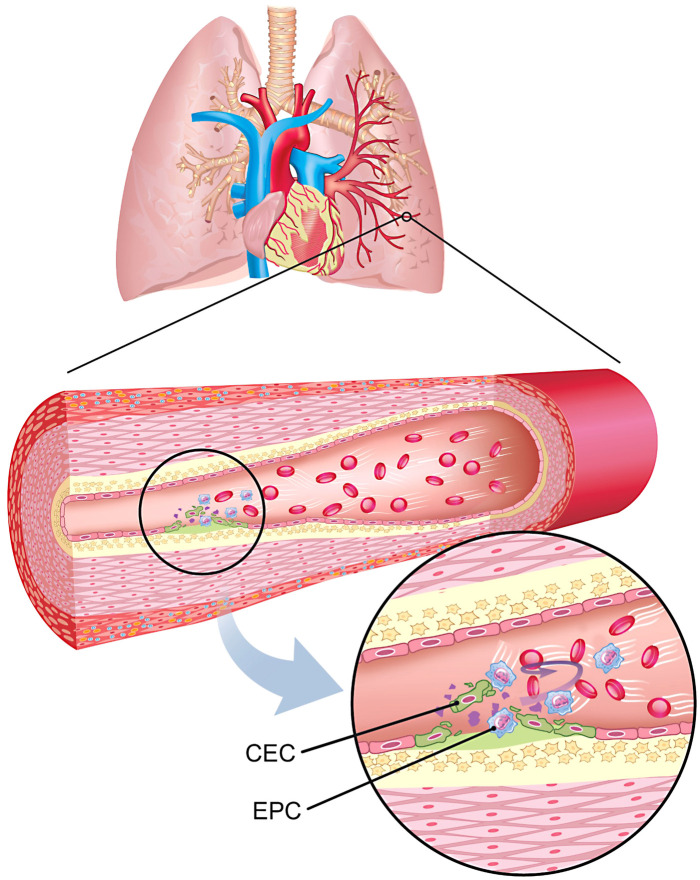
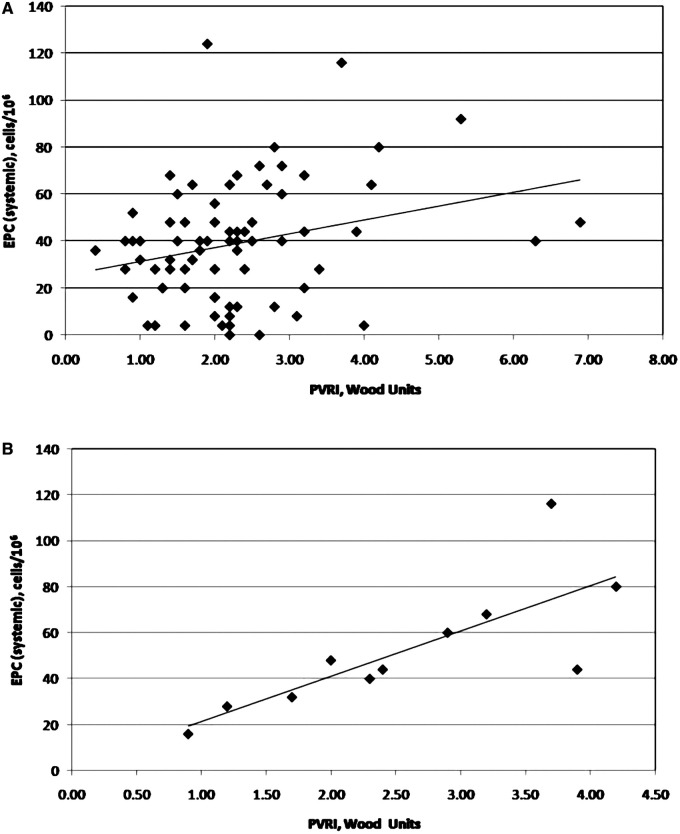
Endothelial progenitor cells and circulating endothelial cells have been proposed as useful markers of severity and disease progression in certain vascular diseases, including pulmonary arterial hypertension. Our study focused on evaluating the levels of circulating endothelial progenitor cells and circulating endothelial cells in patients with congenital left-to-right shunts and pulmonary hypertension undergoing definitive repair. Endothelial progenitor cells (identified by simultaneous co-expression of CD45dim, CD34 + and KDR2 + surface antibodies) and circulating endothelial cells (identified by simultaneous co-expression of inherent antibodies CD45-, CD31+, CD146 + and CD105+) were prospectively measured in seventy-four children (including children with Down syndrome), median age six years (2.75-10), with clinically significant left-to-right shunts undergoing transcatheter or surgical repair and compared to thirty healthy controls. Endothelial progenitor cells and, particularly, circulating endothelial cells were significantly higher in children with heart disease and pulmonary arterial hypertension when compared to controls. Endothelial progenitor cells showed significant correlation with pulmonary vascular resistance index when measured both systemically ( = 0.259; = 0.026) and in the superior vena cava ( = 0.302; = 0.009). Children with Down syndrome showed a stronger correlation between systemic cellularity and pulmonary vascular resistance index ( = 0.829; = 0.002). Endothelial progenitor cells were reduced along their transit through the lung, whereas circulating endothelial cells did not suffer any modification across the pulmonary circulation. In children with yet to be repaired left-to-right shunts, endothelial progenitor cells and circulating endothelial cell counts are increased compared to healthy subjects.
内皮祖细胞和循环内皮细胞已被认为是某些血管疾病(包括肺动脉高压)严重程度和疾病进展的有用标志物。我们的研究重点是评估接受根治性修复的先天性左向右分流和肺动脉高压患者的循环内皮祖细胞和循环内皮细胞水平。前瞻性地检测了74名儿童(包括唐氏综合征患儿)的内皮祖细胞(通过同时共表达CD45dim、CD34 +和KDR2 +表面抗体鉴定)和循环内皮细胞(通过同时共表达固有抗体CD45-、CD31 +、CD146 +和CD105 +鉴定),这些儿童年龄中位数为6岁(2.75 - 10岁),患有具有临床意义的左向右分流,正在接受经导管或手术修复,并与30名健康对照进行比较。与对照组相比,患有心脏病和肺动脉高压的儿童的内皮祖细胞,尤其是循环内皮细胞显著更高。当在内体循环(r = 0.259;P = 0.026)和上腔静脉(r = 0.302;P = 0.009)中测量时,内皮祖细胞与肺血管阻力指数显示出显著相关性。唐氏综合征患儿的体循环细胞数量与肺血管阻力指数之间的相关性更强(r = 0.829;P = 0.002)。内皮祖细胞在通过肺部的过程中减少,而循环内皮细胞在肺循环中没有任何变化。在尚未修复左向右分流的儿童中,与健康受试者相比,内皮祖细胞和循环内皮细胞计数增加。