Benyamine Audrey, Magalon Jérémy, Cointe Sylvie, Lacroix Romaric, Arnaud Laurent, Bardin Nathalie, Rossi Pascal, Francès Yves, Bernard-Guervilly Fanny, Kaplanski Gilles, Harlé Jean-Robert, Weiller Pierre-Jean, Berbis Philippe, Braunstein David, Jouve Elisabeth, Lesavre Nathalie, Couranjou Françoise, Dignat-George Françoise, Sabatier Florence, Paul Pascale, Granel Brigitte
Internal Medicine Department, Assistance Publique-Hôpitaux de Marseille (APHM), CHU Nord, 13015, Marseilles, France.
Haematology and Vascular Biology Laboratory, APHM, CHU Conception, 13005, Marseilles, France.
Arthritis Res Ther. 2017 Mar 20;19(1):60. doi: 10.1186/s13075-017-1271-7.
The disruption of endothelial homeostasis is a major determinant in the pathogenesis of systemic sclerosis (SSc) and is reflected by soluble and cellular markers of activation, injury and repair. We aimed to provide a combined assessment of endothelial markers to delineate specific profiles associated with SSc disease and its severity.
We conducted an observational, single-centre study comprising 45 patients with SSc and 41 healthy control subjects. Flow cytometry was used to quantify circulating endothelial microparticles (EMPs) and CD34 progenitor cell subsets. Colony-forming unit-endothelial cells (CFU-ECs) were counted by culture assay. Circulating endothelial cells were enumerated using anti-CD146-based immunomagnetic separation. Blood levels of endothelin-1, vascular endothelial growth factor (VEGF) and soluble fractalkine (s-Fractalkine) were evaluated by enzyme-linked immunosorbent assay. Disease-associated markers were identified using univariate, correlation and multivariate analyses.
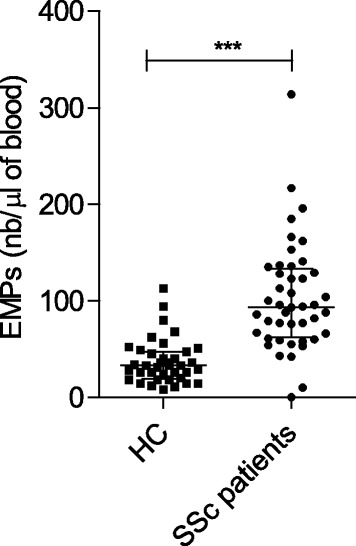
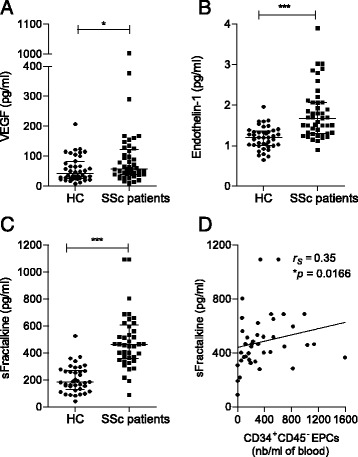
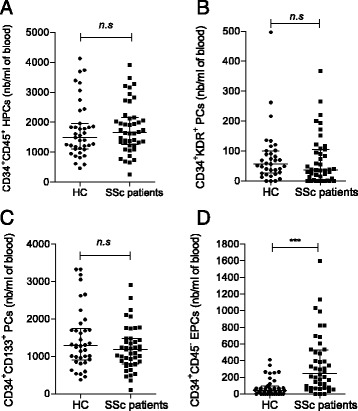
Enhanced numbers of EMPs, CFU-ECs and non-haematopoietic CD34CD45 endothelial progenitor cells (EPCs) were observed in patients with SSc. Patients with SSc also displayed higher serum levels of VEGF, endothelin-1 and s-Fractalkine. s-Fractalkine levels positively correlated with CD34CD45 EPC numbers. EMPs, s-Fractalkine and endothelin-1 were independent factors associated with SSc. Patients with high CD34CD45 EPC numbers had lower forced vital capacity values. Elevated s-Fractalkine levels were associated with disease severity, a higher frequency of pulmonary fibrosis and altered carbon monoxide diffusion.
This study identifies the mobilisation of CD34CD45 EPCs and high levels of s-Fractalkine as specific features of SSc-associated vascular activation and disease severity. This signature may provide novel insights linking endothelial inflammation and defective repair processes in the pathogenesis of SSc.
内皮稳态的破坏是系统性硬化症(SSc)发病机制的主要决定因素,可通过激活、损伤和修复的可溶性及细胞标志物反映出来。我们旨在综合评估内皮标志物,以描绘与SSc疾病及其严重程度相关的特定特征。
我们进行了一项单中心观察性研究,纳入45例SSc患者和41名健康对照者。采用流式细胞术定量循环内皮微粒(EMPs)和CD34祖细胞亚群。通过培养试验计数集落形成单位内皮细胞(CFU-ECs)。使用基于抗CD146的免疫磁珠分离法计数循环内皮细胞。采用酶联免疫吸附测定法评估内皮素-1、血管内皮生长因子(VEGF)和可溶性趋化因子(s-Fractalkine)的血药浓度。使用单变量、相关性和多变量分析确定疾病相关标志物。
在SSc患者中观察到EMPs、CFU-ECs和非造血性CD34CD45内皮祖细胞(EPCs)数量增加。SSc患者还表现出血清VEGF、内皮素-1和s-Fractalkine水平升高。s-Fractalkine水平与CD34CD45 EPC数量呈正相关。EMPs、s-Fractalkine和内皮素-1是与SSc相关的独立因素。CD34CD45 EPC数量高的患者用力肺活量值较低。s-Fractalkine水平升高与疾病严重程度、肺纤维化发生率较高及一氧化碳弥散改变有关。
本研究确定CD34CD45 EPCs的动员和高水平的s-Fractalkine是SSc相关血管激活和疾病严重程度 的特定特征。这一特征可能为SSc发病机制中内皮炎症与修复缺陷过程之间的联系提供新的见解。