Max Planck Institute for the Science of Light, Erlangen, Germany.
Max-Planck-Zentrum für Physik und Medizin, Erlangen, Germany.
J Extracell Vesicles. 2023 Aug;12(8):e12348. doi: 10.1002/jev2.12348.
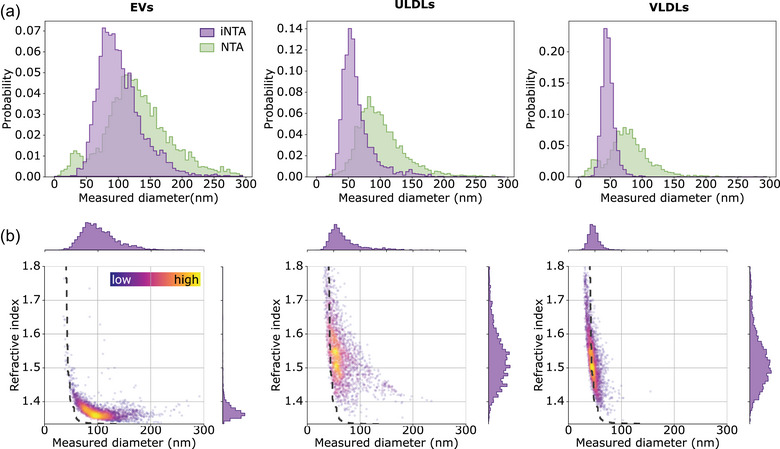
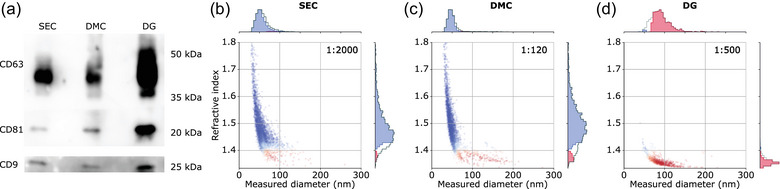
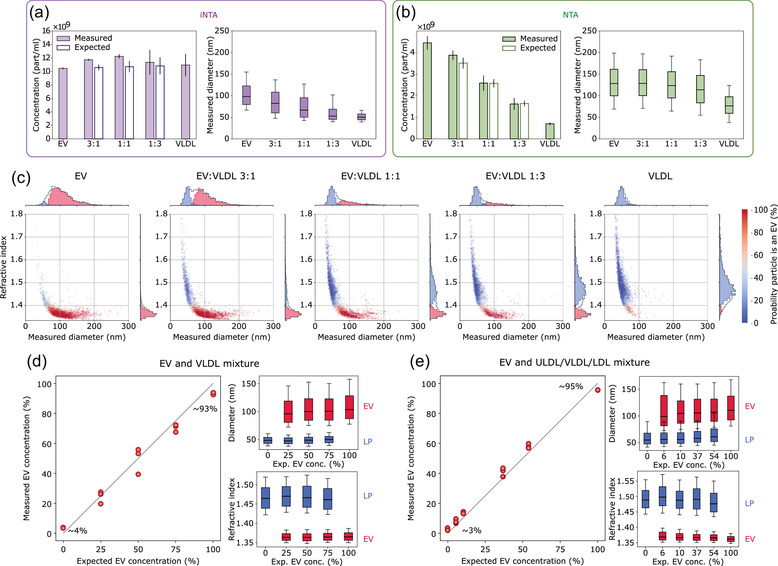
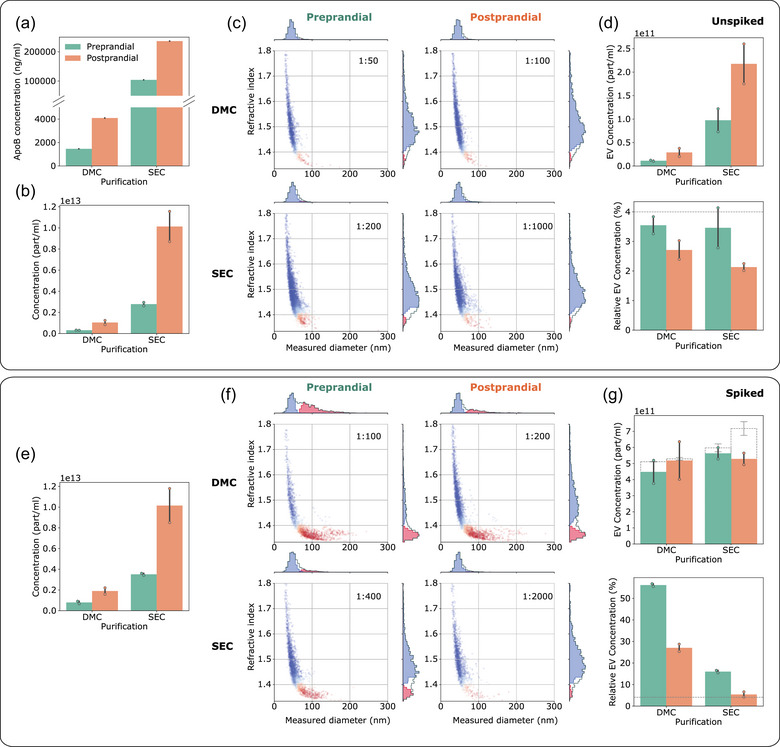
Extracellular vesicles (EVs) are increasingly gaining interest as biomarkers and therapeutics. Accurate sizing and quantification of EVs remain problematic, given their nanometre size range and small scattering cross-sections. This is compounded by the fact that common EV isolation methods result in co-isolation of particles with comparable features. Especially in blood plasma, similarly-sized lipoproteins outnumber EVs to a great extent. Recently, interferometric nanoparticle tracking analysis (iNTA) was introduced as a particle analysis method that enables determining the size and refractive index of nanoparticles with high sensitivity and precision. In this work, we apply iNTA to differentiate between EVs and lipoproteins, and compare its performance to conventional nanoparticle tracking analysis (NTA). We show that iNTA can accurately quantify EVs in artificial EV-lipoprotein mixtures and in plasma-derived EV samples of varying complexity. Conventional NTA could not report on EV numbers, as it was not able to distinguish EVs from lipoproteins. iNTA has the potential to become a new standard for label-free EV characterization in suspension.
细胞外囊泡 (EVs) 作为生物标志物和治疗药物越来越受到关注。由于其纳米尺寸范围和小的散射截面,EVs 的准确尺寸和定量仍然存在问题。这是因为常见的 EV 分离方法导致具有类似特征的颗粒共同分离。特别是在血浆中,具有相似大小的脂蛋白在很大程度上超过了 EVs 的数量。最近,干涉纳米颗粒跟踪分析 (iNTA) 被引入作为一种颗粒分析方法,能够以高灵敏度和精度确定纳米颗粒的尺寸和折射率。在这项工作中,我们应用 iNTA 来区分 EVs 和脂蛋白,并将其性能与传统的纳米颗粒跟踪分析 (NTA) 进行比较。我们表明,iNTA 可以准确地定量人工 EV-脂蛋白混合物和不同复杂程度的血浆衍生 EV 样品中的 EV。传统的 NTA 由于无法将 EV 与脂蛋白区分开来,因此无法报告 EV 的数量。iNTA 有可能成为悬浮液中无标记 EV 特征描述的新标准。