Center for Computational and Theoretical Biology, Faculty of Biology, University of Würzburg, Würzburg, Germany.
School of Life Sciences, The University of Warwick, Coventry, UK.
J R Soc Interface. 2023 Jul;20(204):20230115. doi: 10.1098/rsif.2023.0115. Epub 2023 Jul 26.
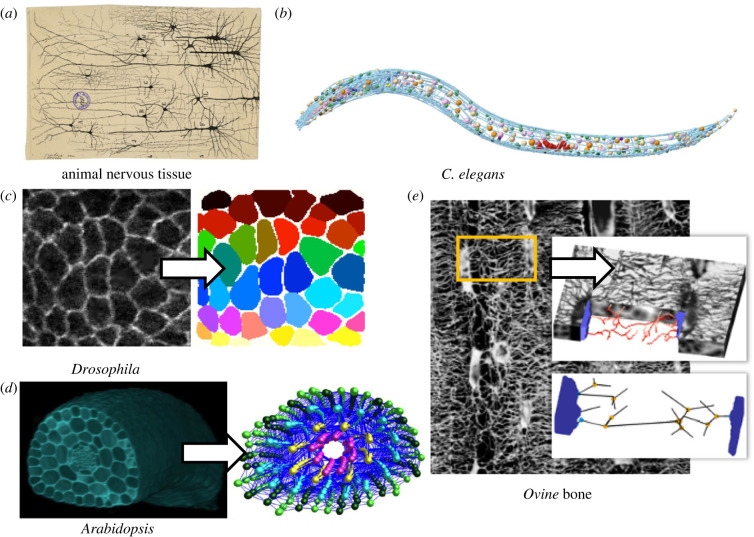
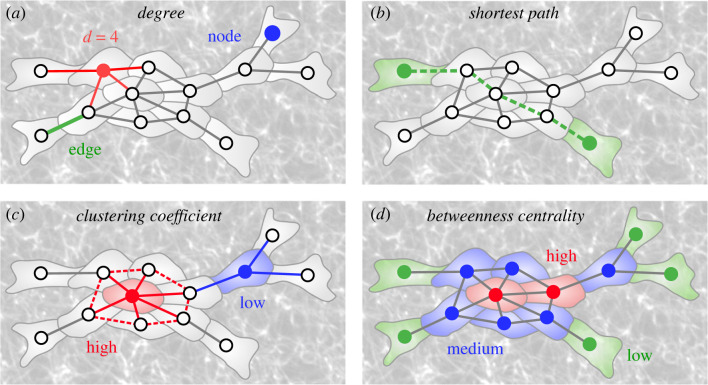
Network analysis is a well-known and powerful tool in molecular biology. More recently, it has been introduced in developmental biology. Tissues can be readily translated into spatial networks such that cells are represented by nodes and intercellular connections by edges. This discretization of cellular organization enables mathematical approaches rooted in network science to be applied towards the understanding of tissue structure and function. Here, we describe how such tissue abstractions can enable the principles that underpin tissue formation and function to be uncovered. We provide an introduction into biologically relevant network measures, then present an overview of different areas of developmental biology where these approaches have been applied. We then summarize the general developmental rules underpinning tissue topology generation. Finally, we discuss how generative models can help to link the developmental rule back to the tissue topologies. Our collection of results points at general mechanisms as to how local developmental rules can give rise to observed topological properties in multicellular systems.
网络分析是分子生物学中一种众所周知且功能强大的工具。最近,它已被引入发育生物学领域。组织可以很容易地转化为空间网络,其中细胞由节点表示,细胞间连接由边表示。这种细胞组织的离散化使得基于网络科学的数学方法能够应用于理解组织的结构和功能。在这里,我们描述了这种组织抽象如何能够揭示组织形成和功能的基础原理。我们介绍了一些与生物学相关的网络度量方法,然后概述了这些方法在发育生物学不同领域的应用。然后,我们总结了生成组织拓扑结构的一般发育规则。最后,我们讨论了生成模型如何帮助将发育规则与组织拓扑结构联系起来。我们的研究结果表明,局部发育规则如何能够在多细胞系统中产生观察到的拓扑性质。