Jason Shourick, Department of Clinical Epidemiology and Public Health, Toulouse University Hospital, Toulouse, France, 11 rue Jean Mermoz, Faculté de Médecine, 37 allées Jules Guesde, 31 062 Toulouse Cedex 9, E-mail address:
J Frailty Aging. 2023;12(3):175-181. doi: 10.14283/jfa.2023.11.
Frailty has emerged as one of the major risk factors of loss of autonomy and it can be reverted through early and appropriate interventions. A wide range of available frailty screening tools are administered, mainly in clinical settings. However, few frailty instruments are self-administered.
The aim of this study was to determine the diagnostic test accuracy of a modified self-administered questionnaire derived from the Study of Osteoporotic Fractures (SOF) index against the Fried frailty phenotype in identifying frailty.
Observational, multicenter, diagnostic test accuracy study.
Participants aged 70 and over, living at home or in community-dwelling (n=5134) in two centers in France were contacted.
Participants were mailed self-administered questionnaires derived from the SOF index. Responders who accepted the home evaluation were assessed by trained nurses, blinded to results of the questionnaire, using the Fried frailty phenotype as the reference method.
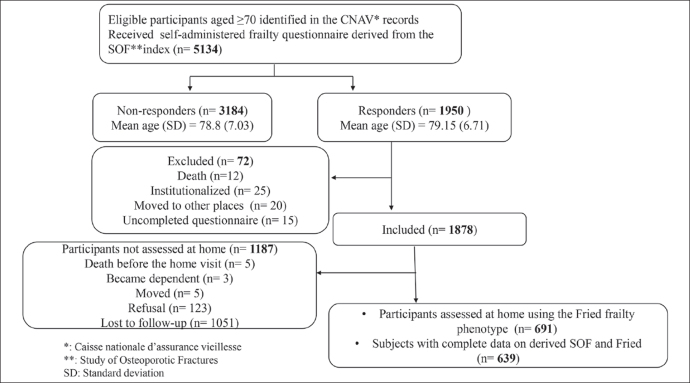
The questionnaire was sent to 5134 participants, of which 1878 (36.6%) met inclusion criteria and returned the questionnaire. Fried frailty assessments were obtained in 691 (35.4%) participants. A total of 639 subjects had a complete evaluation on both the self-administered questionnaire and the Fried phenotype. Mean age was 78.9 (standard deviation [SD]: 5.95) years and 359 (56.2%) participants were women. According to the questionnaire, 159 (24.9%) subjects were considered frail, 172 (26.9%) pre-frail, and 308 (48.2) robust. With the home evaluation, Fried frailty phenotype results were respectively, 114 (17.8%), 295 (46.2%) and 230 (36%). The self-administered questionnaire presented a sensitivity of 66.6% (95% CI: 57.2-75.2) and a specificity of 84.2% (95% CI: 80.8-87.2).
A self-administered questionnaire can be used in elders and represents an opportunity for empowering them in the management of their health in the context of frailty.
衰弱已成为丧失自主性的主要危险因素之一,通过早期和适当的干预可以逆转衰弱。目前有多种可用的衰弱筛查工具,主要在临床环境中使用。然而,很少有衰弱工具是自我管理的。
本研究旨在确定源自骨质疏松性骨折研究(SOF)指数的改良自我管理问卷在识别衰弱方面对 Fried 衰弱表型的诊断测试准确性。
观察性、多中心、诊断测试准确性研究。
联系了法国两个中心的 70 岁及以上、居住在家或社区的参与者(n=5134)。
参与者通过邮寄收到源自 SOF 指数的自我管理问卷。接受家庭评估的应答者由经过培训的护士进行评估,评估人员对问卷结果不知情,使用 Fried 衰弱表型作为参考方法。
问卷发送给了 5134 名参与者,其中 1878 名(36.6%)符合纳入标准并返回了问卷。在 691 名(35.4%)参与者中进行了 Fried 衰弱评估。共有 639 名参与者在自我管理问卷和 Fried 表型上都完成了完整评估。平均年龄为 78.9(标准差 [SD]:5.95)岁,359 名(56.2%)参与者为女性。根据问卷,159 名(24.9%)参与者被认为虚弱,172 名(26.9%)为虚弱前期,308 名(48.2%)为健壮。在家中进行评估时,Fried 衰弱表型的结果分别为 114 名(17.8%)、295 名(46.2%)和 230 名(36%)。自我管理问卷的敏感性为 66.6%(95% CI:57.2-75.2),特异性为 84.2%(95% CI:80.8-87.2)。
自我管理问卷可用于老年人,为他们在衰弱管理中赋权提供了机会。