Division of Reproductive Endocrinology and Infertility, Department of Obstetrics and Gynecology, Northwestern University Feinberg School of Medicine, Chicago, Illinois.
Northwestern University Feinberg School of Medicine, Chicago, Illinois.
JAMA Netw Open. 2023 Jul 3;6(7):e2326192. doi: 10.1001/jamanetworkopen.2023.26192.
Although women are increasingly represented within medicine, gender disparities persist in time to promotion, achievement of academic rank, and appointment to leadership positions, with no narrowing of this gap over time. Career-specific fertility and family building challenges among women physicians may contribute to ongoing disparities and academic attrition.
To evaluate delayed childbearing and infertility among women in medicine and investigate the extent to which women physicians may alter career trajectories to accommodate family building and parenthood.
DESIGN, SETTING, AND PARTICIPANTS: This survey study was conducted among women physicians, with surveys distributed through medical society electronic mailing lists (listserves) and social media from March to August 2022.
Baseline demographic information and fertility knowledge were assessed. Descriptive data on delayed childbearing, infertility, use of assisted reproductive technology, and career alterations to accommodate parenthood were collected. Factors associated with timing of pregnancy and family building regret were assessed using Likert-type scales. Group differences in fertility knowledge, delayed childbearing, infertility, and family building regret were evaluated using χ2 analyses.
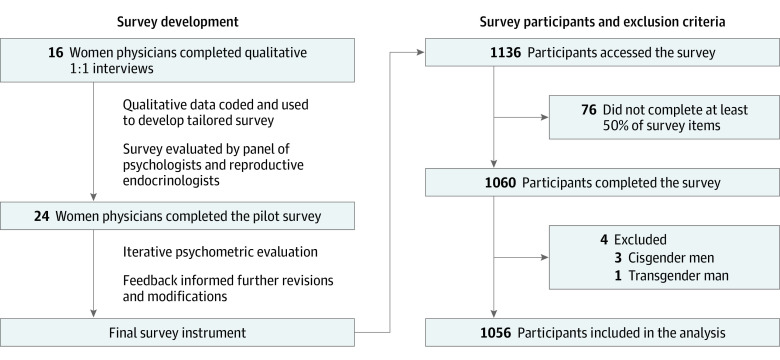
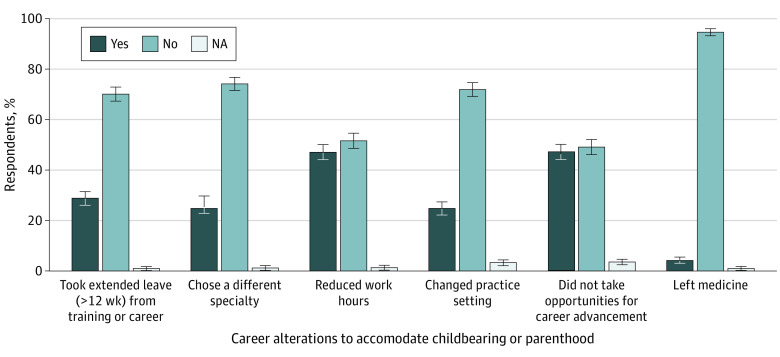
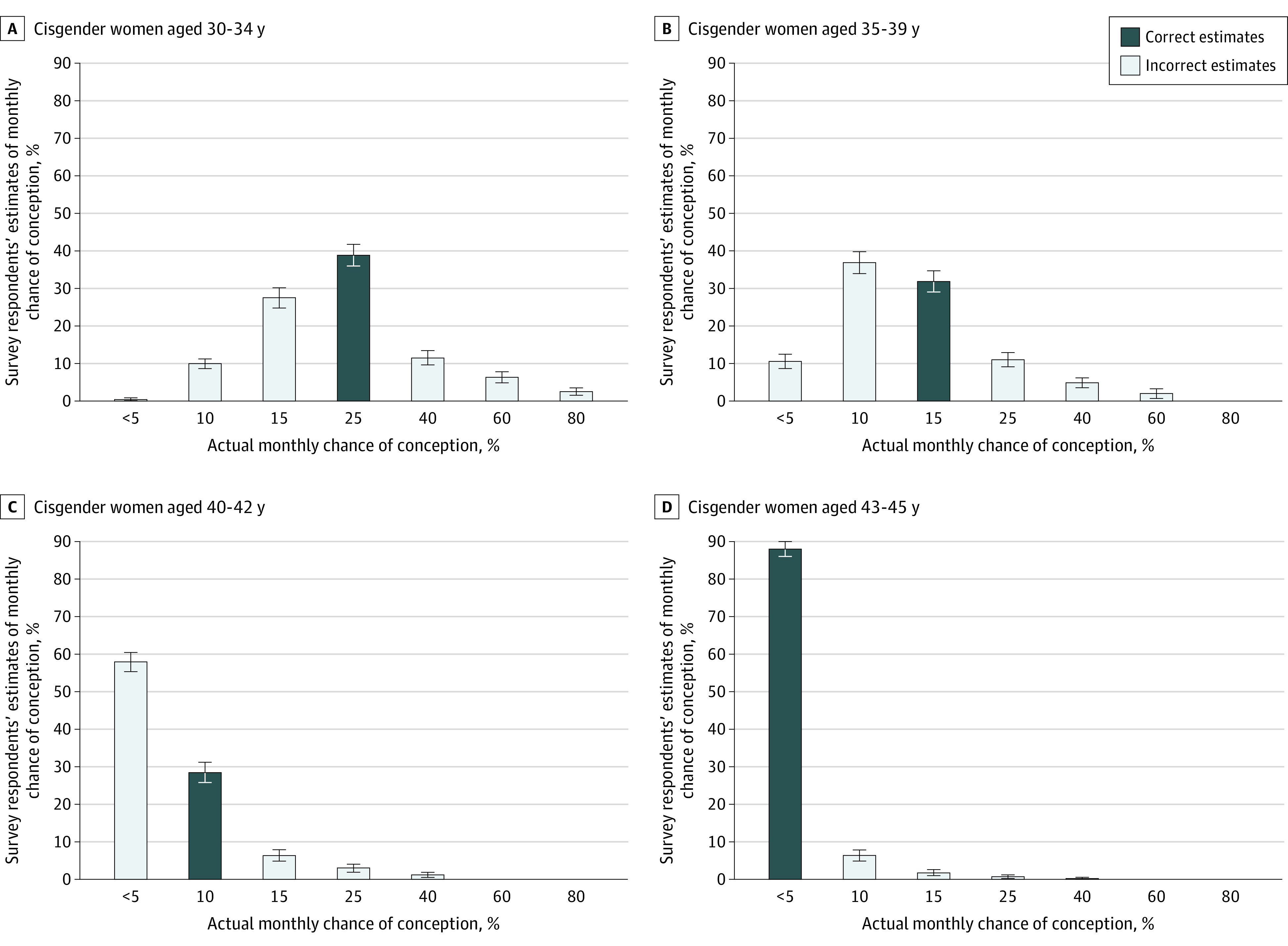
A total of 1056 cisgender women (mean [SD] age, 38.3 [7.7] years) were surveyed across level of training (714 attending physicians [67.6%] and 283 residents or fellows [26.8%]), specialty (408 surgical [38.6%] and 638 nonsurgical [60.4%] specialties), and practice setting (323 academic [45.2%], 263 private [24.9%], and 222 community [21.0%] settings). Among respondents, 1036 individuals [98.1%] resided in the US. Overall, 910 respondents (86.2%) were married or partnered and 690 respondents (65.3%) had children. While 824 physicians (78.0%) correctly identified the age of precipitous fertility decline, 798 individuals (75.6%) reported delaying family building and 389 individuals (36.8%) had experienced infertility. Concerning measures taken to accommodate childbearing or parenthood, 199 women (28.8%) said they had taken extended leave, 171 women (24.8%) said they had chosen a different specialty, 325 women (47.1%) said they had reduced their work hours, 171women (24.8%) said they had changed their practice setting, and 326 women (47.2%) said they had passed up opportunities for career advancement among those with children. Additionally, 30 women with children (4.3%) had left medicine entirely.
In this survey study, women physicians reported that career-related pressures influenced the timing of childbearing and led to marked alterations to career trajectories to accommodate family building and parenthood. These findings suggest that fertility and family building concerns among women in medicine may contribute to ongoing gender disparities and attrition and represent a potentially critical area for policy reform and future change.
尽管女性在医学领域的代表性越来越强,但在晋升时间、学术职称的获得以及领导职位的任命方面仍然存在性别差距,而且这种差距并没有随着时间的推移而缩小。女性医生在职业方面的生育和家庭建设方面的挑战可能是导致持续存在差距和学术流失的原因之一。
评估医学领域中女性的延迟生育和不孕问题,并调查女性医生可能会在多大程度上改变职业轨迹来适应家庭建设和育儿需求。
设计、设置和参与者:本调查研究在女性医生中进行,通过医学协会电子邮件列表(列表服务)和社交媒体在 2022 年 3 月至 8 月期间分发问卷。
评估了基线人口统计学信息和生育知识。收集了关于延迟生育、不孕、使用辅助生殖技术以及为适应育儿而改变职业轨迹的描述性数据。使用李克特量表评估了与怀孕和家庭建设遗憾时间相关的因素。使用 χ2 分析评估了生育知识、延迟生育、不孕和家庭建设遗憾方面的组间差异。
共有 1056 名顺性别女性(平均[SD]年龄,38.3[7.7]岁)参加了调查,包括 714 名主治医生(67.6%)和 283 名住院医师或研究员(26.8%)、408 名外科医生(38.6%)和 638 名非外科医生(60.4%)、323 名学术医生(45.2%)、263 名私人医生(24.9%)和 222 名社区医生(21.0%)。在受访者中,有 1036 人[98.1%]居住在美国。总体而言,910 名受访者(86.2%)已婚或处于伴侣关系中,690 名受访者(65.3%)有孩子。尽管 824 名医生(78.0%)正确识别出生育能力急剧下降的年龄,但 798 名受访者(75.6%)报告说他们延迟了生育,389 名受访者(36.8%)经历过不孕。关于为适应生育或育儿而采取的措施,199 名女性(28.8%)表示她们休了延长假,171 名女性(24.8%)表示她们选择了不同的专业,325 名女性(47.1%)表示她们减少了工作时间,171 名女性(24.8%)表示她们改变了工作地点,326 名女性(47.2%)表示她们在有孩子的情况下放弃了职业晋升的机会。此外,30 名有孩子的女性(4.3%)完全离开了医学领域。
在这项调查研究中,女性医生报告称,职业相关的压力影响了生育时间,并导致了职业轨迹的重大改变,以适应家庭建设和育儿需求。这些发现表明,女性医生在生育和家庭建设方面的担忧可能是导致持续存在性别差距和流失的原因之一,这代表了政策改革和未来变革的一个潜在关键领域。