Department of Exercise Physiology, Beijing Sport University, Beijing, China.
Laboratory of Sports Stress and Adaptation of General Administration of Sport, Beijing Sport University, Beijing, China.
Front Endocrinol (Lausanne). 2023 Jul 12;14:1219194. doi: 10.3389/fendo.2023.1219194. eCollection 2023.
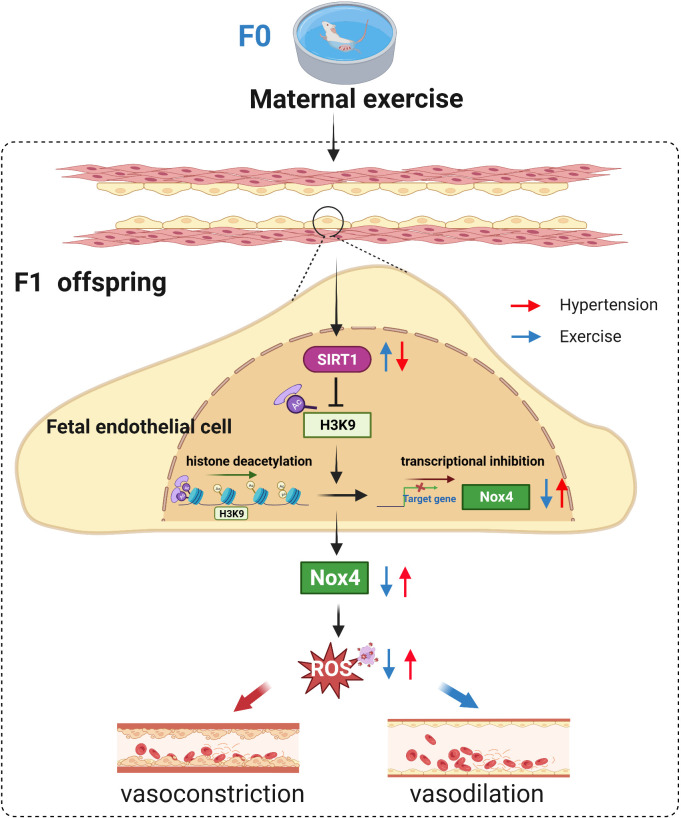
Maternal exercise during pregnancy has emerged as a potentially promising approach to protect offspring from cardiovascular disease, including hypertension. Although endothelial dysfunction is involved in the pathophysiology of hypertension, limited studies have characterized how maternal exercise influences endothelial function of hypertensive offspring. In this study, pregnant spontaneously hypertensive rats and Wistar-Kyoto rats were assigned either to a sedentary lifestyle or to swimming training daily, and fetal histone deacetylase-mediated epigenetic modification and offspring vascular function of mesenteric arteries were analyzed. Maternal exercise ameliorated the impairment of acetylcholine-induced vasodilation without affecting sodium nitroprusside-induced vasodilation in mesenteric arteries from the hypertensive offspring. In accordance, maternal exercise reduced NADPH oxidase-4 (Nox4) protein to prevent the loss of nitric oxide generation and increased reactive oxygen species production in mesenteric arteries of hypertensive offspring. We further found that maternal exercise during pregnancy upregulated vascular SIRT1 (sirtuin 1) expression, leading to a low level of H3K9ac (histone H3 lysine 9 acetylation), resulting in the transcriptional downregulation of Nox4 in mesenteric arteries of hypertensive fetuses. These findings show that maternal exercise alleviates oxidative stress and the impairment of endothelium-dependent vasodilatation via SIRT1-regulated deacetylation of Nox4, which might contribute to improved vascular function in hypertensive offspring.
孕期母体运动作为一种保护后代免受心血管疾病(包括高血压)的潜在方法已经显现出来。尽管内皮功能障碍与高血压的病理生理学有关,但有限的研究表明母体运动如何影响高血压后代的内皮功能。在这项研究中,将自发性高血压大鼠和 Wistar-Kyoto 大鼠的孕鼠分配到久坐生活方式或每天游泳训练中,并分析胎儿组蛋白去乙酰化酶介导的表观遗传修饰和后代肠系膜动脉的血管功能。母体运动改善了乙酰胆碱诱导的血管舒张受损,而不影响高血压后代肠系膜动脉中硝普钠诱导的血管舒张。相应地,母体运动减少了 NADPH 氧化酶-4(Nox4)蛋白,以防止一氧化氮生成的丧失,并增加了高血压后代肠系膜动脉中活性氧的产生。我们进一步发现,孕期母体运动上调了血管 SIRT1(沉默调节蛋白 1)表达,导致 H3K9ac(组蛋白 H3 赖氨酸 9 乙酰化)水平降低,从而导致高血压胎儿肠系膜动脉中 Nox4 的转录下调。这些发现表明,母体运动通过 SIRT1 调节的 Nox4 去乙酰化作用减轻氧化应激和内皮依赖性血管舒张受损,这可能有助于改善高血压后代的血管功能。